Brian Kagen pick: “Outline of the Butokukai”
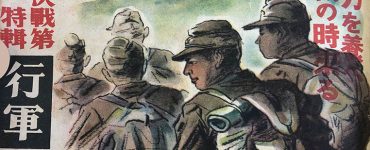
“After the commencement of the Pacific War, on the demand of the military (person responsible at that time was former Lieut. General Ryukichi Tanaka, Chief of Military Affairs Bureau) and with the object of coordinating military arts and the advancement of bayonet drill and shooting, the Ministry of Welfare (the then Minister of Welfare, former Surgeon Lieut. General Koizumi) planned to establish a new Martial Arts Organization. Despite strong opposition from the Butokukai which took its stand from its tradition and original mission, it was arbitrarily taken over and the old name of Butokukai was continued, while in addition to fencing, judo and archery (including the arts of scythe, staff and stick wielding) the two arts of bayonet drill and shooting were added, thus culminating in March 1942 in the formation of a new organization as an outer organization of the government.”
Click here to read entire article.
Brian Kagen is an avid web researcher with a particular interest in martial arts. His training background includes both judo and aikido.
March 16th, 2006 (add comment)
Reader Comments
Kanolowe writes:
I found this article quite interesting and stimulating, in that it caused me to do some research. I am still not sure if this was presented as a factual article, or as an example of revisionist history.
While it may be true that the rank and file did not agree with the militarists who ran the country, it certainly was not true of the leadership of the Butokukai that the author himself lists. I take particular exception to him characterizing GEN Hayashi, Senjuro’s leadership (in 1938) as having “not the least signs of either political or ideological activities…”
Seems that GEN Hayashi had an interesting record. He was commander of all forces in Korea during the Manchurian Incident in 1931 and sent his troops across the Yalu River from Korea to China to reinforce the Kwantung Army after they blew up the railroad and blamed it on the Chinese. Apparently Hayashi did this without receiving orders. In 1933 GEN Hayashi was made the Inspector General of Military Education, a post where he oversaw the education and training of the officer corps of the Imperial Army. In 1934 GEN Hayashi, as Army Minister, wrote the preface to a 7 volume series of books on the emergency in China (which he helped precipitate) and called for a total mobilization of the nation to fight future wars. This book series was published as part of a propaganda effort and included works by GEN Tojo, Hideki, who railed against Western ideas of liberal democracy. GEN Hayashi was a big supporter of Tojo and appears to have been part of his “Control Faction”, the faction of Army officers that won out over control of the Japanese government. In 1936 Hayashi helped put down a rebellion by young Army officers in the opposing “Imperial Way Faction.” By 1940, Hayashi had already served as Prime Minister and was one of five former PMs who voted for Konoe to become the Prime Minister. Konoe appointed Tojo as Army Minister and Hayashi pushed for Tojo to become Prime Minister when Konoe resigned in 1941. In high level discussions that included the Emperor, Hayashi pushed for war with the US. This meeting was two days after the Japanese fleet left their harbor en-route to attack Pearl Harbor. (Source is Herbert Bix, Hirohito and the Making of Modern Japan).
Clearly Hayashi was involved in politics before and after he assumed Chairmanship of the Butokukai. Considering his role in educating Army officers as Inspector General of Military Education, his role in writing preface to books designed to inculcate “correct thinking” in the Army, and his post-Butokukai political activities, it is quite a stretch to argue that he exerted no political or ideological influence over the members of the Butokukai while he was head of the organization. And, if they really objected to his ideology and the direction of the organization, why didn’t they vote with their feet? They certainly would have known his personal history.
GEN Suzuki, Soroku, who the author mentions as another Chairman of the Butokukai gets honorable mention in Bix for speaking out against curtailing military spending in 1931. He saw arms reduction as a precursor to Japan pulling out of China.
I cant find any references to the other men of “high moral integrity” that were listed such as Hongo Fusataro and Nara Taketsugyi[sic]. Could this last fellow be Nara, Takeji? Was the Manchurian clique in charge of the Butokukai?
At any rate, it appears they were prime targets to be purged. Recall that the GHQ was attempting to eradicate the roots of fascism from the country when it issued its purges. At least two of the Chairmen of the Butokukai were likely candidates. It is a shame that the lower rank and file who merely belonged to the club because of their love for martial arts had to suffer. They should have picked a better class of Chairmen. Then again, that would have required a civil society that valued their opinions; something like a liberal democracy. Hmmm, maybe GHQ was on to something.
Kanolowe writes:
Found some references to Lt Gen Tanaka, Ryukichi. As a Major, in 1932, he precipitated the Shanghai Incident allegedly by instigating a Chinese mob to attack Japanese priests in the city. This caused the Japanese Navy to respond by attacking Chinese troops in Shanghai with Marines. As a Maj Gen in China in 1940, he pioneered the technique of completely annihilating Communist guerrilla bases in China. (Bix) After the war, SCAP authorities found him to be an “exceedingly valuable source of inside information about high-level army activity, including transgressions in China and the military’s deep involvement in opium trafficking.” (John Dower, “Embracing Defeat”)