A Unified Field Theory: Aiki and Weapons - Intermezzo
This article should now be considered a work-in-progress, of interest both for the discussion it engendered as well as presenting an earlier perspective on my work. I have radically revised this essay in my new book, HIDDEN IN PLAIN SIGHT. Some of the conclusions I have reached are somewhat at variance to what you will find here. Those interested in the book can find it at www.edgework.info/buy.html
PART II - Aikijutsu/do comes from Kenjutsu
I have seen many brilliant Japanese kenjutsuka, as well as some of the finest kendo practioners in Japan. Nakakura Kiyoshi, one of the best of the best, was once Ueshiba Morihei’s son-in-law, and hoped-for successor. Yet most of these people have no special skill in taijutsu whatsoever. Nakakura, for example, stated that one of the primary reasons he resigned from the Kobukan was that he realized he would never approach Ueshiba Morihei’s level of skill in taijutsu. In other words, one cannot simply learn taijutsu by osmosis from kenjutsu. Otherwise, given that there were many swordsman through history who were Takeda’s equals or even superiors, why were there not more brilliant creators of aikijutsu systems?
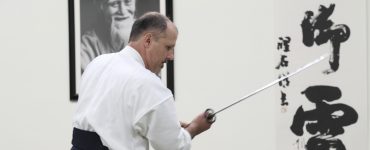
I am still working on Part III, regarding Ueshiba Morihei, but one of these “Hidden in Plain Sight” moments leaps out. Takeda Sokaku was remarkable among Japanese bugeisha for his one-handed kenjutsu - ambidextrous, alternating from hand-to-hand! I have only a modicum of experience in Chinese chien and dao (the straight sword and curve “cutlass,” respectively), but I found the requirements of one-handed swordsmanship to be quite different from ordinary Japanese kenjutsu. (Even more so when I attempt to use my shinken with one-hand, beyond the few singular one-handed waza within my ryu).
In kenjutsu, one moves one’s body as if one has an axis from the crown of the head through the perinium. One thereby generates tremendous torque - and this is related to discussions on “namba aruki” - walking with same hand and leg forward. Whether samurai ever did walk this way in ordinary perambulations, as some have asserted, there is no doubt that training in this fashion teaches some very intriguing neuro-muscular connections (Kuroda Tetsuzan, for example, asserts that it is a key to what he does).
One-handed swordsmanship, on the other hand, more easily (potentially so, at any rate) trains the vaunted “six direction” type of physical organization - winding chains of power from, for example, right hand to left foot, left shoulder to right hip, etc.
So, imagine this: Takeda Sokaku developed his unique understanding of taijutsu - that some knowledgeable people find remarkably similar to that in certain Chinese arts - through kenjutsu, yes. Ambidextrous one-handed and/or two sword techniques. Let us imagine that he taught the taijutsu skills to the next generation, and some of them “got it” - the essence of his aiki-skills. Additionally, they picked up some conventional kenjutsu from him - perhaps more a consultation on the skills they already brought, rather than formalized step-by-step instruction.
It is possible that Takeda, typical of many “old school” type teachers, did not teach his one-handed sword style because this was his “secret” that enabled him to best all others, and he wasn’t going to put the keys to his defeat in anyone else’s hands. Even if this were not true in his case, without an assertion by Takeda that the essence of aiki-weaponry was one-handed swordsmanship, and further, that this style was REQUIRED as a student of his “ryu,” his successors, heirs also to the innate psychological and social conservatism of Meiji and Taisho Japanese, may have regarded his style as a personal specialty or eccentricity - not something to follow. Finally, many teachers instruct by example: if his students did not adopt his own methods, truly the gokui of his skill with a sword, Takeda may well have shrugged his shoulders, seeing them as not willing to really learn what he had to offer.
I believe that his students later tried, each in his own way, to extend the principles of taijutsu BACK into their two-handed kenjutsu/aiki-ken, with varying degrees of success. It may well be that subsequent generations would find themselves more and more divorced from a kenjutsu that would vivify their taijutsu. Their teacher (Ueshiba, for example), could make it work, but the two-handed style of swordsmanship was permeated with information (and common practice) at variance to Takeda’s original kenjutsu. Generation after generation it would become increasingly more difficult to trace his insights through kenjutsu, leaving the taijutsu practice alone a possible vessel of his aiki principles.
Ellis Amdur — March 18th, 2006 (add comment)
Reader Comments
Stanley Pranin writes:
Ellis,
I think yours is a brillant observation! I never in a million years would have connected the dots on that. Surely using the sword ambidextrously would produce a quite different body movement and would leave one hand free for additional manipulation of the opponent’s body or weapon.
Geoffrey Yudien writes:
Interesting what you say about walking with the same side leg and arm forward. I’ve run (walked?) into some of that in Qigong.
Allen Beebe writes:
Ellis,
Some years ago Robert Stroud (Kendo Rokudan, Renshi) shared with me that at a dinner during a visit to Seattle Nakakura Kiyoshi was asked what the secret of his ability to compete so successfully into his “senior years” was. Considering this was a kendo affair and consequently those present were kendoka, Nakakura sensei’s answer was surprising.
“My Aikido training.”
Nakakura sensei may have “realized he would never approach Ueshiba Morihei’s level of skill in taijutsu.” However, as you stated it seems that this ‘Kendo Demon’ successfully parlayed what he did learn in the ‘Hell Dojo’ into becoming “the best of the best” in the kendo world.
It is interesting to note that, if I’m not mistaken, Nakakura sensei used a single left handed tsuki successfully in major competition more than once. If Nakakura’s statement about the contribution of his Aikido training is any indication, perhaps he picked up at least enough taijutsu to make a significant long-term difference in his kendo. However, based on my experience as a student of Shirata Rinjiro who both studied Aikido and Kendo at the Kobukan while Nakakura Kiyoshi was training and teaching there, I believe that there is more to the success of these Aiki/Kendo Greats than just taijutsu alone… at least how it is commonly understood. As I believe you indicate in your article it is important to note that kenjutsu and/or taijutsu can be the vehicle of the Aiki principles. These can either embody Aiki principles or, more commonly, they cannot …
Interesting stuff! Please keep it up. I’m looking forward to the next thought-provoking installment!
Allen Beebe
tomoo yawata writes:
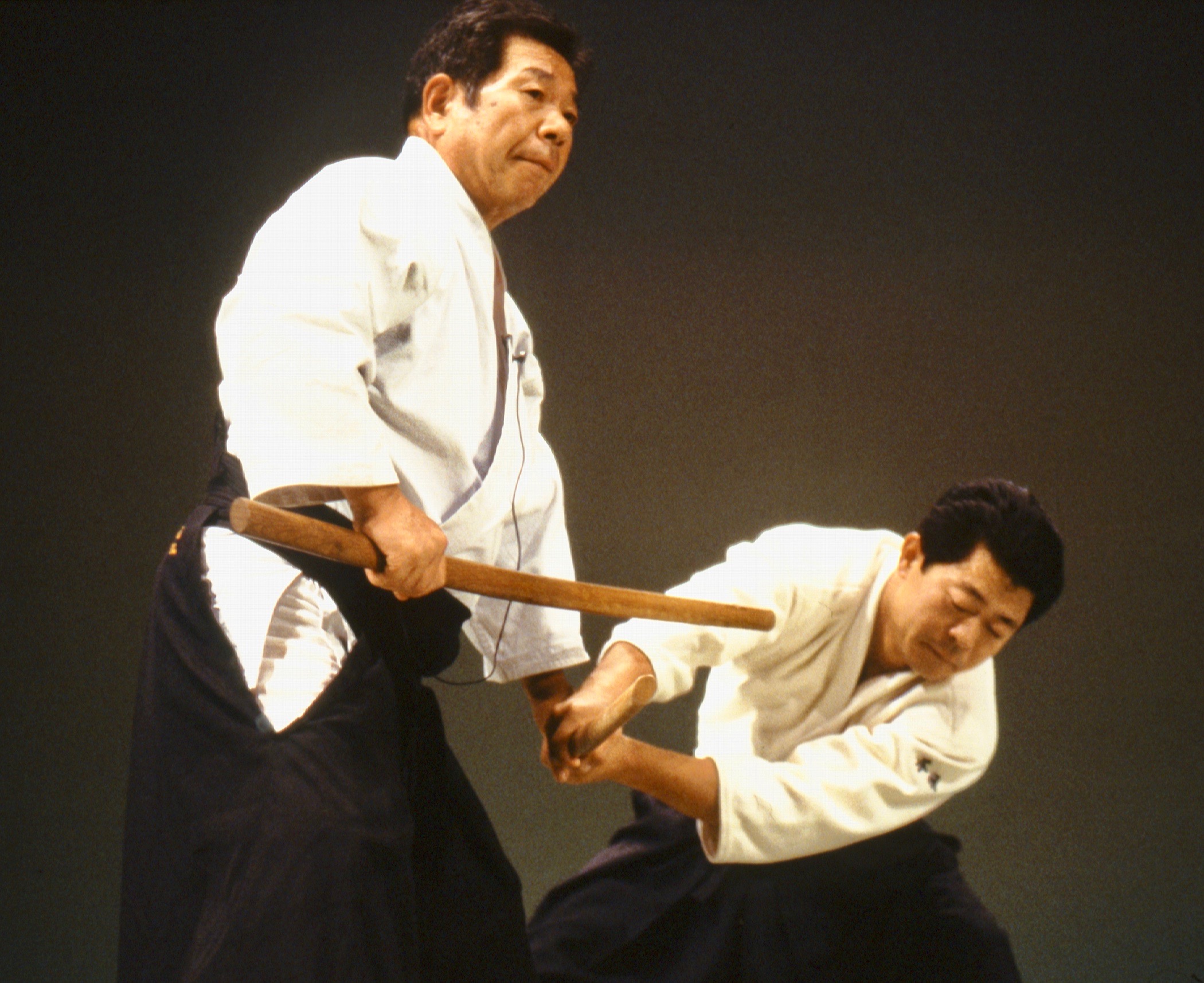
In “Aikido Shugyou” Shioda recounts that during the Kobukan era, Nakakura faced a “slump” during the All Japan Kendo Championship. Ueshiba gave some advice to him, and Shioda says that the advice of Ueshiba was to break the conventional manipulation of the sword by gripping the sword with one hand and suddenly switch it to the other hand.
According to Shioda after this advice Nakakura revived and could win the championship (using this technique). I didn’t post about that because Nakakura said in an interview with aikido journal that the advice of Ueshiba was restricted to mental advices.
Even if this episode recounted by Shioda includes some inaccuracy, it is clear that Shioda knew about this manipulation of the sword with the one hand. In the video of the “Second friendship demonstration” there is a moment where Shioda explains the concept of Irimi manipulating the sword with one hand( he is demonstrating an “sabaki” and a “tsuki (thrust)” to the opponents throat gripping the sword with one hand). In an older video from the early 1960ies, he is showing more of this one hand sword manipulation. I don’t think that shioda was great at sword. But I am definitely sure that he saw Ueshiba doing the one handed sword manipulation (and thus imitating).
In other words, I believe that there is clearly a technical genealogy from Takeda to Ueshiba and to some part to his own students.
That said I don’t think that “one hand sword manipulation” is the only key to Takeda’s sword art. The basic would be the two hand sword art, and the one hand manipulation would be just a “Henka” and “Ouyo” rather than the principles of his art.
Ellis Amdur writes:
Tomoo, I agree. The basis of Sokaku’s kenjutsu was the two-handed swordsmanship that he first studied. The one-handed skills he developed were, apparently, his own revelation - not the product of some previous tradition. Although the skills in taijutsu, referred to as aiki, were probably not his alone (note E. J. Harrison’s account of another master), he was probably at the pinnacle among practitioners in the late Meiji, Taisho and early Showa. He was, by all accounts I have read, regarded as someone unique - as were Ueshiba, Sagawa and Horikawa in the next generation. Either the skills were largely lost in Takeda’s generation, or he had refined something, if not new, scintillating in his version of it.
Aiki can be considered somewhere between the “henka” and the “gokui” of taijutsu. It’s not a magic power, apart from jujutsu. It is the utmost refinement of the use of the body. Similarly, his one-handed swordsmanship was more than just a variation - henka. It was his gokui.
And if his taijutsu skills came from the sword, then his usage of the sword, rather than kenjutsu in general, must have been the key. If a portion of this was passed down to the next generation (Ueshiba, in the example you cite, and subsequently, Nakakura in A. Beebe’s example), then some level of this insight was, in fact, passed on. But how about the next generation? If not, this avenue to his aiki, through weaponry, would be lost.
To give an example in my own ryu, there is a movement in Araki-ryu that we, in my dojo, call “itachi iri.” It is unique to the line of Araki-ryu that I learned. I did not mention it for the first few years of my teaching, and although it was right in front of my students, none of them noticed. They thought they were doing the same thing, but they weren’t. I could accomplish things thereby, that they could not. It was clear that, unless, I required this movement, they would never see it. So I taught it explicitly. Otherwise, for all intents and purposes, none of my students would be doing real Araki-ryu in the generation after me. (Perhaps I should have waited for that one student to “steal it.” But teaching day-after-day, with them making the same mistake and not even realizing it was a mistake, over and over again, bewildered why they couldn’t make things work!!!! I couldn’t stand it anymore.)
Ellis Amdur writes:
Here are some quotations, which I have spliced together, from an interview with Sagawa Yukiyoshi that substantiate my views in Part I and II :
SAGAWA - “He also mastered the secrets of various martial arts schools. Takeda Sensei’s sword was very original, and he was highly skilled at wielding the sword with either the right or left hand… . I believe he trained (in Ono-ha Itto-ryu) at the dojo of Toma Shibuya in Bange-cho in Fukushima Prefecture. I don’t think he studied it seriously. His sword was very original, and he combined elements of several schools to create his own techniques. Also, Takeda Sensei didn’t teach kata. His arts were very practical, and he taught techniques according to specific situations.”.
Doug Walker writes:
Perhaps not so uncommon…
“Ordinarily Japanese fencers stand much closer to each other than do those of Europe, and it is truly remarkable what little space a couple of good native swordsmen require for a fight to the death. ***Some on the contrary are very fond of keeping well away and, if not followed up and brought to close quarters, resort to a widely different mode of attack, consisting mainly of slashing cuts, first with one hand and then with the other, the changes being carried out with wonderful rapidity.*** The principle swinging cut can be delivered for either side of an opponent’s head, but if he is a good swordsman it is a somewhat risky one to resort to, for he can reply to it by either a stop thrust or a stop cut at the head. The guard for it is a mere raising of the sword to a sufficient height and in the right line.” F. J. Norman “The fighting Man of Japan: The training and exercises of the Samurai” 1905 [emp. mine]
note: the author was a student of Umezawa at the Takanawana Police Station dojo in Tokyo circa 1890 and is mentioned by Harrison (“he won an enviable reputation among the Japanese and engaged in many a hard-fought encounter”)
Frank Van Glabeke writes:
Very interesting. As always Ellis’ blog gives much food for thought and discussion.
I’ve had some contacts with Hirokazu Kobayashi and of the Japanese teachers I saw he was the only one who instructed in one-handed use of the ken. He taught exercices for two where the uke attacked twohanded(in the “normal” way)and tori used the ken onehanded. We always practiced both sides : we did each exercise with the ken in the right hand, right side forward and we changed : ken in left hand, left side forward.
I’ve never asked him specifically where he got those exercices. In general he always stressed that what he taught was not his aikido but that he only passed on what he learned from Osensei.
If anyone has some more information?