A Unified Field Theory: Aiki and Weapons — Adagio un Poco Mosso
This article should now be considered a work-in-progress, of interest both for the discussion it engendered as well as presenting an earlier perspective on my work. I have radically revised this essay in my new book, HIDDEN IN PLAIN SIGHT. Some of the conclusions I have reached are somewhat at variance to what you will find here. Those interested in the book can find it at www.edgework.info/buy.html
PART IV - Ueshiba Morihei and Weapons — Kobukan sword: Shinto-ryu, Kage-ryu, Chujo-ryu
Refiner’s Fire
And then Ueshiba Morihei studied Daito-ryu — simply put, the sun around which his creative energies first revolved, and from which they later evolved. Here lies what he embraced, what he embellished, and what he rejected. Did he study weaponry in any detail from Takeda Sokaku? Perhaps. Perhaps not. But even if he didn’t, even if such instruction was limited, Ueshiba learned Daito-ryu empty-hand methods, and he began to develop his own way of expressing aiki with weapons as well.
In the 1920’s, he began to teach: first, at Ayabe, and then at the Kobukan, he became one of the most significant teachers of martial arts in Japan. Unlike today, where some, at least, regard aikido as an idealistic, not-very-effective martial practice, Ueshiba was recognized as a formidable man - many, from a variety of disciplines, regarded him as the best they had ever seen. He was not only sponsored by dignitaries, but many of the leading martial artists in Japan regarded him with admiration, even reverence. He readily took challenges, and humbled some very strong men.
Unlike many, who achieve some skill and then rest on their considerable laurels, Ueshiba was hungry — he continued to desire to learn. Sugino Yoshio stated, “Ueshiba was always smiling or laughing cheerfully like some sort of playful god, but when it came to bujutsu he had an almost superhuman insight. Whenever we were watching demonstrations of other martial arts he would provide his own running commentary - ‘That technique was like this… Did you see that movement he just did? It was actually this kind of movement here… .’ and so on. He understood everything that was being done, even if he was watching from a distance.”
From a Japanese social context, however, Ueshiba was somewhat constrained in how he learned. He had not only achieved a certain level of notoriety — he was the master of his own art. Thus, he could not study from just anyone, no matter how good they might be. Additionally, he had already established, through his studies with Takeda Sokaku, his “core” art. It is very likely that he “stole” techniques - even essential knowledge (gokui) - from other ryu through the kind of observation Sugino describes. Rather than trying to learn NEW martial arts, however, it is obvious from what he did over the rest of his life that he was trying to REFINE his own art — and he used other arts to that end.
Kenjutsu at the Kobukan
Although more a useful working image than strictly factual, Japanese kenjutsu has been subsumed into three general categories, allegedly the three primordial lines from which it emerged: Shinto-ryu, Chujo-ryu and Kage-ryu. Shinto-ryu encompasses such famous schools as Tenshin-Shoden Katori Shinto-ryu, Kashima Shinto-ryu, Kashima Shin-ryu and Bokuden-ryu; Kage-ryu is the mother lode from which emerged, among myriads of others, Yagyu Shinkage-ryu and Jikishinkage-ryu; and from Chujo-ryu, perhaps the most influential, emerged Toda-ryu, Nen-ryu and Itto-ryu. Chujo-ryu is perhaps the most central influence on the development of modern kendo. To some degree, each of these lines passes through the Kobukan.
Tenshin-Shoden Katori Shinto-ryu (TSKSR) “entered” the Kobukan through three young men: Mochizuki Minoru, Murashige Aritoshi, and then later, Sugino Yoshio. Mochizuki and Murashige were dispatched, along with Tomiki Kenji, by Kano Jigoro. The former two men studied Katori Shinto-ryu at the Kodokan, something Sugino studied in far more depth as well. Ueshiba regarded Mochizuki and Sugino quite highly, even considering them, separately, as prospective son-in-laws. Is it possible that TSKSR had a significant influence on Ueshiba’s sword or staff? It is very unlikely - for several reasons. Technically speaking, TSKSR has a quite unique style of kata — long chains of waza linked together, with killing techniques “hidden” within the linkages. Bo techniques are done in “overhand” fashion, with a lot of body-displacement and crushing blows: spear methods have a characteristic tucking of the butt of the weapon underneath the armpit upon the thrust; and sword is typified by methods that insure that one avoids one’s helmet and other armor when cutting. Ueshiba could have, as Sugino describes, absorbed through observation if these young men practiced TSKSR while at the Kobukan — but no tincture of its methods are apparent in his sword methods.
At any rate, Ueshiba could not have directly learned from them. They were his students, and such a role reversal was unthinkable, particularly because they were not teachers, merely young men, avid though they might have been. It would have been a loss of considerable face if TSKSR techniques started to appear in Ueshiba’s sword or staff, he thereby copying his young, not-even-fully-trained deshi.
Kendo, however, became quite significant at that time. As is well known, Nakakura Kiyoshi entered under Ueshiba’s aegis, becoming his son-in-law, and he started a kendo class at the Kobukan. This must have been a wonderful outlet for the hot-blooded young uchi-deshi, because, unlike the kata-type practice of Ueshiba’s aikijutsu, they could actually compete against one another. Did Ueshiba learn kendo from his son-in-law? Of course not! But it is probable that the developing weapons skills of the young men of this period — Shirata Rinjiro, for example — were influenced by their hours practicing kendo. This is borne out by the fact that the vast majority of the uchi-deshi from the Kobukan did not emerge with sword skills bearing the stamp of one or another sword school, nor do they display high level skills with the sword from the perspective of classical kenjutsu. Instead, they very likely learned the basics of using a sword through their kendo practice, skills that were refined on an informal (if anything with their teacher could be truly informal) basis, either by observing Ueshiba using weapons to teach principles, or specific one-on-one instruction - the latter surely resulting in all the variations on a theme we see among Ueshiba’s closest students. For example, Sudanomari Kanshu stated in an Aikido Journal Interview: “I learned personally from O-Sensei when I was an uchideshi, and saw his way of swinging the ken, and when I was thrown by him or when he applied techniques on me and, of course, after I came to Kumamoto for about the first 3 years in both the spring and fall when O-Sensei came to give seminars. Then when I went home I would practice swinging the ken myself. The key to swinging the ken freely in all directions is the use of the hips. I was taught the methods of swinging the jo individually by Ueshiba Sensei. Those jo movements were in fragmented form and I combined them into a single flowing movement as a training method.”
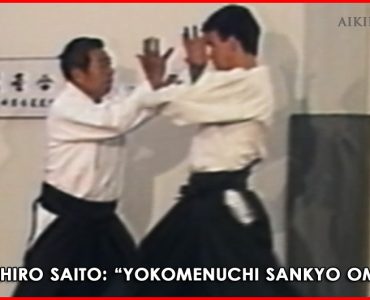
Shirata Rinjiro, as described by his long-time student, Allen Beebe, in his post in the forum thread, “Origins of the AikiJo Revisited,” seems to have learned in a similar manner. Mr. Beebe describes nine ken kata (apparently solo forms, several with sub-groupings), which have “no significant similarity at all to Saito sensei’s ken practice.” He goes on to describe ken awase and kumitachi forms, as well as jo suburi, kumijo, and jo tai ken “which do bear some similarity to Saito sensei’s ken forms. However, I would hasten to point out that the execution of all of these were qualitatively different … . Misogi-no-jo seems to be Shirata sensei’s creation based on his experience and teaching… . I’m guessing that Saito’s influence was primarily on Shirata sensei’s jo.”*
Returning to the sword, Ueshiba Kisshomaru stated in an interview: “Mr. Shiho Otsubo of the Yagyu Shinkage-ryu used to come to our house in the old days. When he saw my father’s movements one day, he was surprised and said: “You must have studied Yagyu-ryu somewhere.” At the time of this interview, many years after Otsubo would have made his visit, Doshu was focused on the new “historical” development regarding Ueshiba’s early training in Goto-ha Yagyu Shingan-ryu. However, Otsubo, a shihan in Yagyu Shinkage-ryu, would not have seen similarities to Shinkage-ryu - which is what he would have meant by “Yagyu-ryu” - were there merely influences from Shingan-ryu in Ueshiba’s weapons techniques. Goto-ha Yagyu Shingan-ryu is a wonderful martial art, but it is referred to as “taijutsu” — body technique — for a reason. It uses the muscles and the skeletal structure as a generator of massive, crushing force. I am not saying that it is crude — far from it! But it is a radically different method of combat from Yagyu Shinkage-ryu’s sophisticated slashing, that is complete with some of the best Irimi - entering technique - in any koryu kenjutsu. Otsubo, obviously offering what was, from his perspective, quite a compliment, was saying that he saw Shinkage-ryu, NOT Shingan-ryu. But was not the hackneyed claim that Ueshiba did Yagyu Shinkage-ryu sword long-ago debunked — the Shinkage-ryu menkyo of Takeda Sokaku referring to jujutsu and the Yagyu “mid-level-unsigned-certificate” that of the Yagyu Shingan-ryu?
At my request, Toby Threadgill contacted Shishida Fumiaki, a prominent martial arts historian and one of the leading shihan of Shodokan (Tomiki) aikido. The passage in his reply relevant to our discussion is as follows: “He (Tomiki) told me that he learned Shinkage-Yagyu-ryu (kenjyutsu) with Ueshiba from master Gejo Kosaburo in Tokyo.” Does this not contradict my thesis above about Ueshiba — a master of his own school — studying from someone else? Gejo was a special case, however. He was, I believe, friendly with Takeda Sokaku, thus Ueshiba’s elder not only in years but in budo hierarchy. If he was Takeda’s friend, he would be, in that world, a kind of “uncle.” He was a shihan in Yagyu Shinkage-ryu. Equally important, he was a retired Imperial Navy Admiral (I’ve also read Commander). Ueshiba was, thus, honored by Gejo studying with him. All of this, together, created a particular social context which allowed Ueshiba to also study from him without any loss of face. Gejo is seen in photos of the period, a saintly looking elderly man with a wispy white beard — almost the template for Ueshiba in future decades - sitting at the place of honor to the right of Ueshiba.
What this suggests is that, not only did Ueshiba pursue his own training in the company of one-or-another of his students, he really did seem to select people out as specifically suitable both for his own training and for theirs as well. Here Tomiki - and perhaps unnamed others - was receiving special training in the company of their own teacher! It may, however, be objected that perhaps Tomiki was embellishing his own history a bit — perhaps Gejo showed a few things to Ueshiba in his presence, but this, the argument could go, would not constitute real training.
We have, however, proof that Ueshiba learned Yagyu Shinkage-ryu with some degree of depth. This proof lies in the sword method of Hikitsuchi Michio. Hikitsuchi taught three sword forms, called Sho (matsu — pine), Chiku (take — bamboo), and Bai (ume — plum). According to Meik Skoss, who trained under Hikitsuchi, “Sho” embodies Irimi — the triangle; “Chiku” embodies Tenkan — the circle: and “Bai” embodies Osae — the square. Fascinatingly, these three kumitachi forms are modifications of forms from Yagyu Shinkage-ryu: “Sho” is Kaboku, #4 from Kuka no Tachi; “Chiku” is Settetsu, #2 from Sangakuen no Tachi; and “Bai” is Ozume, #7 from Kuka no Tachi. In essence, then, not only did Ueshiba learn a good deal of the Yagyu Shinkage-ryu curriculum, he abstracted out three different forms as a: the embodiment of what were, to him, the three fundamental principals of his art, and b. creating a curriculum, using these forms as “containers,” specifically tailored to Hikitsuchi Michio.
This puts one more sword school in a somewhat different light. In the late 1930’s, somewhat after Gejo Kosaburo no longer appears in the Kobukan history or photos, two members of the Kashima Shinto-ryu, Mssrs. Iida and Aoki, on their return home from teaching at the Kodokan Kobudo section, would stop by the Kobukan. They taught Kashima Shinto-ryu to Ueshiba Kisshomaru and Akazawa Zenzaburo for a period of about one year, with Ueshiba Morihei observing. Social forms were also observed — only Ueshiba Morihei, along with Akazawa, signed the enrollment books of the ryu as a student — it would have been odd, Ueshiba Kisshomaru says, for a father and son to enroll together. Doshu states, “My father would watch us practice and then, after they had left, we would train together, saying how in “Aiki” we should do it this or that way.” Ueshiba let this year’s training “jell” for a number of years. Doshu went on to state, “He began to practice this weapon as it is now being done in Iwama around 1955.” What I find fascinating is that this is probably around the same time he was teaching Hikitsuchi his distillation of Yagyu Shinkage-ryu.
Refined Fire
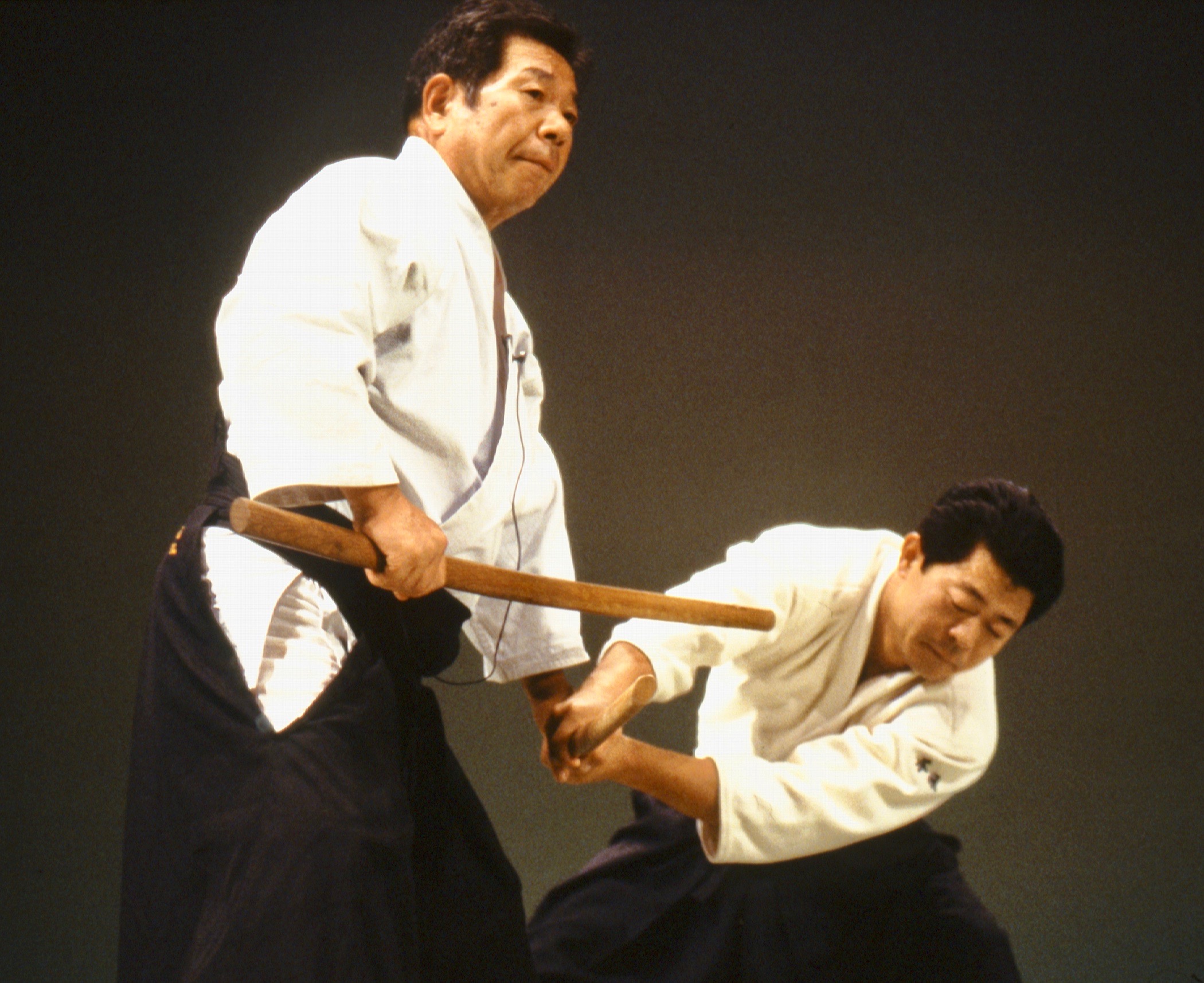
In the same interview that I cited, just above, Ueshiba Kisshomaru also stated, “My father never taught the ken in a systematic manner either.” This is, I believe, almost completely true. Similar to my thesis regarding Takeda Sokaku, I believe that Ueshiba, particularly when it came to weaponry, taught in the moment. He took each student with the skills, potential skills (or lack of skills) that they had, and taught them a version of aiki-ken suitable to that instant in time. Unlike Takeda, however, who was already a complete master of any number of weapons when he started teaching Daito-ryu, Ueshiba was a work-in-progress, still refining his art — particularly his weapons skills - until a few years before his death. It is likely that the majority of his students learned sword much as Sudanomari Kanshu — a somewhat free-form combination of observation and coaching.
Others — Tomiki Kenji, for example, and Ueshiba Kisshomaru and Akazawa Zenzaburo, actually participated in Ueshiba’s studies as they were happening. Rather than merely observing and picking up a trick (or gokui) here-and-there, Ueshiba continued to engage in some degree of formal study of various sword forms up until the late 1930’s.
Finally, a select few individuals — Saito Morihiro and Hikitsuchi Michio being the two that I am aware of — were presented with kata actually derived from specific ryu, which served as containers to hold what Ueshiba felt were the essential principles that THAT individual, at least, needed to learn, as well as a vehicle for Ueshiba to work out things of particular interest in his own training. It is possible, thereby, that an examination of the essential differences of Hikitsuchi and Saito’s ken forms could reveal, as much as anything, different lines of Ueshiba’s exploration of the principles of aiki, and in a sense, how he regarded Saito and Hikitsuchi. There is a particular intimacy that develops when practicing weapon-to-weapon. The forms and methods of practice developed with each of Ueshiba’s deshi are a distillation of his relationship with that man.
As for the younger - postwar - deshi, most of the Tokyo students seem to have used Saito sensei’s forms as their initial jumping off point. However, just last week, I watched a class of Kato Hiroshi, who seems to have taken the pastiche of sword and jo that Ueshiba showed in Tokyo, and applying his understanding of Ueshiba’s aikido, has developed a very unique, very fine method of embodying aikido within the sword. Unlike the “attack-and-response” type of awase techniques that I have seen in many versions of aiki-ken, Kato seems to combine deflection (which is a small tenkan) and attack (irimi) in one move. Kato here seems to be following in the same kind of footsteps as Sudanomari Kanshu and numerous others - his aikiken is a kind of ideal picture of what he received from Ueshiba. Absorbing and processing what he learned, his weapons work becomes a kind of living photograph of a relationship. You can see and experience what he paid particular attention to, and what it meant to him. This personal expression of one’s teacher’s instruction certainly exists in the movements of the successors of classical ryu, but it is far more hidden within the kata. Here, it is almost naked.
In sum, then, what is the REAL aikido sword? Who is teaching a method of sword that conveys the principles that, although he conformed to no ryu or organized method, led the utterly terrifying kendo and iaido master, Haga Jun’ichi, to assert that Ueshiba was the best swordsman in Japan? It would be that which embodies most closely the principles that Ueshiba Morihei asserted were primary: Circle, Square, and Triangle, these three melding to become Takemusu Aiki. This is surely a disappointing answer - almost a cliche. But, in truth, it is the only answer - recall Ueshiba breaking down Kashima Shinto-ryu kata with his son - “… in Aiki, we should do it this or that way.” For Ueshiba, it was that simple. And you?
*I will return to staff weapons in Part V. Suffice it to say here that it is not surprising that Saito sensei’s influence on Shirata sensei (and all of the post-war instructors) in the realm of the jo was huge, because Ueshiba’s jo is largely a postwar development, a path that leads, for the most part, through Iwama.
Ellis Amdur — April 14th, 2006 (add comment)
Reader Comments
John Driscoll writes:
Another outstanding analysis! I do have a question. I noticed you made is no reference to Nakayama Hakudo regarding his association with O’Sensei or any influence on O’Sensei’s aiki-ken. Do you see any indication of Nakayama Hakudo, the founder of Muso Shinden Ryu, having any impact on O’Sensei’s aiki-ken?
There are a number of references to the association of O’Sensei and Nakayama Hakudo. Gozo Shioda described Nakayama and O’Sensei as “close friends” and Kisshomaru Ueshiba reports Nakayama frequently visited Ueshiba at both at the Omoto center and the Kobukan dojo. Both were instructors at the Toyama Military Academy and both were connected to Admiral Takeshita. Nakayama was responsible for Nakakura Kiyoshi entering the Kobukan dojo, and was apparently involved in Nakakura’s adoption into the Ueshiba family and Nakakura’s marriage to Ueshiba’s daughter.
In addition to founding Muso Shinden Ryu, Nakayama, in his role as a kendo instructor at the Toyama Military Academy, influenced the formulation of the original five forms of Toyama-ryu Batto Jutsu. Besides the batto forms, each of the three branches of Toyama-ryu practice a set of basic kumitachi. I do have some familiarity with Toyama-ryu Batto Jutsu and do not recognize any similarity between Toyama-ryu Batto Jutsu and O’Sensei’s aiki-ken, as transmitted by Saito Sensei. While I have seen Muso Shinden Ryu, I am not familiar enough with the style to judge if there is any similarity with O’Sensei’s aiki-ken.
Based upon the apparent relationship between O’Sensei and Nakayama, one would think, if O’Sensei trained with or looked to anyone in developing his aiki ken, it would have been Nakayama. I am not saying I think Nakayama influenced O’Sensei. However, based upon the reported association between O’Sensei and Nakayama, I have to ask the question.
I would be interested in any further insight regarding Nakayama and O’Sensei’s relationship, and I am very much looking forward to your thoughts on the development of O’Sensei’s Aiki Jo.
Robert Noha writes:
I enjoyed the analysis very much.
I had the same question regarding the relationship and possible influence of Nakayama Sensei.
Thanks
Bob Noha
Ellis Amdur writes:
John and Robert - I am not surprised that Nakayama and Ueshiba were friends, given their respective stature in Japanese martial arts community. I think they also found something in common - they were both “classical” men, yet innovators. I’ve seen films of Nakayama - and he should be considered, I believe, the “founder” of modern sword. His influence on iaido is simply unparalleled. In terms of influencing the development of Ueshiba’s sword, however, I don’t see any evidence of it in Ueshiba’s way of using the sword. The two men move and use the weapon in very different ways. This is not to say that they didn’t have conversations about the subject - but the results of such conversations or exchanges are not evident in Ueshiba’s footwork, way of cutting, etc.
Nakayama was also, among other things, a shihan in Shindo Muso-ryu. One cannot discuss the jo without making reference to Shindo Muso-ryu, and I will do so in my next blog — suffice it to say here that aikijo and Shindo Muso-ryu share little more than their choice of weapons — two more different ways of using the same weapon could hardly be imagined.
One way I consider such information as that which you’ve just provided is to look for analogues in my own training. I am friendly with a number of expert practitioners of koryu - some of them are, indeed, among my closest friends. We do communicate with each other about our respective methods of training, something I’ve observed in my teachers’ generation as well. How do WE exchange information regarding our various arts? First of all, we jaw over meals and alcohol. Secondly, we occasionally observe the other’s practice, or embu. Third, we sometimes engage in very low key comparison-and-contrast: as in “How do you handle x?” Finally, when I was younger, I engaged in several taryu shiai with practitioners of other ryu. We were and still are friends - but none of us like to lose and were prepared to get hurt not to have that happen. On some occasions, we used shinai and other “safe” practice equipment, complete with kendo armor - and on other occasions, bokuto and no protective equipment.
I think it is fair to say that Ueshiba was probably friends, or at least a respected acquaintance of most of the prominent practitioners of the period (Kunii Zen’ya excepted!). I’m sure that, when younger, Ueshiba probably crossed practice weapons in friendly exchanges with a few of these people. Older, he watched them very carefully, and they him. It is very likely that Ueshiba, as described in the blog, saw things in a number of ryu that he could use. I think he simply gobbled them up and then, “in Aiki, we do it this way.”
I am simply making an informed guess here, but I believe that Ueshiba probably dealt with Nakayama (and other friends of his stature) in this manner. On the other hand, it’s certainly possible that he and Nakayama and yet another of his students got together privately and worked things out, much as he did with Gejo Kosaburo and the instructors of Kashima Shinto-ryu. There’s simply no account of it happening, nor any evidence of such a possiblity in Ueshiba’s technique. If Nakayama HAD exerted a strong influence upon Ueshiba, I would bet that his sword would look a lot more like Nishio Shoji’s - he, in fact, a student of iaido AND Shindo Muso-ryu.
John Driscoll writes:
Ellis —
Thanks for taking the time to answer my question. I appreciate the insight you provided clarifying the probable relationship between Nakayama and O’Sensei. The additional comments will be of value to anyone reading your commentary in the future. I am very much looking forward to Part V addressing staff weapons.
James Williams writes:
Ellis,
Thanks for the in depth information, insight, and hard work. I personally find it interesting and valuable.
James
PS I thought we could discuss some of this stuff over a beer however I am now beginning to think it might take a keg.
Ellis Amdur writes:
James - Caipirinhas, if you want to get the gokui. I tend to lose track of what’s supposed to be secret under the influence of cachaca and lime.
I appreciate the good words.
Ellis
James Williams writes:
Ellis,
Okay I’ll buy, I can feel the morning after headache already. We will put sharp pointy things away, invite Toby, and get serious. I should be in Washington in September and will co-ordinate with you.
James
Ellis Amdur writes:
Today I reviewed the “collected works,” so to speak - the films of Ueshiba from the 1936 Asahi Shinbun dojo through those of the rest of his life. Ueshiba had clearly consolidated - at least mentally - what he thought his sword should be. He used much the same waza throughout. (Which includes an irimi with a one-hand thrust, arm fixed at the waist.
What a difference the years made, however - and NOT in the direction many might assume! Looking at the 1936 film, Ueshiba was really not very good with a sword. Although he was quite speedy, he had little root. He skipped on the balls of his feet and cut, mostly, with his arms. He looked like he was doing kendo - sort of.
Some pre-war deshi were in the habit of claiming that Ueshiba was doing “real” martial arts pre-WWII, and that, after the war, he was doing “old man’s martial arts.” Since the release of the Asahi newspaper film, this has become a rather fashionable truism in even wider circles. Additionally, Daito-ryu partisans assert that Ueshiba was stronger in earlier days when he hewed more closely to Daito-ryu parameters. The response to Ueshiba’s claim that he perfected his art in Iwama was that he must have meant that he changed aikido from a real fighting art to a spiritualized practice.
As far as the sword goes, however, nothing could be further from the truth.
As one watches the years “progress,” through the films, you see Ueshiba get better and better. His efficient and powerful use of his body postwar - particularly in the LAST films - is remarkable. He is using his bokken with rapid moves, one after the other, some at very short range. But quite unlike kendo’s kirikaeshi, each one is a real cut with a sword. That he could cut so powerfully with such abbreviated movements is a testimony to a whole body integration that he definitely did not have while younger.
Ellis Amdur writes:
A little more information on Shirata Rinjiro’s sword, derived from corespondence from a long-term student of Shirata sensei as well as my personal review of films.
Shirata sensei taught 12 different solo sword forms (and these forms had subsets) - the twelvth being a compilation of all the previous forms. He also had ken awase and kumitachi forms, which appear to me to owe something to Saito Morihiro’s kumitachi. In Shirata sensei’s two person forms, he deflects and then enters quite close, and then uses the cutting action of the sword to throw. Clearly, this would not “work” in such a manner in a swordfight. But it is an exemplary approach towards melding his sword with his empty-hand waza. There is a smoothness and flow in the way he uses the sword, ferocity in the initial irimi, follwed by a close, almost slithering cut which “emulates” the aikido technique.
This, I believe, was Shirata’s creation - Ueshiba, at least on film, does not do anything quite like it, nor do any of the other senior teachers. Were I to try to put it on a “matrix,” the principles he exemplifies seem, to me, to fall between those of Saito Morihiro and Nishio Shoji’s sword techniques.
Ellis Amdur writes:
I received some additional information from one of Shirata sensei’s senior students, who informed me that he had spoken directly to him about weapons training at the Kobukan. Shirata sensei said that Ueshiba explained nearly everything in terms of sword work and, apparently, take him aside, and teach him on an individual basis. What makes Shirata so wonderful, in my opinion, is that he would go to other senior instructors and ask, “What did Osensei teach you?” For example, he incorporated into his own curriculum a set of kumi-tachi that he learned from Takaoka sensei of Wakayama (who had his own individual relationship with Ueshiba)
George Ledyard writes:
Great installment on the series, Ellis! Thanks.
I would add that the post war deshi participated in another chapter in the development of sword work in Aikido. All of them picked up various elements from O-Sensei since he hardly ever taught without reference to the sword in some way.
But some, not all, of the deshi from that time period picked up sword technique from some as yet to be revealed source. If you look at the sword work done by Saotome, Chiba and Imaizumi Sensei (this is not meant to be a totally inclusive list) you will find elements of itto ryu and kashima sword. They have been asked where they picked this up and the response is immediately murky and vague… clearly the intention is to not provide an answer to the question.
Kevin Lam, my Assistant Chief Instructor, is a senior student of Imaizumi Sensei. He has a three ring binder with everything he was taught by Imaizumi Sensei. In it are quite a number of sword forms which are taken directly from the Itto Ryu curriculum. He got these directly from Imaizumi Sensei, yet to my knowledge, Imaizumi sensei never took kenjutsu, Itto Ryu or otherwise.
I, of course, trained with Saotome Sensei. Being of entirely differing disposition from Imaizumi Sensei, there are no notebooks full of kata. In fact when I trained with Sensei in the late seventies, there were no kata at all (he created those later in the early 80’s). The sword work we did was full of material which I later came to recognize as loosely based on itto ryu, kashima ryu, and to some extent yagyu ryu sword. Sensei has a whole repertoire of sword techniques which collectively involve movement of the blade and body which make the movement extremely deceptive. It is my understanding that these movements were taken directly from, though out of the proper context, the forms of kashima ryu. I once asked Sensei where he learned these things and it is notable, I think, that he did not answer that O-Sensei had taught them. Rather, he didn’t provide any answer at all.
Kevin Lam’s experience was identical when he asked the same question of Imaizumi Sensei. Over the years, reading between the lines from things we both heard said by our teachers, it became clear that some sort of training was offered to the post war deshi at honbu. It was clearly optional because many of the deshi from that time show no sign of it. My own theory on this was that O-Sensei’s friendship with various high level instructors led to “informal” training from certain, as yet unnamed koryu practitioners. I believe that the reluctance of our teachers to talk about where they got this training is the result of having been given the training on condition of not publicly talking about it.
While Saito Sensei was busy systematizing what he had been taught by O-Sensei, you find various deshi back in Tokyo acquiring technique which is clearly not derived from that Iwama curriculum. So far, I can’t find anyone who can say where this came from. I asked Stan Pranin about it once and he said he didn’t know either.
I do think that it is revealing that the Founder either arranged or at least approved of whatever this supplementary training was. To my knowledge it didn’t seem to have continued when he passed away. That would seem to support my own opinion that whatever was happening in this regard, it was as a favor to the Founder and directly due to his connections.
I think it is interesting that it actually seems easier to plot out the sources of influence for the sword work of the prewar deshi than it is for the post war. Obviously, quite a bit more research remains to be done. Hopefully some of those who were there at the time will eventually be convinced to talk about it.