A Unified Field Theory — Aiki and Weapons — Tempo Allegro, Molto Agitato
This article should now be considered a work-in-progress, of interest both for the discussion it engendered as well as presenting an earlier perspective on my work. I have radically revised this essay in my new book, HIDDEN IN PLAIN SIGHT. Some of the conclusions I have reached are somewhat at variance to what you will find here. Those interested in the book can find it at www.edgework.info/buy.html
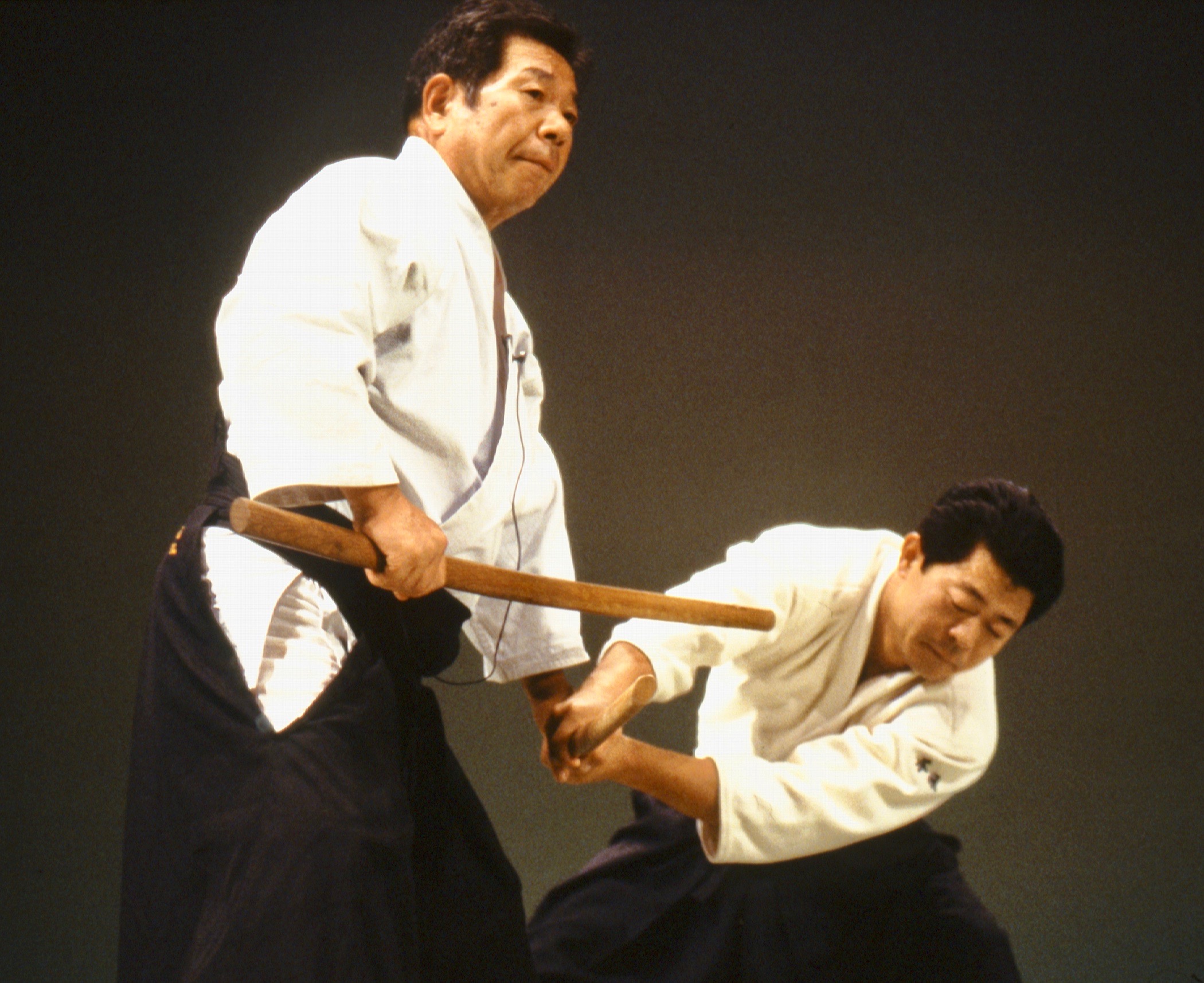
PART V - Ueshiba Morihei and Weapons — The Influence of Spear Technique Upon Stave and Stick
He was better at using a longer weapon. He would use a long-handled spear, and he was better with a bo (stave) than with a jo. It was in later years when he became older that he used the jo. Also, when he lived in Ayabe, he would often practice the jo and ken in the garden. I think that it was something of his own that he didn’t learn from any master at all. Ueshiba Kisshomaru
Hozoin-ryu Takada-ha Kanenori Dengoro Kurokochi, Takeda Sokaku’s grandfather was, according Kono Yoshinori in Aikido Journal #102 (1995), pre-eminent among Aizu warriors, and one of the finest martial artists in Japan during the late Edo period. Among the martial arts that Kanenori achieved mastery was Hozoin-ryu Takada-ha, a style also practiced by Takeda Soemon and Takeda Sokichi, and one of the first ryu that Takeda Sokaku learned. Hozoin-ryu is a formidable style of spear-fighting, famous for its cruciform spearhead. Their kata are quite short, spear against cross-bar spear, and these kata most significantly feature trapping, pinning and use of a kind of vibratory force to deflect the other’s weapon, this last generated by the entire body moving as one unit in such a way that all the force is transmitted through one’s own weapon to deflect the other’s - similar to what is called “fajing” in Chinese martial arts. Hozoin-ryu Takada-ha also had kata to train against sword, naginata, bow-and-arrow, and, at advanced levels, against multiple opponents — reportedly most of these aspects of the ryu are no longer practiced.
Hozoin-ryu was one of the most significant influences on the development of Japanese bayonet technique (jukenjutsu), one of the first martial practices that Ueshiba achieved any level of skill. Jukenjutsu remained both a strong interest of Ueshiba’s and a significant influence on the development of aiki-bo and aiki-jo, up through the war years. Basic spear technique, unlike jukenjutsu that uses fixed-hand-thrusting, slides the spear through the front hand, with the back/power hand, stopping at either the hip or under the arm. This is definitely seen in aiki-stave technique, but is generic to any and all schools of spear. One particular Hozoin-ryu technique called maki-otoshi (wrapping drop) that was incorporated into jukenjutsu is also used in Ueshiba’s staff technique.
It could be argued, then, that almost any element within Ueshiba’s jo and bo can be found within jukenjutsu, or perhaps, through superficial observation of basic spear technique. So was Ueshiba being less than honest in his statement that he studied Hozoin-ryu? I think that I established in previous articles, however, that Ueshiba was truthful about every other art that he claimed that he studied: not that he had formally entered each school with an oath and blood-seal, or that he received menkyo-kaiden, but that his statements of studying each school as he named them were based on fact. Why should Hozoin-ryu be any different?
In that light, Takeda very much liked spear — there are some quite dramatic stories about his training with and against spears in his biography. He lived with Ueshiba on two occasions for a number of months, first in Hokkaido, and then in Ayabe. By all descriptions, Takeda does not sound like the kind of man who would take joy in dandling Ueshiba’s children on his knee — and there was a limit to how many games of shogi they could play (particularly as Takeda, according to Mochizuchi Minoru, was prone to cheating!). What would they do to while away the hours, during the rain or snow? Surely Daito-ryu jujutsu, since that was the reason Ueshiba had him live in his home. I know that, in my own case, given inclement weather or just out of boredom, I will sometimes teach one of my students something quite out of sequence in the mokuroku. I recently did this with ryofundo (short weighted chain), teaching one student on a single occasion - it is my expectation that the next time I bring it up - maybe even years from now - he, like I did in similar circumstances, will be far advanced in skill.
But wouldn’t they have been seen in the dojo if Takeda was teaching young Ueshiba special training? The agricultural holdings in both communities surely had storehouses — and if you’ve ever been in a Japanese farmer’s storehouse, they can be very broad and high ceilinged. They had space and privacy if they wanted it.
It is quite likely, in my opinion, that Takeda, the snow or rain falling outside, might grab spears and show young Morihei how to REALLY use the weapon, not that “crude jukenjutsu stuff” he learned in the modern military. Takeda Tokimune recalls that, at Ayabe while still a small boy, “I also witnessed an occasion when Morihei Ueshiba, a chief petty officer and a master of Juken Jutsu (mock bayonet weapon) was felled by a thrust from a training spear nearly nine feet long delivered by Sokaku who had assumed a kasumi jodan stance.” Kasumi jodan is a high stance, with the spear held at head/eyebrow height, directly forward like the prow of a ship. It is a pre-eminent stance for “dropping power” - fajing from high to low, similar to pi ch’uan in xingyi. And thus, Ueshiba could have learned a little Hozoin-ryu. And just as I used to train, striking leaves on the trees in my garden from any and all angles with my ryofundo to improve my targeting (and I assume my student will as well), so, too, by Ueshiba Kisshomaru’s description, did his father target the trees in the garden, stabbing the apricot tree so deeply that his spearhead got jammed, and broke off. Perhaps I am incorrect — but Ueshiba, though definitely prone to hyperbole, did not otherwise lie about his training — why would he do so here?
The other significant fact is that Ueshiba Kisshomaru describes him training alone — not replicating Hozoin-ryu kata nor creating new aiki-sojutsu (aiki-spear) two-person forms with a young deshi. Instead, as early as Ayabe, he was starting to create a solo polearm practice — at this time, apparently free-form. Whether it was mere suburi, or he was actually conjuring up and “fighting” imagined opponents is not known.
However, as recently as one week ago, I would have written that I could see little to support the claim that he derived his staff art from Hozoin-ryu — or if he did, that he incorporated only the most superficial elements, common to all spear schools. However, I just reviewed the old Aiki News video “Morihei Ueshiba and Aikido” which provided a panoramic view of his life, with excerpts from most of the major films. There were several scenes of him doing stave work (BTW - please refer to the comment section of PART IV for my new commentary on his swordwork that I also derived from this review). Most of the film sequences were what I had seen innumerable times before — the “jo trick,” some jo nage and Ueshiba doing solo jo form, whirling, thrusting and dropping on one knee with speed and precision. Each film of his “kata” had a slightly different sequence of moves. I think he had the essential parameters in his body/mind, so to speak, and improvised as he went. It was all the “same” - just different sequences. Nonetheless, I had watched these sequences innumerable times over the years, and honestly, I’ve become jaded. Ueshiba was, in my opinion, better - more powerful and more integrated - than of any of his disciples, but I’d seen it all before. Yawn.
However, I was absolutely STUNNED by the film of his stave work (using a sharpened staff - the short spear or nuboko referred to in an earlier blog.) in the 1961 film from his trip to Hawaii. Ueshiba starts by repeating a number of movements, sometimes two or three times, and then a second and a third, etc. All are various various deflections. He was doing “fajin!” His whole body is relaxed and at the moment of the simulated deflection (which he does upwards, downwards and to the side), his whole body snaps into an “implosive” channeling of body power - I still don’t know what to call it — but you can see the power emerge from his root and center, and out through the staff - downwards, upwards, sideways and at angles. Were he using a long spear, it would flex like a tree in a high wind. He is NOT doing it in the manner of jukenjutsu, which have a number of deflections, nor is it the movement used in the powerful “clacking” together of staves that we see in Goto-ha Yagyu Shingan-ryu. This is truly one of the “gokui” of the proper use of a spear or long-staff — and I am quite prepared to believe that he learned this from Takeda Sokaku, as this is, I am told, an essential technique of Hozoin-ryu. Sure, he could have learned it elsewhere. He could have figured it out on his own. But the dates add up - around the time Takeda lived for months with the Ueshiba family in Ayabe, Ueshiba was out in the garden working on spear technique.
In a follow-up post yesterday in the “Hidden in Plain Sight” blog (post 136, to be exact), I wrote that I was amazed to see the same thing — “fajin” - in the way Ueshiba was doing funa-kogu-undo and ikkyo-undo in the 1962 film of Ueshiba at Iwama with Terry Dobson. I have not seen ANY other teacher doing this in either weapon or unarmed techniques. Generally speaking, Ueshiba’s solo jo movements are so fast that I think this technique has simply past under everyone’s vision. People do the jo kata with variations of emphasis of muscular cuts and/or flowing movements. As for the “aiki-taiso,” I think almost everyone seems to have regarded this as a “warm-up” to get past before getting to the “real stuff,” or merely the remnants of Ueshiba’s inexplicable spiritual practices. The “aiki-taiso” was something he did daily. I would wager he did the isolation of movements with the stave that we see in the Hawaii film quite frequently. Once again, it seems that the secrets were “hidden in plain sight.”
Why didn’t he explicitly teach this? He did! How explicit must he get!!!!!? Most instructors, particularly of this period in history, expected their students to be watching! My conclusions here are as follows:
1. Ueshiba didn’t lie about what he trained. He was imagistic, and may have used some hyperbole, but he seems to have told the truth. That his son recalls his father incessantly training with a spear in Ayabe, which would have been around the period that Takeda lived with him in Ayabe, suggests to me that he DID learn some Hozoin-ryu directly from his teacher. It may be possible that it was this training that gave Ueshiba some essential information on how to gather/and/explode channeled force. Lest their be any mistake, I am talking about biomechanics - see some of Mike Sigman’s posts in “Hidden in Plain Sight.”
2. Whether Hozoin-ryu or from somewhere else, Ueshiba not only learned one of the most important gokui of sojutsu, but he practiced it his entire life — not only in his stave work, but also in the basic exercises that he did every day. This type of training is used in other martial arts (such as Chen family t’ai chi, or xingyi) to develop extraordinary power. We keep asking how Ueshiba had such amazing power - it is obvious to me that he was doing specialized training right under everyone’s eyes. I had no idea that this was a part of aikido previously, but it clearly seems a part of Ueshiba’s! And the evidence is on film.
3. Of course, if Ueshiba received insight into the way of training “internal” power from Takeda/Hozoin-ryu, it was something that his teacher also knew. I wonder if this remains a practice within any Daito-ryu faction. It appears that it was largely lost within aikido, even as the art was being born.
4. One of the areas of aikido that I most detested during my active training days were the jo-nage methods. Every shihan for whom I took ukemi, seemed to be working of trying to do the technique with precise and impeccable timing, directed at the point where the uke was least able to retain balance. I’ve got very long arms and legs - and as I got more skillful, I could react and compensate to their moves. Within a short period of time, I always had to throw myself - or either leave the teacher standing there, trying unsuccessfully to tip me off-balance, or in the case of the more bloody-minded, have him poke me in the eye to get me to fall. WIth this current insight into Ueshiba’s way of using his body (and through this, the bo or jo), I would LOVE to have had a chance to have taken ukemi for him. The difference with “fajin” is that it is not mere blending or timing - it can be the explosive expression of a lot of power at a single point, whether the opponent is resisting, compensating or not.**** Of course, like anything, it works far better against someone whose balance is de-stabilized. But once again, it may be that what Ueshiba looked like he was doing was different from what he really was doing. Again - I so wish I could have taken ukemi from him in this context.
5. As for the “jo trick,” maybe it’s part of the same bag - but I still don’t have a clue.
I thought this would be my last blog on the subject, but I’m not finished yet!
****I learned a method of “fajin” training with a spear from Su Dong Chen when I lived in Tokyo. On a trip to Taiwan, I met a very well-known t’ai chi teacher - Wang Yen-nien. It’s a long story, but I was challenged by him to show him “what I knew,” - I had been introduced to him as a Japanese martial arts practitioner - and just for the heck of it, I showed him this vibratory spear training I had learned. He looked at me and said, “Where’d you learn that? You aren’t supposed to know that!” I said, “Oh, around.” He said, “Oh yeah, well, do you know this?” And on the spot, he showed me two other training exercises with a spear that remain essential training practices of mine. They are three different types of power-generating practices - one of which, interestingly enough, is done by the spear practitioners of Maniwa Nen-ryu. This is all solo training, by the way, but it makes a tremendous difference when working against another weapon. He did NOT teach me the details of what I should be doing - just the motions. The details I would have to (and still have to) work out on my own. He then challenged me to knock him over as he had me press one end of the spear shaft against my hara and the other end against his own. I was pressing all 220 pounds through the spear shaft, and aside from making him step back momentarily, I coulnd’t move him. He got a jack-o-lantern grin and suddenly expanded his belly and that, alone, folded me over and then off my feet. No angle - directly back!
I have never tried to “extrapolate” this study of spear to empty-handed practice - but it now comes to my mind that it is about time.
Ellis Amdur — April 24th, 2006 (add comment)
Reader Comments
Stanley Pranin writes:
Ellis,
It’s wonderful to see how you’ve put all of this together. I see some of the ideas we talked about on the phone have been nicely integrated.
I have an observation on O-Sensei having practiced Hozoin-ryu spear. I believe this statement is based mainly on the short historical passages regurgitated over and over in Kisshomaru’s books on aikido where the arts that the Founder studied are listed. I don’t recall O-Sensei having mentioned Hozoin-ryu in any of the lectures or audio tapes I have of him whereas Daito-ryu, Tenjin Shinyo Jujutsu, and “Yagyu-ryu jujutsu” are. Also, keep in mind that in Kisshomaru’s books it is still stated that O-Sensei learned Kito-ryu jujutsu which he did not actually. This was based on a confusion surrounding the name of one of O-Sensei’s early teachers in Tokyo. I presented this evidence to the Second Doshu about 20 years ago and he agreed that I was correct. Nonetheless, the same factual error continues to appear to this day in books published by the Aikikai. It is then repeated over and over in derivative books in Japanese by other authors and in foreign language texts on aikido.
Anyway, my point is this. It is Kisshomaru who says that O-Sensei studied Hozoin-ryu. I have not seen any other documented or anecdotal evidence other than the late Doshu’s statements. Keep in mind that the early Aikikai leadership took liberties in rewording the Founder’s spiritual texts, by omitting passages, and substituting generic terms for deities where O-Sensei uttered specific names.
That’s why it was somewhat of a shock to me in my early years of research when I finally heard a voice recording of a lecture of O-Sensei. I expected beautiful, straight-forward spiritual passages of the sort that one found in the “Memoirs of the Master” text in Kisshomaru’s early “Aikido” book. What O-Sensei was saying was very complex, esoteric, nearly impossible to understand, but, in its own way far richer and steeped in the historical traditions of the times and circumstances in which he lived. It was completed different from the “sanitized” version of the “Memoirs.”. Since that time I began to scrutinize books published on aikido very carefully and check against what my research was revealing. I have found and continue to find many errors. I very much hesitate to make blanket statements based on a single source.
You may be 100% right in your guesses. Everything you say is perfectly plausible. Probably, we’ll never know with any certaintly the truth of the matter of the exact origin’s of O-Sensei’s jo the way we do for his ken which has been pretty well documented.
I think the great value of this and your other recent essays is the way you bring alive and pick apart the historical reality in which O-Sensei lived and explore all the possibilities to explain how and why something may have occurred. It is very important to use such techniques, particularly for areas of research where we have little to no information and where we are forced to extrapolate and make educated guesses.
We’ll, I’ll stop here as I have to catch a flight to Tokyo tomorrow morning. I look forward to following this thread as closely as possible even though I’ll be moving around quite a bit.
Thanks so much for your wonderful contributions!
Mike Sigman writes:
Ellis wrote:
“Ueshiba starts by repeating a number of movements, sometimes two or three times, and then a second and a third, etc. All are various various deflections. He was doing “fajing!” His whole body is relaxed and at the moment of the simulated deflection (which he does upwards, downwards and to the side), his whole body snaps into an “implosive” channeling of body power - I still don’t know what to call it — but you can see the power emerge from his root and center, and out through the staff - downwards, upwards, sideways and at angles.”
Hi Ellis:
Well, if this is true (I have no reason to doubt it; I’ll take a look at the tape as soon as I can), it just means that all my estimations about what Ueshiba knew… as avant-garde as my projections were… were short of the mark.
One of the bothersome things about these clues is that they indicate a level of knowledge that is far higher in the ki and kokyu areas than I ever had a suspicion of. Takeda and Ueshiba could not have been the only people in Japan to have this level of knowledge; that means that within a number of the various ryu on Japan today, there are a certain number of people who have these skills, in all probability, and the knowledge is not getting out to western practitioners of the Japanese martial arts. Hmmmmm…. come to think of it, that same thing is happening with the Chinese and Indonesian arts; the “hidden skills” are only getting out to foreigners in small bits and pieces.
On the other hand, if you look at the legitimately trained teachers under Ueshiba, not that many of them (particularly the post-war group) seem to have gotten very much of these skills, so it’s not all “picking on the gaijin”.
I’m nonplussed with this revelation, Ellis. I’ll need to take a look at the film and see what can be analysed from his movements before I can say much more.
Thanks very much for the information.
Regards,
Mike Sigman
Robert John writes:
Not directly related, but just wanted to drop a couple of comments. Both of Ark’s(Akuzawa, the guy mentioned in Hidden in Plain Site) teacher’s who remain fairly anonymous today, had substantial long weapons training. One of instructors used to do Jukendo, which was emphasized in “nihonkempo”, and back in the day, nihonkempo was something to be reckoned with supposedly (even though it’s been considerably watered down now). The other placed a huge emphasis on basic spear work, and from my own experience in it, I’ll guess that if you understand the basic mechanics, then solo practice (tanren) becomes a central part of the training. I’d say a lot of the fajing like expressions of the body also come naturally from using the spear correctly, since there’s only so many ways you can manipulate it efficiently :) Cool stuff tho. I thought it was weird that there was no mention of Ueshiba having spear work…be interesting to see what would happen to the current student body of Aikido if they made those tanren exercises central to aikido ^^
Mike Sigman writes:
Rob John wrote:
“I’d say a lot of the fajing like expressions of the body also come naturally from using the spear correctly, since there’s only so many ways you can manipulate it efficiently.”
Hi Rob:
Well, I’ve only seen a couple of “right” ways to shake a spear, but I’ve seen a hell of a lot of “wrong” ways passed off as spear or pole shaking.
Incidentally, I have to admit to being consistently slow in picking up that Ueshiba had any real skills in the “internal strength” categories… but that was because I let the lack of knowledge by both western and Japanese Aikido practitioners convince me that nothing substantial was there. So I let a lot of clues slide with the unspoken thought of “oh, he was just mimicking some of the old Chinese stuff, probably as some holdover ritual, the meaning of which has long been forgotten”. Now I’m beginning to think that I was the victim of my own reverse prejudices. Take a simple thing like the portrait that Ueshiba had painted of himself as a Kami. There’s a reason for that pronounced belly in the portrait… it’s to signify a greatly developed dantien and hence, ki strength. Listening to Ellis, I’m afraid I’d have to bet that if Ueshiba had real shaking powers, he knew quite well about the dantien development.
Regards,
Mike
Daniel Harden writes:
First Blog entry” Unified field theory.
My first posts
“I think we need to look past Ueshiba to Takeda-the true source of his internal skills.”
“It is a mistake to look for any in-depth training in China or Chinese arts-Stan has pretty much discounted that possibility. As there just wasn’t time”
Which was met with some interesting commentary, arguement and reactions from certain people..
Now……….at the end, It’s nice to see we’re back. Interesting
Spear
As for fa-jing and shaking power-while it is excellent-there are other methods in Koryu: grips, arm placement, for using a spear that have nothing to do with that. Which Ellis is quite aware of as well.
Dan
Ellis Amdur writes:
Dan writes:
“As for fa-jing and shaking power-while it is excellent-there are other methods in Koryu: grips, arm placement, for using a spear that have nothing to do with that. Which Ellis is quite aware of as well.”
Sure - but the question I’m interested in is Ueshiba’s stave arts. I had written the piece asserting that there was no need for any assumption of training in Hozoin-ryu, because all the waza in the aikijo, with the exception of some elementary stuff that could have been “stolen” watching others do spear, were explainable by his study of jukenjutsu. When I noticed this “shaking power,” which, as I say, I have not seen in anyone elses aikistaff, I had to rewrite the article, and gathered the disparate pieces I could find that supported the possibility of a study of Hozoin-ryu. It is also possible that he learned it at a later date - BUT, Takeda’s residence at Ayabe corresponding with Ueshiba’s intense practice of sojutsu makes that the most likely explanation.
Dan also writes:
“It is a mistake to look for any in-depth training in China or Chinese arts-Stan has pretty much discounted that possibility. As there just wasn’t time”
Cut out the word “in-depth” - my next entry may go in some interesting directions.
On a second point - the Chinese arts filtering through pseudo-Shinto practices of Futaki, etc., and given Ueshiba’s adamant assertion of the importance of his solo training (non-DR based) as a key to his strength, I still find it quite plasuible that the development of his skill did not being-and-end with DR only. Either Ueshiba was merely an ungrateful liar, or he was telling the truth that he a) also trained in other things b) never stopped refining and working his on his own. (I am going to return to this in spades in the future.
Anyway, watch this space. I have some surprises left.
Best
Ellis Amdur
Ellis Amdur writes:
John Driscoll kindly forwarded the reference from which I originally got Osensei’s list of arts that he trained (including Hozoin-ryu).
Aiki News No. 18, August 2, 1976
The following interview with O-Sensei and his son, Kisshomaru, took place
some twenty years ago and was published in Aikido, by Kisshomaru Ueshiba,
Tokyo, Kowado, 1957,pp. 198-219. The interview was conducted by two unnamed
newspapermen and contains a wealth of valuable insights into the life of
O-Sensei and the history and dvelopment of Aikido. Aiki News will publish
the entire text in four parts starting with this issue.
AN INTERVIEW WITH O-SENSEI AND KISSHOMARU UESHIBA
A: “When did you begin your study of martial arts?
UESHIBA: At about the age of 14 or 15. First I learned Tenshinyo-ryu
Jiujitsu from Tozawa Tokusaburo Sensei, then Kito-ryu, Yagyu-ryu, Aioi-ryu,
Shinkage-ryu, all of them Jiujitsu forms. However, I thought there might be
a true form of budo elsewhere. I tried Hozoin-ryu Sojitsu and Kendo. But
all of these arts are concerned with one-to-one combat forms and they could
not satisfy me. So I visited many parts of the country seeking the Way and
training…but all in vain.”
Note #1 - I discussed the reference to Kito-ryu in an earlier blog - that for Osensei, as for many others, I believe this referred to “old school” judo - so different from the sport it became.
Note #2 - Aioi-ryu was a reference to a certain period of Ueshiba’s own martial art
Note #3 - He refers to Takeda Sokaku and Daito-ryu later in the interview
Note #4 - the reference to kendo is, I believe, a reference to his research during Kobukan days - his movements in the 1936 film have, in my opinion, a lot of elements in common with kendo. As I’ve stated earlier, his swordwork is light-years stronger post-war.
Ellis Amdur writes:
I’ve been informed that Matsuda Ryuichi is cited in Shishida & Nariyama’s “Aikido Tradition & Competitive Edge” that Sagawa Yukiyoshi was taught Aiki NIto-ryu and Aiki Sojutsu by Takeda Sokaku. If true, this supports both of my theses regarding the influence of spear and one-handed/double sword on the roots of some of the body skills that Takeda taught. The Sagawa dojo is well-known as being secretive (an oxymoron I like as much as the fact that the addresses of Japanese modern ninjutsu instructors are in the phone book). Nonetheless, it is possible that more information can be gleaned in Matsuda and Kimura’s writings, if one is looking for it.