Aikido Journal Home » Aiki Blog Aiki News Japan

A Unified Field Theory — Aiki and Weapons — Fantasia Chinoise

This article should now be considered a work-in-progress, of interest both for the discussion it engendered as well as presenting an earlier perspective on my work. I have radically revised this essay in my new book, HIDDEN IN PLAIN SIGHT. Some of the conclusions I have reached are somewhat at variance to what you will find here. Those interested in the book can find it at www.edgework.info/buy.html

PART VI- Ueshiba Morihei and Weapons — A Chinese Connection After All?

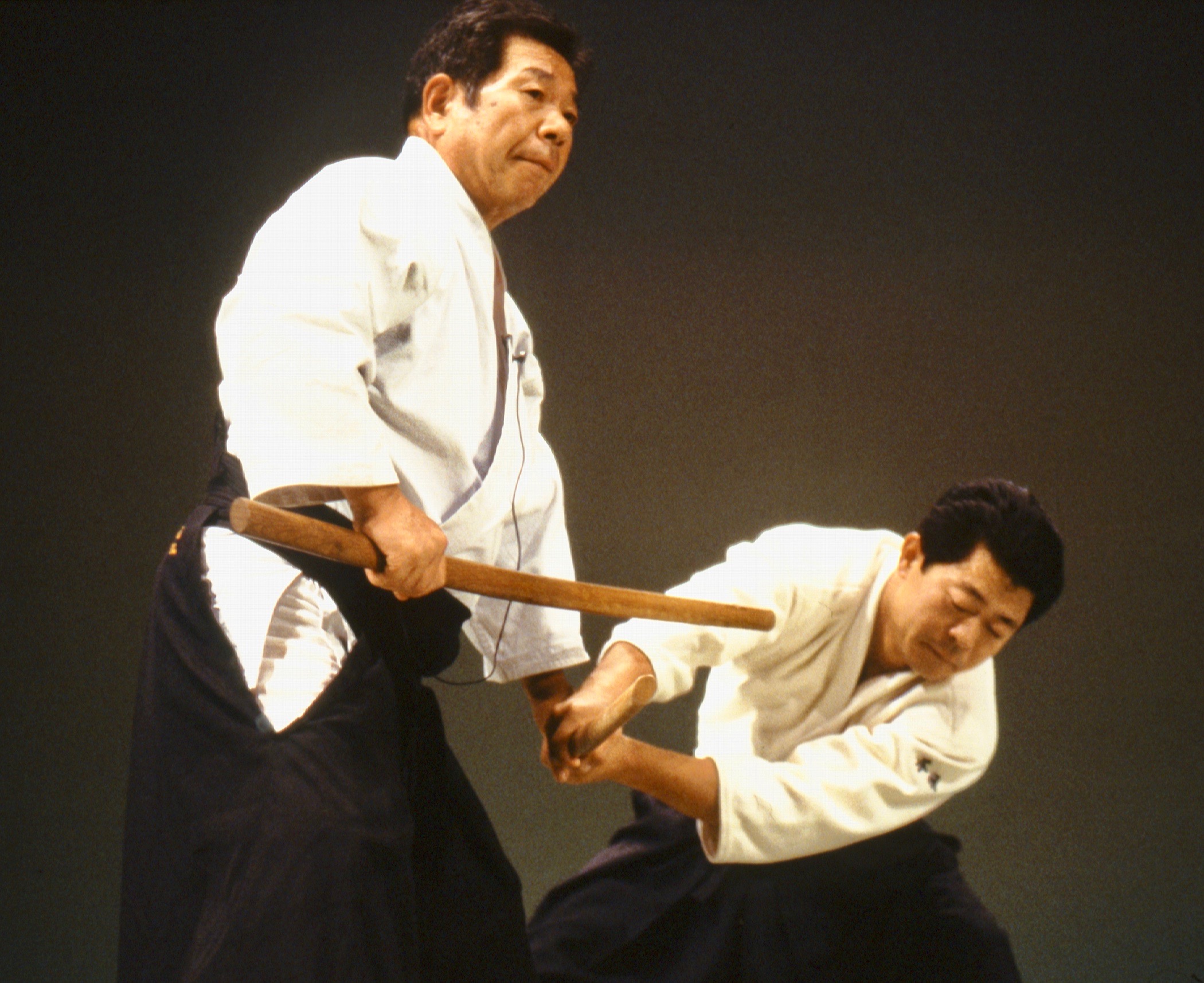
Imagine Ueshiba in the garden in Ayabe, working on his spear technique — hour after hour. He was, by then, an incredibly powerful man — consider how much power it would take to thrust a spear so deeply into a tree that they couldn’t, as his son describes, recover the spearhead, being forced, instead, to cut the shaft, and leave it embedded in the living tree.

Imagine Ueshiba at the Kobukan, teaching juken, which, Shirata sensei has stated, was the main “polearm” that they practiced there. The thrusts have more snap, they are shorter and they are chambered, from hip to chest and back again. The body is held rigidly upright, as if moving in ranks and the hands do not slide, but remain fixed on the weapon. It would be far more difficult to learn the kind of implosive/focused strength that I’ve loosely referred to as “fajin” while using the thick, inflexible mokuju (the wooden replica of rifle and bayonet). There would be no “cues” from the weapon — one would have to find it within one’s own body alone. Did his students not see him practicing with a spear — the hands sliding on the shaft, the tip vibrating and swaying like a cobra pinned by the tail? Did no one take it upon himself to copy him, or to request instruction in this far more dynamic and far more fascinating weapon? Was this one of the first lost opportunities for many of the deshi in “stealing” their teacher’s skills?

And consider this — Ueshiba, perhaps as early as his days with Takeda Sokaku, began working and teaching with bo. In a recent interview with Kondo Katsuyuki in Black Belt, he stated “I met [Ueshiba] in 1968 or 1969 at the Aikikai honbu dojo. I had an introduction from Tokimune Takeda. When he saw the introduction letter from Tokimune, [Ueshiba] said, ‘I learned Daito-ryu aikijujutsu, also.’ Ueshiba was practicing the jo and said, ‘Let me show you some of the techniques I learned from [Sokaku] Takeda.’ So he called me over to train, and he threw me using the jo.” Regarding this, Ron Tisdale wrote on the forum, “From what I vaguely remember of a translation of a conversation Kondo Sensei had where I was present: ‘I still don’t know how he threw me…’” NOTE: This establishes absolutely nothing new regarding any bojutsu within Daito-ryu. I’ve already noted that several lines practice jo-nage and jo-tori. What has not been otherwise established is any bojutsu as weapons practice - solo or dual kata - within any of the Daito-ryu factions. However, it does strongly suggest that Ueshiba was able to throw Kondo with explosive, untrackable force and skill, something he attributed to Takeda Sokaku’s teaching (see Part V).

Why would he begin to emphasize bojutsu? The bo is long enough to flex, thus making fajin-type training accessible. It can be thrust like a spear, and and also thrust like a bayonet. And it can be swung and “cut” like a sword. If his aikijutsu, in the 1930’s, was moving towards more universal principals (I mean in terms of combat, not humanism), the bo was a wonderful training instrument towards this end. And perhaps Ueshiba was here offering an essential avenue to his power, far more accessible than the juken, and more, versatile, more easily acquired and more easily transported than a spear - once again, offered and hidden in plain sight.

As I wrote in my last blog, each film of Ueshiba shows him doing a solo form, but they are not identical — he improvises as he moves. I do not think he ever established a fixed sequence that he repeated in rote repetition. But somehow, at some period, he made a transition from a purely free-form, anything-goes training to a kind of kata. One can think of it as a little jazz improvisation on a basic theme — every time a little different, but not so rare that one can’t hum along with it.

An Influence from Chinese martial arts?

Notwithstanding his clear debt to Takeda Sokaku, something he acknowledged and demonstrated within a year of his death, perhaps this is not all. Ueshiba was one of those men who kept studying, kept paring and honing his skills, using every bit of information he could find. So was there more?

The idea that Ueshiba studied any Chinese martial art in depth has been done to death — neither the times nor the circumstances fit. I recently read someone’s speculations that he could have learned Chinese martial arts while serving in the military. Even the slightest understanding of the rigors of the life of a Japanese enlisted man would put paid to such a fantasy.

Then, of course, is the fantasy that he must have learned bagua, t’ai chi, or something else during his adventure in Mongolia in the 1920’s. This expedition was only a few months in time, darting around the countryside in cars from place to place, harassed by various militia and bandits, and eventually arrested by the authorities. Where was there time to settle to study? “Well,” one might suggest, “how about this — there must have been skilled Chinese martial artists among their entourage, and they exchanged techniques with Ueshiba, and he, wanting to preserve his image of being a purely Japanese martial artist, never revealed his debt.” That takes a lot of time-travel-mind-reading — for all we know, Ueshiba might have bragged to the high heavens either that he learned the real goods in China (which would have been a good political move, giving him distance from his real, primary debt to Daito-ryu), or that he proved the superiority of Japanese martial arts in his defeat of valiant Chinese practitioners. But more than that — Deguchi Onisaburo was the most grandiose, self-centered, no-brake-on-his-mouth-whatsoever individual in existence, a man who breezily said that, facing a firing squad, Ueshiba was the most frightened of all his entourage, because, as a martial artist, he was the most “sensitive.” (Jeez, thanks for back-handed compliment, sensei. Payback for Ueshiba’s role in the Omoto incident? I’m sure there’s a story behind that dagger between the ribs! Come to think of it, Ueshiba’s continued devotion to Omotokyo as a religion, with ever increasing distance from Deguchi and the organization makes more sense to me). Deguchi seems to have held onto Ueshiba in the same way that others do with a mastiff or pit bull on a leash - to show their own “macho.” I, for one, have no doubt whatsoever that if Ueshiba was practicing any Chinese martial arts in his sight, Deguchi would have used it in his own quirky way to his own ends — publicly. (You should read the court transcripts of Deguchi, who, when asked by the judge if he regarded himself as divine, replied that it was difficult being regarded as a god: that once in his bath, some women devotees came to usher him from the water, and when he started to stand up to leave the bath, he happened to have an erection, so he couldn’t leave, and it wouldn’t go down for one-half hour, the women waiting with towel and yukata, while he almost poached to death in the hot water).

However, Ueshiba did observe Chinese martial arts. Takeda Hiroshi studied Ruyi Tongbei ch’uan from He Zhenfang in the 1920’s and 1930’s. Takeda published the first book on Tongbei ch’uan in 1936. Tongbei is a martial system that uses a very flexible upper body and whipping techniques with the arms, as if there is an axle from one shoulder to the other. Although I do not know if this is true in Takeda’s line, some Tongbei ch’uan traditions have staff and/or spear training with fajin practice as part of their system. According to the following website,

www.tongbei.homestead.comHistoryQiShiStyles.html,

“Interestingly, although the content in certain portions of the book are very clear, other parts are very puzzling and strange. Many believe the reason is that Master He did not really want to teach Takeda, and so he diverted the teaching on purpose. There is speculation that this happened because of the political situation between China and Japan at that time.” In any event, Takeda stated in an interview in a Japanese martial arts magazine in the late 1980’s, that his home became a center, not only for practitioners of Chinese martial arts, but also for visiting Japanese martial artists, and among them was Ueshiba Morihei, who visited him in 1936. According to Okumura Shigenobu, “Yes, he went to Peking too. He saw various Chinese martial arts. There are good martial arts in China. Ueshiba sensei was impressed by them.” Let me be very clear here. I am not saying that I believe that Ueshiba studied under Takeda Hiroshi - or anybody else in Beijing. But it is possible that, in his visit to Beijing, that he observed such training either by Takeda Hiroshi or by some of his other compadres, and saw something of value that he could “steal.” Remember, Ueshiba was the man of whom Sugino Yoshio stated that he could observe something once and see exactly what they were doing. In sum, what I am saying here is that the type of force-building and expression that I am loosely referring to as “fajin,” may have been something that Ueshiba did observe in China and integrate in his own way into his art — either as something new or as a augmentation or variation to what he had already learned.

Can any aspect of this be proven? I have inquiries in one direction (Japan), which I hope might bear some fruit regarding more details of Ueshiba’s visit to Beijing, but as for the other, it is up to you, my assiduous readers. Liang Junbo was He Zhenfang’s instructor, and his longest lived student was the marvelous Wang Peisheng. One of Wang’s senior students, Zhang Yun, lives and teaches in Pittsburgh, Pennsylvania, and surely he or his student Strider Clarke can be contacted through the website I mentioned above. If either of them is willing, why not bring a compendium of films of Ueshiba doing staff work - the kind I mentioned in Part V, as well as some of his empty handed training (funa kogu, etc.). Ask if they see any common elements in what is done in Tongbei with what they see Ueshiba doing. Generalities are of no use - but if Ueshiba is vibrating the spear and using his body with the same method and body mechanics as is used in their branch of Tongbei, then perhaps this is a piece of the puzzle. (rather than inundate them with simultaneous requests, if anyone might be interested in this, email me).

There is another, more general point: Okumura Shigenobu also stated, “Chinese came to our Kenkoku University and demonstrated various bujutsu. There is a wonderful bujutsu where you swing about a Chinese broad sword.” Were Ueshiba Morihei truly impressed with Chinese martial arts, he would have had to have respected solo pattern practice — because that is the heart of the majority of Chinese martial arts training regimes, this broadsword form among them. Solo kata practice is very rare within Japanese martial arts. Ueshiba’s staff work does not, either in its sequences or many of its techniques, look much like any Chinese staff that I have seen, so I am NOT suggesting that he either officially learned from any Chinese teachers or even copied their forms (with the aforementioned exception of the possibility of having learned a somewhat different method of power building and expression). I’m suggesting the unproveable possibility that Ueshiba, seeing experts at solo work and the high level of skill they thereby developed, was inspired to codify his own training with the stave, shifting from free-style to a kind of solo kata practice, something he then offered to some of his students.

Am I finished? Nope. I’ve got a couple more sticks to throw on the fire.

www.ellisamdur.com

Ellis Amdur — May 5th, 2006 (add comment)