A Unified Field Theory — Aiki and Weapons — Divertimento: Moderato Risoluto
This article should now be considered a work-in-progress, of interest both for the discussion it engendered as well as presenting an earlier perspective on my work. I have radically revised this essay in my new book, HIDDEN IN PLAIN SIGHT. Some of the conclusions I have reached are somewhat at variance to what you will find here. Those interested in the book can find it at www.edgework.info/buy.html
PART VII — Ante-Bellum: Bo & Jo
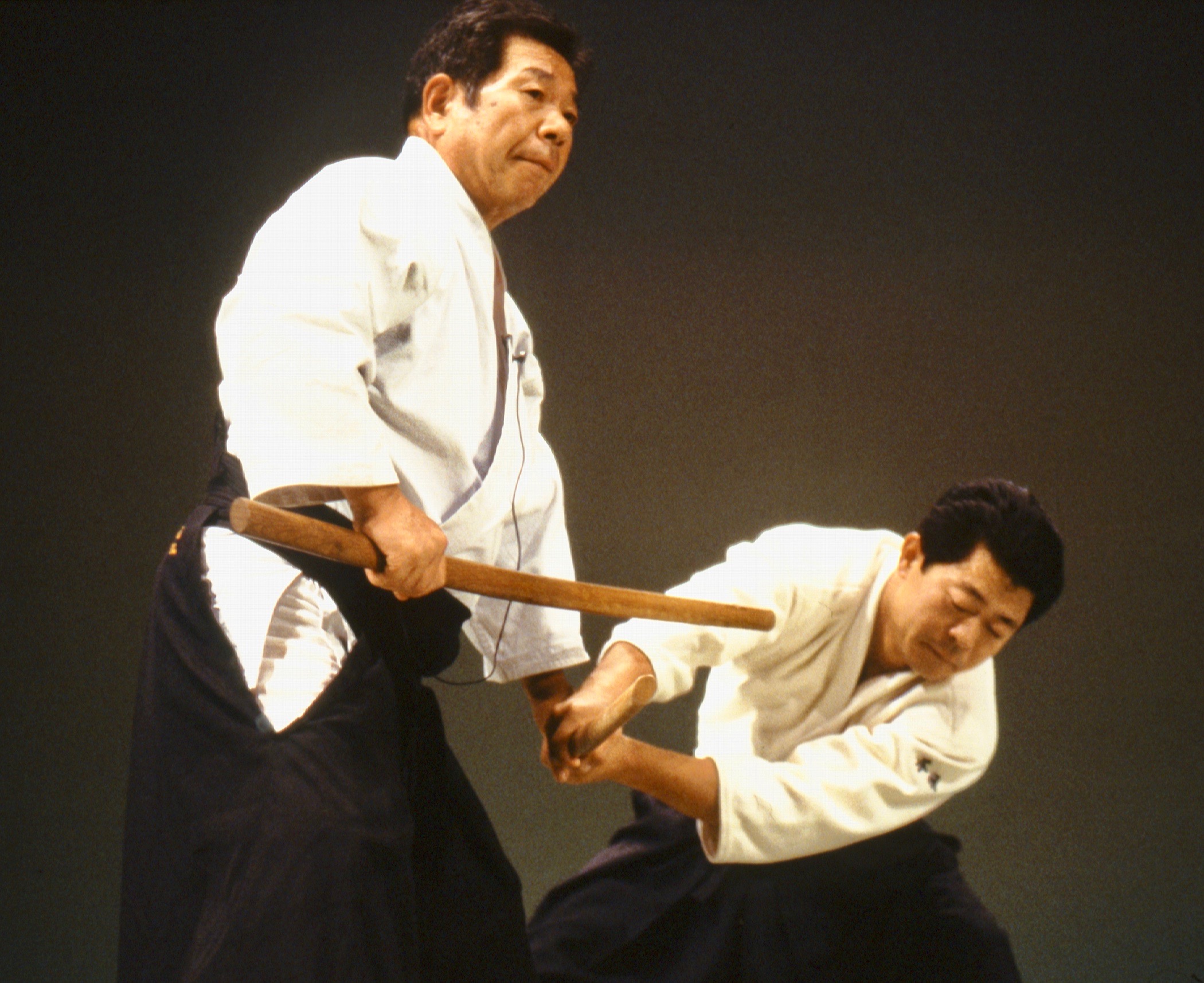
There are three aspects to staff arts.
1) Staff taking, staff throwing and illustrations of principles with the staff (the “jo trick,” for example). These are all Daito-ryu practices.
2) The solo jo form
3) Kumibo and kumijo forms — two person kata
Shirata Rinjiro stated to several long-term students that weapons training at the Kobukan was largely confined to sword and juken. It is unclear when Ueshiba really started to concentrate on practice with bo and jo, but it is most likely that he began to teach his students from the 1940’s. Once again, my suggestions for why he did so are speculative, but here goes. I do not subscribe to the romantic idea that Ueshiba, repelled by violence, eliminated practice of the juken and spear, and turned to the more humble staff, the weapon of monks rather than warriors. First of all, the staff was a prominent weapon in hundreds of martial traditions — it was not the weapon of the pacifist, (an oxymoron to be proud of, don’t you think?) At any rate, Ueshiba continued to use a short spear as well as a bokken in his own demonstrations — he never put aside training with lethal weaponry.
If we consider Ueshiba’s goals in his development of aikido, however, both the juken and the spear are weapons that offer a limited array of techniques, governed by the blade at the end. Other than a strike with the butt of the weapon, there are no blows, much less “cuts” with the juken. As for the long spear, Ueshiba used this weapon for his own study, but there are no accounts of him teaching it to any of his students. Both the bo and the jo, symmetrical, allow one to practice a greater range of techniques: thrusts with either end of the weapon, short clubbing blows, cutting and slashing techniques, whirling the weapon, which requires management of centrifugal force. Paradoxically, the simplest weapon offered the most possibility for variation and improvisation: from a few basics, any number of techniques and sequences can be created, the essence of Takemusu Aiki. As the reader will observe below, this is explicitly stated within the bojutsu scroll that Ueshiba presented to Hikitsuchi Michio.
What follows will not be an exhaustive survey of all the individuals doing aikido staff. An assiduous (pathologically obsessive-compulsive) researcher could devote half-a-life to making the rounds of the various weapons practices of Ueshiba’s senior students, analyzing the sequences and parameters of the weapons training, and hopefully delineating something of their provenance. I will merely discuss some exemplars.
Iwata Ikusai
Iwata Ikusai, recently deceased, was one of the last of the Kobukan disciples. There is, perhaps, some debate how close a student he was, but he apparently trained, off-and-on, over a span of almost a decade.
Iwata taught what quite possibly was the oldest remaining form of Ueshiba’s staff work — using bo rather than jo. I recall him displaying throwing techniques with a bo, and also a solo form. I do not know if he also had a kumibo practice within his curriculum. Iwata’s kata had its own “personality,” characteristics unique to him, but it was clearly part of the same method that we see Ueshiba doing. The thrusting techniques bear a very close resemblance to jukenjutsu — his posture was upright and he “snapped” the weapon into position with the back hand against the pectoral muscle. (I will mention this just once — to the best of my knowledge, neither he nor any other practitioner included the “fajin” that I have previously referred to. I would be delighted to find out that I am mistaken here, for this would be a still living repository of information I believe otherwise lost to the aikido world). I do not know if he learned aikibo in the 1930’s, or if he learned it later, upon his return from China, in the 1940’s.+++
Shirata Rinjiro
Shirata’s kumijo bears very clear relationship to that of Saito Morihiro. According to Stan Pranin, “Shirata Sensei liked Saito Sensei’s aikido very much, and would often participate as a student in Saito Sensei’s classes! I saw this personally on more than one occasion… . Shirata was heavily influenced in weapons practiced by Saito as well and I heard it from his own lips!” Aside from Shirata Sensei’s admirable humility, taking class with a man a decade junior to him in the hierarchy, what we have here is another example of using a form as a vessel to enclose principles. Shirata’s aikido was, in many ways, quite distinct from that of Saito — and this includes his weaponry. As stated elsewhere, he learned sword on an individual basis from Ueshiba. But although he may have learned principles of the use of long weapons (mostly juken), it is likely that his instruction in this area was far less detailed. Shirata evidently used Saito’s kumijo forms to contain his own understanding of application of aikido principles through the use of the staff.
The best way to consider Shirata’s jo practice is his “Misogi no Jo,” sets of solo movements that he chained into a long form. This was, I believe, an ongoing creation, reflecting his research regarding the expression of aikido with the staff, paralleled by his “Misogi no Ken,” a similar enterprise using the sword. Shirata held his body in more upright fashion than Saito, and he, like Iwata, used to thrust the weapon in the same manner as one thrusts a bayonet. Shirata would emphasize to his students that, at certain points in the form, the jo should be regarded/imagined as a spear (a stabbing weapon) at other times, a naginata (a slashing weapon), and at other moments, a staff (a thrusting/striking weapon). In other words, the jo was to exemplify universal principles using hand-held weaponry.
Shirata’s two-person kumijo forms, despite their “sequential debt” to Saito Morihiro are remarkable to me in their “flow,” from one position to another and their study of kuzushi (a domination of the other’s movement by perfect positioning of the weapon). From the moment of engagement, Shirata’s jo unbalances the other, either by threat or physical action — in either case, making it impossible for the other to regain postural stability.
Hikitsuchi Michio
Hikitsuchi engaged in intensive training with Ueshiba, centered on the sword. As I described elsewhere, Ueshiba’s aiki principles are contained in three forms he adapted from Yagyu Shinkage-ryu. Hikitsuchi trained extensively in jukenjutsu as a young man, and was very skilled in both iaido and kendo. Hikitsuchi recounts a midnight, lights-out training with Ueshiba, in which he broke off the tip of Osensei’s bokken. The piece flew off, and he searched throughout the dojo for it. Eventually, Ueshiba pulled it out of the folds of his kimono, praising him highly for his skill.*** Some months afterwards, Ueshiba gave Hikitsuchi a menkyo kaiden in bojutsu that were extensively illustrated by a famous artist, Ueshiba writing explanations for the techniques. As Meik Skoss, who has viewed the scroll, wrote, “One of the phrases on the scroll is very interesting, words to the effect that ‘each of these pictures is the seed for a hundred techniques; study them well.’”
This scroll was entitled, “Bojutsu Masakatsu Agatsu” — True Victor is Self-Victory. Clint George, one of Hikitsuchi’s closest students, told me that the “Shingu bojutsu” had five levels:
Ikkyo — a fundamental solo form
Nikyo — a solo form that explored circular movement
Sankyo — a solo form that explored three dimensional, spherical movement
Yonkyo —Jiyuwaza — free, un-choreographed movement
Gokyo — Misogi no bo — a form that included techniques from the previous sets as well as those which had ritual, spiritual significance
According to Clint, Hikitsuchi disliked two person forms that were “long and dragged out.” Rather than kumibo kata, he would show waza applications derived from the forms. Hikitsuchi was much more concerned with what he called, kigata — “energy form” — the ability to spontaneously change as needed within one’s movements. Further, he emphasized inryoku — a “magnetic” power of attraction. This is a form of kiaijutsu, in which one sets up the opponent so that they conform to one’s will — the opponent is drawn into certain actions and positions that put him, inadvertently, at a disadvantage. Hikitsuchi’s bojutsu also focused on precision and clarity of technique, and he demanded an awareness of one’s openings, unified body movement and a feeling that one was in a real duel.
Saito Morihiro
Saito’s weapons training is not only the most extensively studied, but also the most extensively discussed among aikiken and aikijo training regimens. Because of Meik Skoss’ recognition of movement sequences derived from Kashima Shinto-ryu within Saito’s kumitachi forms, there has been all sorts of speculation what martial system the kumijo forms might have been derived. Kobayashi Yasuo, whose weapons work, like that of most of the post-war Aikikai students, is primarily derived from that of Saito Morihiro, is quite instructive here. “ “The Iwama Dojo was located in a large garden-like compound which was needed to practice ken and jo. O Sensei would teach ken and jo however he felt inclined, and then the next day would do something completely different. It was owing to the genius of Saito Sensei that an easy to understand system of teaching jo and ken was established.”
To make it even clearer, Saito has stated exactly how and where these forms were created on one of the films released by Aikido Journal. He says, “I would like to explain the ten kumijo. Osensei bequeathed to us the thirty-one movement kata, and many other jo movements. However, I did not learn complete kumijo practices. He would teach me partial movements from time to time. I combined them into kumijo for demonstration purposes. I devised seven kumijo. Then, in 1983, I received the Budo Jo Hosho award, and I had to give a demonstration at the Budokan. Therefore, I devised an additional three kumijo — 8, 9 and 10 — and thus there are now a total of ten kumijo.”
And folks, there it is — search all you like, compare and contrast, making overlap pictures of Saito’s kumijo to place on photographs of one or another koryu kata, and you will come back to the same place. Saito Morihiro is the author of the kumijo forms, forms are the gold-standard among those created by other practitioners, and the root of most of the aikijo developed since. As I stated above, my list is not complete. My goal has been to discuss individuals whose own practice enables us to trace back to Ueshiba, rather than a magisterial discussion of all the developments of modern-day aikido weaponry since. It is likely that other prominent instructors, Tanaka Bansen, Kobayashi Hirokazu, and Takaoka Sadao, for example, also learned an individualized method of training from Ueshiba, and they, too, may have codified their own one and two-person sequences. Postwar students, too,have made their own systems of sword and stick — shihan of note are Nishio Shoji, who made a creative synthesis of aikido principals with Shindo Muso-ryu jo and Iaido, into a unique, sophisticated system of weapons practice, and Yamaguchi Seigo, who incorporated elements of an off-shoot of Kashima Shin-ryu - spear and sword - into his taijutsu. Among the younger deshi of the Aikikai, most owe a primary debt to Saito Morihiro. Kato Hiroshi is rather unique among his peers in his developement of ken and jo that are independent of Iwama style weapons practice.
I have put to rest two out of three aspects of aikijo: one third (jo/ken-tori and throwing with the weapon) is clearly from Daito-ryu, and one third (kumibo and kumijo) is various instructors’ adaptations of the solo forms and applications learned from Ueshiba on an individual basis. Which leaves a final piece — the solo form - something quite unusual in Japanese martial arts. I’ll be back.
+++HOMEWORK NOTE : It is likely that Iwata sensei’s dojo and “line” did not die with him. It would surely be worthwhile to seek out and ask his senior students questions about his bojutsu: When did he learn it? What salient characteristics differentiate it from other aikistaff work? How and in what context did he learn bojutsu from Ueshiba? Did he learn an actual form, or did he piece one together from separate techniques and sequences that he was taught? To underscore — he held, perhaps, the oldest surviving aikistaff method extant. For those who are interested in this history, is it not worthwhile to do some investigative work to find out what he learned?
*** The bokken was preserved at the Ueshiba family home in Tanabe. Interestingly, this bokken was given to Ueshiba by Okawa Shumei, someone I’ve written about in Dueling with Osensei in the chapter, “Tenchi: Head in the Clouds and Feet in the Muck.” That Ueshiba treasured this bokken throughout his life, given to him by a Class A war criminal who was the unscrupulous architect of the ideology which favored the imperialist “Strike South” to take over Southeast Asia and China puts paid to those who believe that Ueshiba became a pacifist, utterly opposed to the militarists who guided Japan into the 2nd World War.
Ellis Amdur — May 19th, 2006 (add comment)
Reader Comments
Ellis Amdur writes:
An additional comment - As I said above, my goal has been to discuss Takeda Sokaku and Ueshiba Morihei’s weapon’s work, and regarding the latter, I’ve tried to refer to teachers who might assist in tracing back what Ueshiba was doing. There are, of course, a number of teachers (or their surviving students) with other variants of weapons work. If you think it worthwhile to make a “data base” regarding them, I would recommend that you post it here, in the comments section. The followng information should be included:
1. When and under what circumstances the indivudal studied with Ueshiba (brief)
2. What is the curriculum of their aiki weapons work.
3. Any links to films of their practice
4. A brief exegesis, based on your questions to the instructor, as to the antecedents of the practice. Seriously, the whole idea of this set of articles was to eliminate speculation. Therefore, it is essential that you ask your instructor if s/he learned the art from Ueshiba (or, if their teacher did so), and if not, what are the components that were used to develop the practice
5. What they see as the goals of the training. What are they trying to develop?
But, please, do not post something like, “I think X sensei’s work is really intriguing. You (Ellis) or You (the collective readers) should check it out. He has real aiki - or He’s the only legitimate heir to Ueshiba, etc.”
Nico Poppelier writes:
I would like to point one senior instructor from the postwar period I find particularly interesting, namely Koichi Tohei sensei. For the sake of completeness I will add here that Tohei sensei was Director of the Aikikai and Head of the Aikikai Shihan Bucho (shihan group) until 1974, and received 10-dan from O-sensei in 1969 [Aikido Journal #107, p. 8-17].
In the seventies he published a programme of 30 series of aikido techniques, which he called ‘taigi’. Within the Ki no Kenkyukai this continues to be an important way of arranging the aikido techniques.
Ten of these series are weapon forms, i.e. for tanto, bokken or jo. To be complete: tanto tori (1 series), jo nage (1), jo tori (1), bokken tori (1), jo solo (2), bokken solo (3), kumitachi (1). These ten series are also mandatory part of the examination criteria: 3 for shodan, 6 for nidan, and all of them for sandan. It is obvious that within the Ki no Kenkyukai weapons practice is considered to be an important part of aikido training!
The two solo forms with jo can each be used as one half of a jo versus bokken kata, and the second solo form with bokken can be used as one half of a kumitachi. Tohei sensei never formalized these partner forms, but his former uchi deshi Kenjiro Yoshigasaki sensei added them to the programme for the European dojos.
There are also bokken suburi, which Tohei sensei taught to his student Shinichi Suzuki sensei. These are not part of the official Ki no Kenkyukai curriculum and are mainly taught on Hawaii.
Tohei sensei can be seen demonstrating with the jo in the video clip from the film shot in Florida in 1967, which you will find in the AJ archives.
Considering the position of Tohei sensei in the Aikikai until 1974, and the fact that he already was an established teacher when Morihiro Saito started, it is unlikely that Tohei sensei derived much from Saito sensei (thanks to Ellis Amdur for pointing this out). My hypothesis is that Tohei sensei developed the weapons taigi on his own, based on careful observation of his own teacher, Morihei Ueshiba.