Aikido Journal Home » Aiki Blog Aiki News Japan

A Unified Field Theory — Aiki and Weapons — Il Crepuscolo degli dei

This article should now be considered a work-in-progress, of interest both for the discussion it engendered as well as presenting an earlier perspective on my work. I have radically revised this essay in my new book, HIDDEN IN PLAIN SIGHT. Some of the conclusions I have reached are somewhat at variance to what you will find here. Those interested in the book can find it at www.edgework.info/buy.html

Part VIII — The Solo Jo Form

An ongoing topic of discussion among those curious about the antecedents of Ueshiba’s weapons technique is the possibility that he may have studied Kukishin-ryu (properly called Kukishinden Tenshin Hyoho), a martial art associated with the Kuki family, holders of a lineage of Ko-Shinto (archaic Shinto).

Shinto is not a monolithic religion. There are different lines, and some have heterodox texts, held within their own group, that are at variance with that of the mainstream. One of the oldest is that of the Kuki family, who are associated not only with archaic Shinto, but also with Kumano Honzan Shugendo.****

The Kuki family was also associated with martial practices — specifically, the Kukishin-ryu (primarily a weapons art), and the Takagi Yoshin-ryu (primarily a taijutsu art, although it includes a lot of practice with weaponry). These two ryu were taught in conjunction and exerted some mutual influence upon each other.

At some pointing the past, the Kuki family themselves largely abandoned the practice of martial arts, focusing almost entirely upon their spiritual practices. However, the ryu continued to be practiced throughout history, and continues to the present day. Among of the most significant 20th century instructors of the Kuki family arts were Ishitani Matsutaro, Takamatsu Toshitsugu, and Iwami Nangaku. This resulted in several intertwined “lines” of Kuki family arts (each with a slightly different name), that of Takamatsu becoming the most prominent due to his late-life mentoring of Hatsumi Masaaki, of Bujinkan fame.

According to the archives of the Kuki family, Ueshiba Morihei went to Tokyo on a journey from Ayabe, and during a visit at Asakusa-Kannon, he saw two men (named Saito and Goto) practicing “wonderful swordplay.” Told that it was the martial art of the Kuki family, they claim that he asked to become a student, the three of them practicing “in the corner of the temple for some period.”

My inquiries to sources within the ryu suggest that this was probably a matter of days rather than years or even months. They believe that his training may have been an extensive “run-through” of the compendium of techniques and kata of both Takagi Yoshin-ryu and Kukishinden Tenshin Hyoho. It is highly unlikely that any person, even Ueshiba, would remember many forms or details of a ryu presented in this manner. But were they truly open in their explanations, Ueshiba might have been able to “steal” the essential character (gokui) of what he had been shown.

• Sugino Yoshio, as cited in Part IV, describes Ueshiba as having an almost uncanny ability to do just that — to discern from a single viewing what the essential character of a ryu’s kata. “He understood everything that was being done, even if he was watching from a distance.”

• Ueshiba Kisshomaru described how his father would make something his own, taking the Kashima Shinto-ryu kata he had observed his son and several deshi practicing, and after the instructors left, reworking the kata, saying, “in ‘Aiki,’ we should do it this or that way.”

At any rate, it sounds to me like Ueshiba cross-trained with these men, and they found him interesting enough to give him some real data. But in hyperbole not uncommon in Japan, they thereafter made him a “student” rather than a guest/training partner.

On the other hand, he may have continued his training, intermittently, at later periods of time. The Kuki family had extensive land holdings in the Ayabe area, and therefore, it is conceivable that he either continued his training back in Ayabe, or his “discovery” of the practitioners in Tokyo was due to an already existing connection he’d established in his hometown. Unfortunately, further historical research as to exactly what Ueshiba might have studied is likely to prove difficult. The archives of the Kuki family are reportedly huge, and martial arts references, currently not an interest of the family, are merely mentioned in passing.

However, according to the Kuki website, the archives also note that Ueshiba later sought out Kuki Takaharu, the head of the family at an Omoto dojo in Tokyo, at the end of Taisho or beginning of Showa (the mid 1920’s). According to these archives, Ueshiba stated to Kuki Takaharu, “My budo is that of Kukishinden,” going on to say that he owned some scrolls of the ryu, and worshiped Ushitora-no-Kimonkonjin, a deity also worshiped by the Kuki family. “At their first meeting, Morihei and Sir.Takaharu became on friendly terms with each other. They established Takemusu Aikido, to be exact, Amenomurakumo Samuhara Aikido, which is the archetype of Aikido today.”

This passage deserves a little commentary. Please recall Kano Jigoro’s statement upon viewing Ueshiba’ aikido, “This is my ideal budo.” This kind of praise really means, “You guys are so good you are just like me,” or, “You are accomplishing what I am trying to accomplish,” rather than “All I do is inferior to you.” Ueshiba is, in an imagistic way, noting a much more fundamental connection than technique or kata between the Kukishinden and himself - that both his own study and that of the Kuki family used budo as a medium for invocation to and connection with divinity.

Kuki Takaharu later became the “honorary chief priest” of the “Aiki Shrine” in Iwama, presenting the shrine with treasures associated with the Kuki’s sect of Shinto. Given that this is not noted as a significant event in standard aikido history, it is unclear if this is something later obscured for political reasons, or if such a designation was a) shared by many dignitaries and/or b) the equivalent of an honorary doctorate for a politician at a college graduation.

There is no doubt, however, that his relationship with the Kuki family was important to Ueshiba. He frequently visited Kuki’s residence in Kobe and taught at a dojo owned by the Kuki family. According to Abe Seiseki, who wrote the dojo signboard (Amenotakemusu Aikijuku Takamikura Dojo), Ueshiba taught aikido there, not Takagi Yoshin-ryu or Kukishinden-ryu. Abe Seiseki recalls this dojo well. The Kitano high school, where he used to teach, used to hold their gasshuku there — the dojo had cooking and sleeping facilities and was located right on a mountainside (hillside), so that one could climb right to the top, ideal for misogi.

The Kuki family was of the nobility (hence the reference to “Sir Kuki” in the quotes from their own website). They were also rich, with a lot of holdings in the aluminum industry. Abe mentioned to my informant, in passing, that this was why Ueshiba began to have dealings with them, because “he was always looking for wealthy patrons.” To be clear, this was not a minimization of their relationship — Japanese martial artists strove to have at least one or more patrons, from daimyo in the feudal period, to rich executives today. It would be all that much better that his patron were someone who actually shared the same spiritual interests.

I would like to raise one final point. Ueshiba withdrew from both of his main teachers, Takeda and Deguchi, in the 1930’s. The stories have been told elsewhere in considerable detail, but suffice it to say that he left Osaka upon word that Takeda had arrived, thereby ceding the Asahi Shinbun Dojo to him. In the case of Deguchi, the entire sect was swept up by the Kempetai in the mid-1930’s, Ueshiba alone among the significant members of the Omotokyo avoiding arrest through the intercession of patrons in the police and political establishment. He kept his distance from the sect afterwards, although he certainly remained a devotee of Omotokyo - notwithstanding that he later took his spiritual practices in some avenues beyond “orthodox” Omoto. Some partisans of both Daito-ryu and Omotokyo have viewed him as both a coward and a traitor in each of these incidents. But consider things from Ueshiba’s perspective. He was a man in the full flower of manhood, very unconventional in many respects, but still bound, nonetheless, by almost feudal rules regarding the relationship between teacher and student. Takeda was not, as some have portrayed him, the devil incarnate, but he was a nasty, demanding, disagreeable old man. Any time the two of them were in the same room, Takeda would expect, and his culture would support, absolute obsequious attendance by Ueshiba. Deguchi was even more problematic — a grandiose, messianic rascal, who got Ueshiba almost killed in Mongolia, and now, thanks to his unsuccessful machinations with the far right in Japan, was manipulated in turn, committing what was viewed as lese majeste. In short, one teacher, a grouchy, paranoid old man, kept popping up, expecting to take over and be taken care of, ridiculing Ueshiba in the process, and the other, an inflated half-charlatan, half-holy man, who delighted in molesting the maids by poking his august member through the shoji screens. Takeda might have become burdensome and unpleasant, but Deguchi could get one imprisoned, if not killed. And if Ueshiba no longer fully shared Deguchi’s ever-changing vision of Utopia, no wonder that he might have decided that he didn’t want to go to jail merely because his guru wouldn’t keep his mouth shut. It was around this time that Ueshiba began cultivating a circle of friends in the martial arts world, men and women who treated him as an equal — as a man. Similarly, he began making connections with spiritual figures, such as Goi Masahisa and Kuki Takaharu, men with whom he could discuss and share their similar explorations without becoming embroiled in shenanigans concerning either the government or the maids. Rather than cowardice or moral failing, the man might have just wanted some room to breathe!

At any rate, Ueshiba did have a several decade long connection with Kukishin-ryu. There is no doubt that this connection existed regarding reijutsu (spiritual matters), but did it, in fact, apply to bujutsu as well? Did Ueshiba learn anything significant on the grounds of Asakusa-Kannon? On his visits to the Kuki family or later at the Kobe dojo, did he also visit with shihan of the martial ryu? Although Abe Seiseki was very circumspect, I was informed that he did seem to suggest that Ueshiba might have had contact with Kukishinden martial artists during such visits. Finally, Takamatsu Toshitsugu is reported to have demonstrated martial arts during one of the exhibitions in Manchuria that Ueshiba also demonstrated. Although Okumura Shigenobu, who accompanied Ueshiba, mentioned nothing about a meeting between the two, did Ueshiba use the opportunity to compare notes and techniques with him? Did any of these contacts, if they, in fact, happened, have the slightest influence upon his own martial art? In sum, there is a lot of smoke, but is there any fire?

I recently viewed a DVD that contained bojutsu (staff arts), sojutsu (spear arts) and kenjutsu (sword arts) from the main line of Kukishin-ryu. I’ve also seen videotape of a very old Takamatsu Toshitsugu teaching a very young and then unskilled Hatsumi Masaaki. This is a very powerful ryu! The spear, used against a sword, was particularly robust. However, it is categorically different from any aikido-related stave work that I’ve seen. Furthermore, it is, with its simple direct movements, without the coiling power generation I’ve previously described in my discussion of Hozoin-ryu sojutsu. I must add one exception — the spearman uses the back leg to kick/sweep forward, loading the weight on the forward foot as he thrusts, and then, almost leaping backwards off of the foot, to pull the weapon back to center. One can see this, in far more mannered form, in many aikijo kata. However, this movement is not uncommon — it is a trademark of Toda-ha Buko-ryu naginatajutsu as well. Ueshiba could easily have seen this move in any demonstration and added it to his repertoire, without any requirement of a formal study of Kukishin-ryu.

The bojutsu and kenjutsu are both quite strong as well; concise brawny forms which differ from aikido not only in timing and biomechanics, but in technique as well. In short, on simply viewing the dual kata, it’s hard to see any influence upon from Kukishin-ryu upon Ueshiba’s aikido, even if he met with them on a daily basis!

At my request, several shihan of the Kukishin-ryu were shown a compendium film of Ueshiba doing various weapons forms and taijutsu. They observed, particularly in the later years, what they felt were some similarities in Ueshiba’s sword work with their own, and even more, his nuboko (short spear) with their stave methods. However, they stated that it was a matter of the underpinnings (nuances) in the movements, not specific techniques. Whatever influence there is, then, it seems rather vague, because, as I have written in previous blogs, one can see kendo, Kashima Shinto-ryu and Yagyu Shinkage-ryu in his technique as well, and in more definitive ways.

However, Kukishin-ryu also has, unusual in Japanese martial arts, a solo bo form. This form is used in Shinto rituals as harai — sweeping away malignant influences. This form exhibits what I consider the typical brawny techniques of the ryu — it is linear, strong and forceful. In terms of bio-mechanical organization, its techniques are done quite differently from those we see in Ueshiba’s aikijo. However, some of the techniques, even though executed quite differently, are remarkably similar. In particular, the combination of a drop to one knee with a thrust of the butt end of the stave is common to both.

It is my opinion that there are some very good reasons to believe that Ueshiba may have derived his solo staff form from the Kukishin-ryu solo staff. First of all, there is the “smoke” - such rumors about Kukishin-ryu stave’s relation to aikido has been around for years. Secondly, as I stated above, there are several rather unique techniques that are shared by both. Third, this is a ryu with which he had some connection, that, quite unusually, had a solo form that performed a spiritual function quite in congruence with his own. Finally, in reviewing Ueshiba’s training and teaching history, he always found a way to covertly pay homage to the various supplemental trainings to which he owes the greatest debt — for example, using Yagyu Shinkage-ryu forms at Shingu to encase his sword instruction to Hikitsuchi Morio. I don’t think too much should be made of this speculative connection, however, which is even more tenuous than that of Kashima Shinto-ryu and Iwama sword, or Yagyu Shinkage-ryu and the swordwork of the Shingu dojo. I think that he might have been inspired by Kukishin-ryu “harai bo” to develop something of his own, borrowing some viable techniques from the kata in the process. From that, like everything else he did, he made it aiki.

But what he did with the idea! I have recently watched his solo form on film a number of times, and I’ve compared it to that I’ve seen done by different factions of aikido. All of his successors seem to lack what is important within Ueshiba’s own execution of the “form.” They either move as if the idea of the practice is mere fluidity; or swing the staff with their arms, isolated from the body or ground, as if the gods respond to waving; or crunch down muscularly, as if all Ueshiba had to offer was “a little more of the same.”

More and more, I believe that this form was absolutely central to Ueshiba Morihei’s personal training, something that comes out most clearly in the film of his visit to Hawaii. This starts with his ritual with the Shinto implement, with the many pieces of folded paper symbolizing lightning, where he whirls it, using waist and body, as if a rooted tree in the center of a tornado, and then he raises up and drops his entire body weight as if on an elevator that suddenly loses and regains its brakes in a moment. Then he goes on to the staff, and he repeats movements over and over again, as if to say, “Do you see it? I’ll do it again. Do you see it this time?” He includes the same whirling rise of the staff, then repeats one thrust or strike over and over, sometimes chaining several moves together, then repeating, then taking a new avenue. The more formal kata Ueshiba does in some films is merely something to hang his practice on, a chaining together of what he believed to be important, like pearls on a string. But in Hawaii, rather than a form, he is displaying his own personal practice method. The expression of whole body power is stunning to me, upwards and downwards, and coiling in lateral movements, something I discussed in a previous piece as exemplifying fajin, a rooted detonation of physical force directed in one or another direction, the body “snapping” from relaxation to contained explosion. Whether his use of a solo form was derived, in fact, from an idea he got observing Chinese martial arts, from Kukishin-ryu or some other source is, ultimately, irrelevant, because he made it completely his own. Without the concern of hurting an uke, either empty handed or in paired weapons practice, Ueshiba is free to let out all of his power. In that film in Hawaii, on foreign ground, he displays his own personal practice - the distilled essence of a lifetime of training, showing everything he knew. Not even “hidden in plain sight.” Right out in the open.

With all this talk over the years about aikido being the reconciliation of mankind, peace on earth and all the rest, what did Ueshiba truly have to offer other than what he really possessed - not more spiritual lessons of which the world is is uselessly glutted, but acts. What more “loving” act could he have expressed than when, invited to another land, a country against whom his was so recently at war, he openly presented everything he knew. And we, all of us, Japanese and foreigner alike, let it slip right through our fingers, thinking all he was doing was waving a stick.

**** http://www.shinjin.co.jp/kuki/hyoho/index_e.html

www.ellisamdur.com

Ellis Amdur — October 1st, 2006 (add comment)

Reader Comments

Jem Wilson writes:

What a wonderful article. The perspective on how Ueshiba handled his two mentors was interesting; he really did practice what he preached - and regarding practice; the last few sentences remind me to watch more closely since such important demonstrations may be happening more frequently than we realize. Ueshiba is a wonderful example for all Budoka, however, are there lesser known figures who have attained similar insight and ability - and what type of cross training (staves? swords?) was relevant for them? Thanks.

Allen Beebe writes:

Dear Ellis,

Thank you again for another thoughtful article. I’m certain that I’m not alone in appreciating the effort you must have extended to complete your research. Obviously this piece was a product of extended time, multiple contacts, and personal effort. It is a shame that within a day it was five articles down. At a time when the historical antecedents of Aikido are becoming ever more difficult to accurately discern, it is refreshing to have new factual information brought to light.

Sincerely,

Allen Beebe

Stanley Pranin writes:

Ellis’ fine article has indeed scrolled down the page because of the way our front page is set up. To easily retrieve this and his other articles, find the heading on the right titled “Featured Authors” and click on “Ellis Amdur.” His latest blog will immediately appear as the link on top followed by his earlier articles in descending order. Please take a few moments to learn how our interface is set up and you’ll be able to find things easily.

Allen Beebe writes:

Hi Stan,

If it weren’t for your A.J. efforts Ellis’s article might not have been publicly available at all, not to mention that much of his research is predicated upon your publicly shared findings. My concern was that the casual observer might not know that Ellis’s article was newly posted if they hadn’t seen the board at the right time or if they didn’t periodically check specifically for it. This is a technical problem, which I can appreciate since I run a (much) smaller private forum myself. My concern was for the individuals that inadvertently and regrettably miss the chance to read Ellis’s work.

It is due to the new bits of information, as exemplified in Ellis’s latest post, and the plethora of accurate older information available within A.J., that I have been a supporter of your publications since their inception. Please accept my continued appreciation.

Allen Beebe

Stanley Pranin writes:

Allen,

Thank you very much for the kind words. There is one other way the readers are notified of Ellis’ new articles and a great deal of other news and that is via our free, daily email newsletters. The signup form appears on the right of this page beneath the Japanese flag link for those who are interested.

In that we have over 7,000 pages of material hosted on this website, it is a continuing challenge to provide ready access to everything in an easily understood way. We hope that readers will make a little effort to familiarize themselves with the site layout so that they can find whatever interests them.

Gambatte Ellis!

Mike Sigman writes:

“More and more, I believe that this form was absolutely central to Ueshiba Morihei’s personal training, something that comes out most clearly in the film of his visit to Hawaii. This starts with his ritual with the Shinto implement, with the many pieces of folded paper symbolizing lightning, where he whirls it, using waist and body, as if a rooted tree in the center of a tornado, and then he raises up and drops his entire body weight as if on an elevator that suddenly loses and regains its brakes in a moment. Then he goes on to the staff, and he repeats movements over and over again, as if to say, “Do you see it? I’ll do it again. Do you see it this time?” He includes the same whirling rise of the staff, then repeats one thrust or strike over and over, sometimes chaining several moves together, then repeating, then taking a new avenue.”

Ellis, I’ve noticed that he did this as part of a ritual of some sort, but I always assumed he was signifying the union of the Ki of Earth and the Ki of Heaven, while moving the staff (or whatever) in an obvious “whole body” way.

Because it was overtly a ritual with the “Ki of Heaven” and “Ki of Earth” part of it being fairly blatant, I didn’t look much deeper. Good point, though. I had just assumed it was something probably impossible to pin down, but probably derived from Deguchi’s stuff.

My 1 cent, FWIW.

Mike Sigman

Robert H Cowham writes:

Great article (and series) Ellis.

Any references to the Hawaii video - is it commercially available?

Regards

Robert

Ellis Amdur writes:

The “Hawaii” video is part of the Aikido Journal series. As I have it on an old video as opposed to the DVD, I don’t know where it is on the series now.

By the way, a menkyo kaiden in musicology to the first person who translates “Il Crepuscolo degli dei”

Nev writes:

It’s meaning: The Twilight Of The Gods, (From the fourth and final part of Wagner’s Tetralogy: In Italian it is: Il Crepuscolo Degli Dei; in German: Götoterdammerung)- but I’m considered tone deaf when I attempt to sing so can not in fairness accept the honour. Apropos title for a brilliant article which brings up many questions though and a reminder there will always be another Alba, and as the opera goes Al Alba Vincero. Hmm.. why wait?

Ellis Amdur writes:

A little additional comment is in order. I just had a fine afternoon trading stories and information with Fred Little. Part one of what follows is his observation, part two is mine.

1. As some may know, Ueshiba saw himself as imbued by the kami Susano-o, the “wind god,” who was a combination of a trickster and Prometheus. Rather than cite a particular myth twice, I’ll paraphrase/quote Fred here. “When Ueshiba was doing the upward and downward spirals in his jo form, that upward thrust is like a tornado spirally up into heaven, like Susano-o using his spear to stab the repository of all the rice, hoarded by Heaven, and then the downward expanding spiral as we spreads it over the world. I don’t think he was emulating this - he was, at that moment, Susano-o.”

2. I think there is no doubt that Ueshiba practiced a kind of voodun - spirit possession. In Shingon mikkyo, one meditates on the image of a Buddha/diety, one takes it into oneself, one places it outside oneself - all with the goal of controlling the mind that manages that experience and images AND to see through to the emptiness of even this kind of phenomena - that divinity, even the Buddha, is a product of mind. However, Ueshiba’s later practice was Chinkon-kishin, which is, Shingon in reverse. One creates and BECOMES the deity. Note the story by Takahashi Mariye, describing Ueshiba calling up/dealing with an unruly diety. Some readers may roll their eyes, thinking this some sort of mountebank show. I don’t agree. Ueshiba was profoundly religious. I do think that the spiritual practice he inherited from Deguchi, where one is, in a sense, taken possession by the god or becomes them (is “ridden” as is said in Haiti), lends itself to grandiosity.

That commentary aside, I am very curious - though surely I will never have it answered - about what the rest of the jo form meant to Ueshiba, aside from the martial acts and internal training I’ve previously described. What symbolic import - what myth was he embodying after his liberation of the bounty of Heaven and spreading it all over the earth? Was he righteously “slaying” injustice or obstructions that would impede the unification of Heaven and Earth through man, or was he purifying himself internally - the internal training/shaking/etc., a kind of misogi that had a corollary of making him yet stronger?

Thomas Campbell writes:

Ellis,

About midway through this video clip,

http://www.aikidojournal.com/download_media.php?media=video&id=15 ,

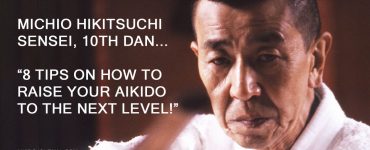
Hikitsuchi does a very brief solo performance with staff that that seems to resemble your description of Ueshiba Morihei’s performance with the staff on his visit to Hawaii.

I don’t know if there is enough on the clip to really evaluate, but to your eye, does Hikitsuchi show the kind of connection and fajin that you see in Ueshiba’s performance?

Ellis Amdur writes:

Tom - I’m sorry I missed this question. My apologies to you. I never felt Hikitsuchi sensei, so I may well be missing something profound. Several of his students (Anno and Tojima, in particular) are said to be absolutely brilliant - far better than their teacher, in some informed people’s opinions, but again this is not something I’ve experienced.

But in reference to your question, no, I do not see Hikitsuchi there - nor did I when I observed him first-hand doing his bo form - evidence any of the fajing or connection that I believe I see with Ueshiba. All this is my opinion - all of it may be wrong, but that’s what I believe I see.