The Spirit of Aikido: Learning, Feeling, and Transmitting the Essence (Part 3)
The following article is a partial English translation of the column entitled “The Spirit of Aikido: Learning, Feeling, and Transmitting the Essence (Part 3)” which appeared in Japanese in Aikido Journal’s sister publication, Dou published in the Summer of 2005. Additional footnotes have been added by the author for its English publication.
The excerpts below are taken from Sunadomari Sensei’s instruction at the 352nd Yudansha Exchange Seminar held on February 20, 2005 in Kumamoto City, Japan.
On Aikido’s basic technique
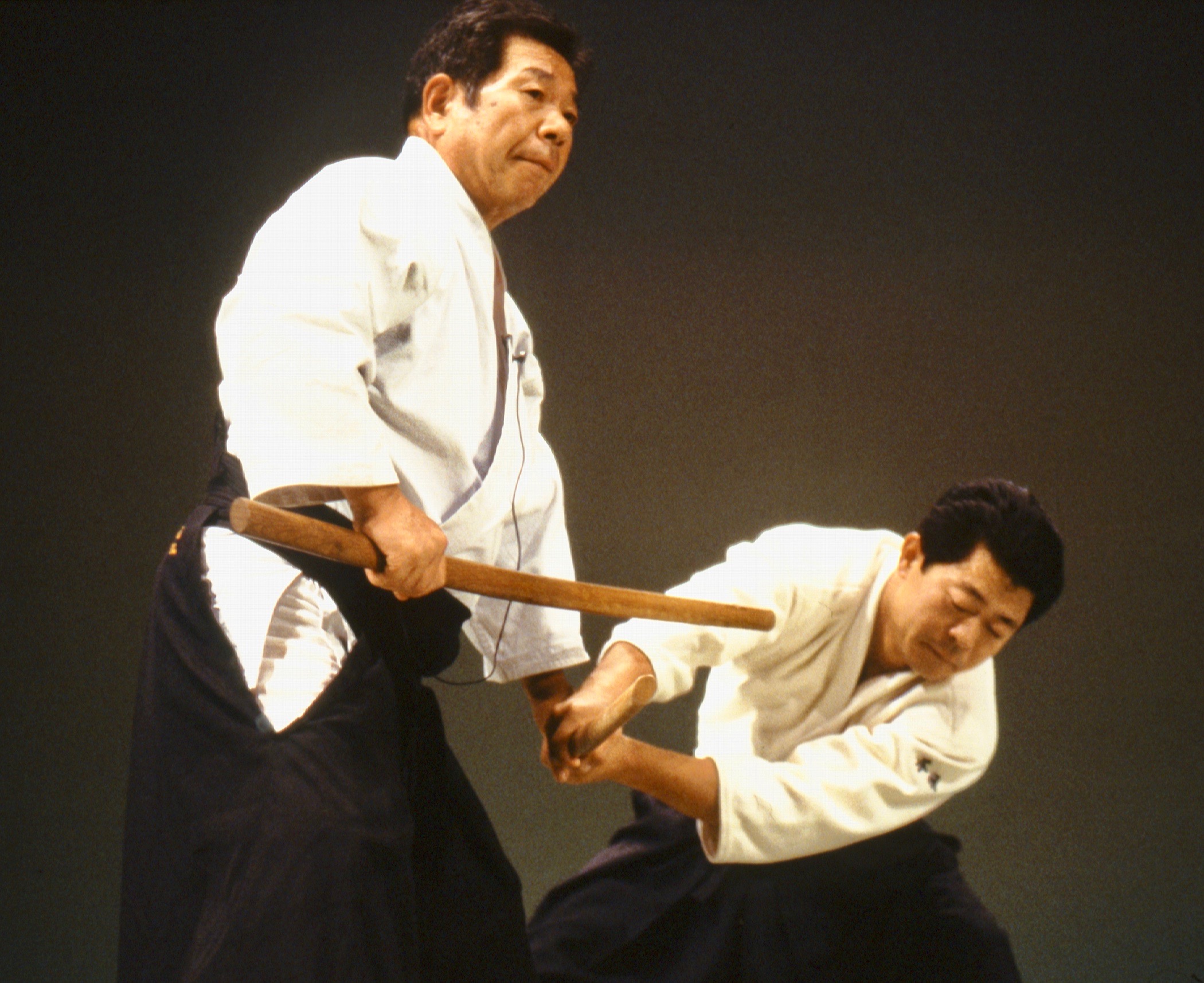
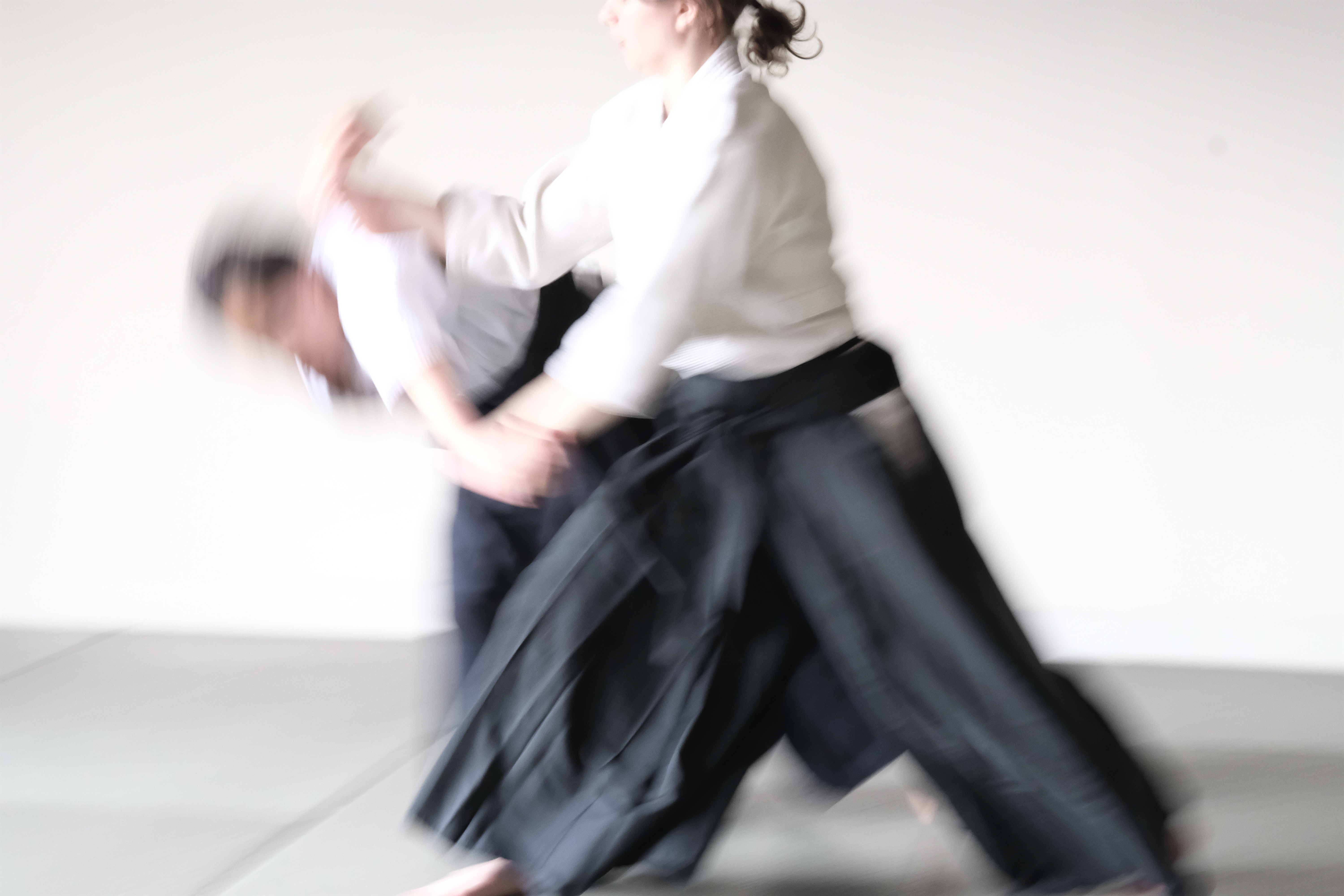
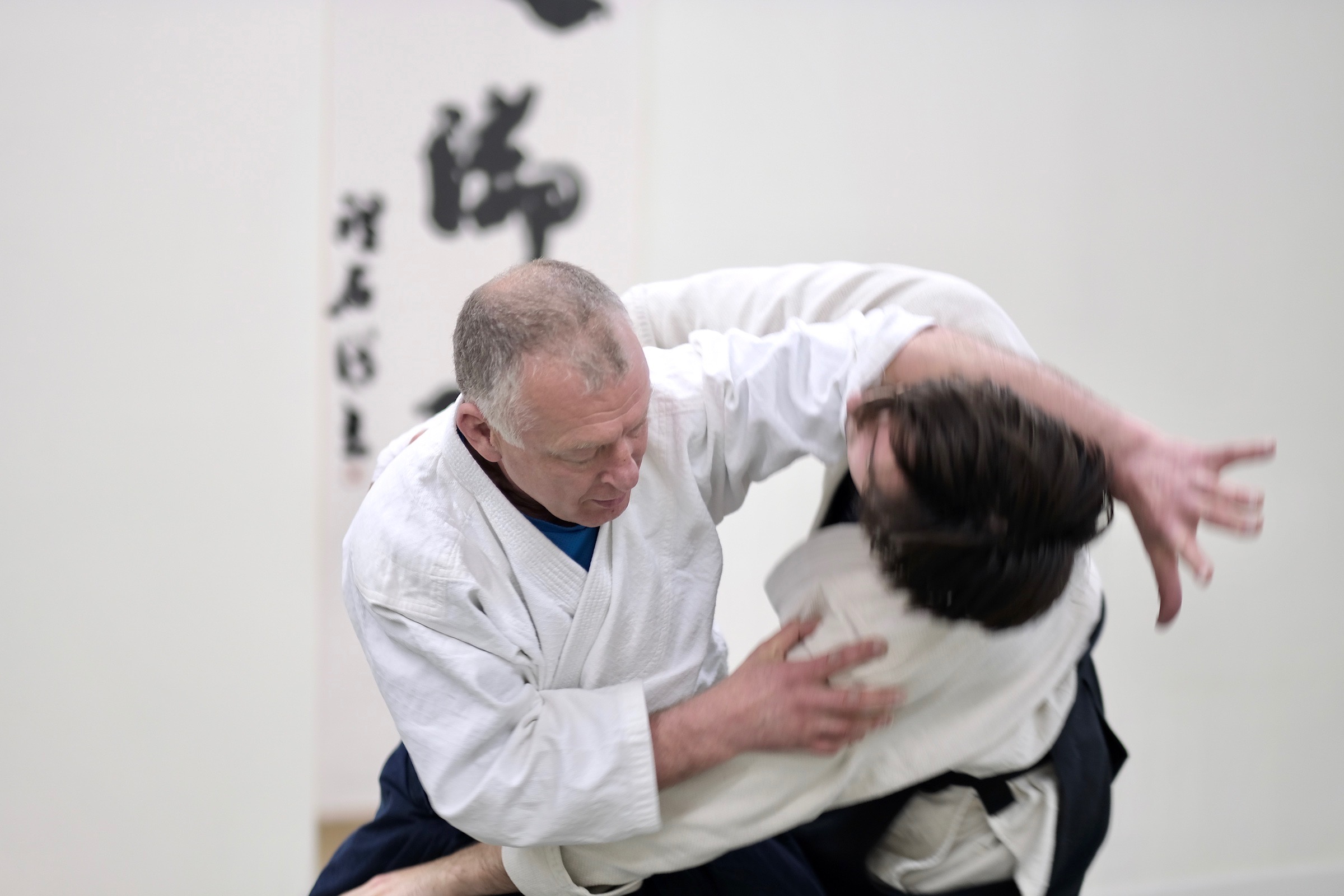
The Founder clearly stated that basic technique, Ikkajo through Yonkajo, is kasu tori*(which refers to the extraction of the pulp-like sediment that is a by-product of the production of Japanese alcohol, e.g. shochu, sake, etc.). In other words, through the performance of basic techniques we remove the sediment or residue (by removing the tension) built up in our partner’s joints. Therefore, (contrary to popular belief) these techniques are not techniques for the purpose of knocking down others. I heard the Founder say this and use the term “kasutori” only once, but now upon reflection I realize that I was lucky to have had the opportunity to hear this(see footnote A). The practice of the basic technique is an excellent means to maintain good health and should be performed in this spirit. In practice, there is a tendency to perform these techniques (ikkajyo, nikkajyo, etc.) with both uke and nage using physical strength. However, it is best to practice these techniques letting go of physical power and with the intended purpose of softening the joints (see footnote B). When taking ukemi for basic technique as well, you should not fight your partner but rather perform ukemi with the feeling of leading him. Uke should not take ukemi because he is being pushed or forced, instead uke should do so by first inviting and leading. When taking ukemi, if you entrust yourself completely to the movement of your partner, even the slightest bit of unnatural use of physical strength on the part of nage part.will effectively send him flying instead.
Entrusting yourself to your partner
(When being grabbed) performing technique by “entrusting yourself to your partner” does not mean going completely limp. Going limp is completely different. If you go completely limp you will be defeated. Yet, if you use physical strength to resist physical strength, conflict arises. (Entrusting yourself) is about sensitivity and feeling. If you are stiff and use physical strength, the moment that your attacker makes contact you cannot determine where his strength lies. However, if you entrust yourself completely to him at the moment of contact, you can determine his strongest point. His strongest point is where he is the most weak. You can easily move him by directly connecting at the point at which he is holding his strength. Once you are able to do so you can take your partner’s balance with even the subtlest of movement when he has gripped you with all of his strength.
Elevating our soul through the practice of physical technique
Physical technique is a means by which we elevate our soul. In common, everyday thinking, the word tenkamuteki (which the Founder used when speaking with me privately during my teens) refers to being “invincible” or being of such incredible strength that you have no contenders. However, (I interpret) the Founder’s use of this word “tenkamuteki” to mean that we have no enemies under heaven. If you harbor animosity toward someone, he or she can feel it. By constantly training the techniques of Aikido in the spirit of harmonizing with your partner and extinguishing the animosity in your heart, you will eventually reach a point that you are able to feel within yourself that “enemies” do not exist. The Founder was a person of unparalleled physical strength, yet he became enlightened to this truth. The fact that a person who possessed such tremendous strength as the Founder came to spread such a teaching is really quite magnificent.
Footnote A: During a previous seminar, Sunadomari Sensei mentioned that he heard the Founder use the term “kasutori” to describe basic technique only once during a special training session with the Founder that he traveled to attend in Tokyo in the mid-1950’s.
Footnote B: Sunadomari Sensei continually stresses the correct use of the physical practice of basic kime-waza techniques as a type of massage to help soften our partner’s joints and improve his/her health. During a recent seminar (after this article was published) Sunadomari Sensei further explained that the purpose of the pins which finish basic kime-waza techniques should also be to purify our partner’s hearts. He stressed that these techniques should be performed with the feeling and intention of removing the contamination built up in our partner’s heart as well as his or her physical body.
Reflections on the seminar
At this seminar, I was really struck listening to Sunadomari Sensei’s lecture and interpretations of what he received from the Founder. It occurred to me that as our life experience increases and as we grow and develop as a person, the teachings that that we have received from our teachers tend to reveal new and deeper meanings over time. In this regard, I will endeavor to always keep the teachings that I have received in top of heart and mind as I continue my practice on this path.
The preceding blog entry was submitted by one of our readers. If you would like to submit your own entry, please click here. Be sure to read over the rules and guidelines before submission.
Dennis Clark — March 20th, 2007 (add comment)
Reader Comments
Peter Chow writes:
Excellent article. Sunadomari Sensei was one the very few who truly understand O Sensei’s teaching. Please read his book, it is a bit hard to understand at the beginning. Once you read it a few times, its meaning will become clear.
Ellis Amdur writes:
Perhaps some readers will recall a piece that I wrote - and cannot find - among the blogs, entitled “A Riddle and a Mission.” Kobayashi Yasuo mentioned a special training in the mid-1950’s attended by the uchi-deshi as well as by the leading instructors of aikido. I urged people studying with surviving individuals who might have attended this training to inquire of their teachers what Osensei had taught, because this was the last time he assembled all his “rival” senior students in one place. In a sense, this was his legacy. What, I asked, did he teach? Here, Sudanomari sensei states that “During a previous seminar, Sunadomari Sensei mentioned that he heard the Founder use the term “kasutori” to describe basic technique only once during a special training session with the Founder that he traveled to attend in Tokyo in the mid-1950’s.” and further, “the Founder clearly stated that basic technique, Ikkajo through Yonkajo, is kasu tori*(which refers to the extraction of the pulp-like sediment that is a by-product of the production of Japanese alcohol, e.g. shochu, sake, etc.). In other words, through the performance of basic techniques we remove the sediment or residue (by removing the tension) built up in our partner’s joints.” This is identical to a passage I cited in “Aikido is Three Peaches” in Osensei’s interviews for the Byakko-kai. Sudanomari Sensei’s exposition further substantiates the point that tori is, in a sense, uke, and that UKE receives the technique through both leading tori, and develops an ability to receive and counter within one’s own body - (true ukemi) - through relaxation.
In this brief passage, we have some substantiation of a lot that has been asserted, both here and on Aikiweb, on what Osensei really was doing, and desired to pass on.
I strongly urge the writer of this piece to inquire as specifically as possible what Osensei taught during that special 1950’s seminar - I truly believe this might have been, in a way, his last testament of direct leadership of the art before handing its direction over to his son. In essence, he gathered everyone together and informed them of what he had achieved and what he desired for the art as of 1955 or so. Who was listening?
George Ledyard writes:
I would hope that the folks participating in the forums these days would take notice of this interview and Ellis’s comments. I think there seems to be a trend in which practitioners are being seduced by the promise of the great martial skill which the Founder had (perhaps this always been the case) and they lose sight of the fact that the Founder had created something wholly new with a different purpose. Contrast Sunadomari Sensei’s description of proper ukemi with the current talk of being unthrowable and unlockable… Does this not sound like a very different mindset for training?
In Aikido the mindset of how one practices is very important. If one trains with the mind of conflict, one is not doing Aikido. It may have Aikido waza and look like Aikido but it isn’t what is described here. The recent article post about Endo Sensei also brings this issue up.
Power will be a byproduct of training properly. I am not saying that this isn’t a concern. What I am saying is that if one is training in order to get that power, if one trains with the mind of conflict with the intention of defeating others, it isn’t Aikido, it is something else. This is the source of some comments I made at one point on the forums that some people, regardless of how expert they might be, are temperamentally unsuited for Aikido as an art. They simply do not understand what it is and should be. So training with defeat of an “enemy” in mind necessarily results in attempts to devolve the art towards its origins in combat. I would say that this is precisely the opposite of what O-Sensei understood his art to be.
These days, if one can either train with or read the writings of teachers like Sundomari Sensei, Endo Sensei, Anno Sensei (from Shingu), or Abe Sensei you can readily see an approach to Aikido that has a different focus, a different raison d’etre from what is currently being discussed in many of the on0line discussions of what should happen to Aikido.
Dan Dease writes:
Having had the opportunity to accompany Dennis to attend a kenshukai with Sunadomari sensei, I can testify that what he is doing on the waza level is very much “a feeling”. I now train with Endo sensei as my main influence and my belief is that these two shihan are more similar than not, and they are both off the beaten path with regards to their aikido philosophies. Endo sensei has been receiving lots of press lately. Selfishly, I think it’s fantastic, but that’s because if enough folks come to see him here in the States, I’ll save a crap load of money traveling to Japan and Europe every year to spend time with him!
Seriously though, Endo sensei comes from the perspective that aikido is not a “bu-do”, it’s an “aiki-do”. He has said, on more than one occasion, that we are learning how to exchange and develop sensitivity to energy, not how to be more efficient fighters or killers. However, that being said, with all the recent chatter of cooperating ukes, unrealistic attacks, and no-touch throws, please believe me when I tell you that what you see on YouTube.com is a master and his student working together to exchange energy. When Endo sensei is challenged, his response is extremely powerful and decisive. I’ve seen it, felt it, and seen others much larger, stronger, and “badder” than me, feel it as well. As a wise man once told me, “just because we now choose to stay out of the woods, doesn’t mean we still don’t know the paths.” Endo sensei knows them, but his aikido—and perhaps his heart—has abandoned that way of living, training, and being. I hope in time to aspire similarly.
Unfortunately, George, I don’t think most Americans would spend enough time training with either of these sensei to ever grasp what they offer. Dennis is quite unique in this regard, and he and I have spent long hours discussing the significance of his time in Kumamoto and how important his role will be in the future as a student of Sunadomari sensei. Our (Western) over-emphasis of aikido as a “budo” (and the subsequent lack of understanding as to what “a budo” is), will most likely result in Sunadomari sensei’s way being lost—or at least confined to Kyushu where it’s thrived for the past fifty years. Manseido aikido lacks conflict, it lacks the “hold me and don’t let go”, and it lacks the ego gratification found in victory over others.
Tragically, what is most lost in all of this is the Founder’s belief (and those of senseis like Sunadomari and Endo) that aikido is a way to bring folks together and to reconcile conflict without more conflict. Terry Dobson’s story of Osensei on the subway train comes to mind. I know, I know, that kind of crap doesn’t hold up to your lightning fast ikkyo, or your staunch resistance of my shiho-nage. But that’s my point. The great divide still exists and thrives; either you do aikido as a martial art, or you do it “as a dance.” A “spiritual martial art” is an oxymoron in the West. We simply can’t embrace it, any more than we can understand why most Japanese are Buddhists and happen to also believe in Shinto at the same time.
Just my two cents…
Dan Dease
Central Florida Aikikai
Orlando, FL