Doshu’s Way
This article should now be considered a work-in-progress, of interest both for the discussion it engendered as well as presenting an earlier perspective on my work. I have radically revised this essay in my new book, HIDDEN IN PLAIN SIGHT. Some of the conclusions I have reached are somewhat at variance to what you will find here. Those interested in the book can find it at www.edgework.info/buy.html
From 2005 on, there has been a fascinating discussion in the English-language-speaking aikido world concerning the possibility that Ueshiba Morihei’s remarkable skills are still accessible to those willing to train with sufficient diligence. A secondary part of this discussion has been provenance: whether Ueshiba a) developed and maintained his skills using Daito-ryu methods exactly as he learned them or b) took the training methods he learned within Daito-ryu and reworked them into another set of practices. A subsidiary question is whether such a hypothetical reworking was merely “old wine in new bottles,” or a new vintage, created through other training methods that Ueshiba subsequently learned or developed on his own. And finally, there is the “Hidden in Plain Sight” question: that these training methods, whatever their provenance, were either not passed on by Ueshiba, or not picked up by his successors.
Although some are quite adamant in their assertions regarding these questions, little can be proven, because even if the adamant ones possess the truth, they aren’t telling. Given that Daito-ryu is still mostly taught in closed dojo, and furthermore, that many teachers keep the higher-level training away from all but a few of their own students, Daito-ryu’s training methods are not accessible to most people, including, apparently, most Daito-ryu practitioners. Few are qualified to make any assertions of value regarding differences between the technical criteria and abilities of different lines of Daito-ryu and aikido, much less evaluate specific individuals. This is particularly true when the practitioners in question are all on their long tour of the cosmos, pending rebirth.
There is no doubt whatsoever that Ueshiba Morihei made substantial changes in his methods of executing techniques. It is quite possible, then, that orthodox Daito-ryu core-training methods may no longer fit the technical parameters of aikido, and that, were one to set out to “restore” aikido using such procedures, it is quite possible that the two-person techniques one would start executing would also more closely resemble Daito-ryu than aikido.
Returning to the question of training methods to provide sinew, so to speak, to aikido, a similar caveat may apply to such methods as Akuzawa Minoru’s Aunkai. There is no doubt that he has discovered a short-cut to developing effective execution of power within martial arts practice. (Actually, it’s not really a short-cut, as it requires many hours each day of focused dedicated practice; if that is done, the results are impressive). But given that aikido practitioners are primarily interested in aikido, then should not Ueshiba’s personal training methods be of primary importance? Therefore, such students will be interested in WHY Ueshiba changed his personal training methods from those of classical Daito-ryu, if he did, and WHAT changes in substance he made.
It is tempting to marginalize the profound influence of Shingon Buddhism, Omoto-kyo and other spiritual sects and disciplines upon Ueshiba, and call aikido, for example, Ueshiba-ha Daito-ryu, but it is clear that this type of study was central to Ueshiba. His aikido was as much a neo-Shinto practice of misogi as it was a martial art. That his personal aikido could have become — I do not say “was” — a lesser fighting art in comparison to Daito-ryu is conceivable, but from Ueshiba’s perspective, his aikido was vastly improved from what he learned from Takeda Sokaku, and if less “combat-effective” from one perspective, that rounding-out of technique, for example, was what Ueshiba definitely regarded as an improvement.
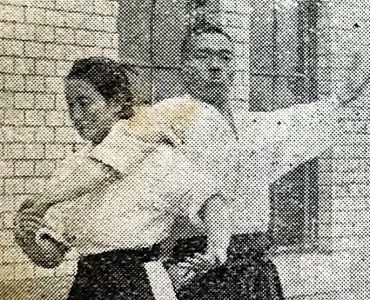
What, in fact, could Ueshiba Morihei do? Tada Hiroshi stated, “In 1942, I was in Shinkyo (present-day Chang Chun, Manchuria), but I just missed Ueshiba Sensei’s performance at the famous Kenkoku University Tenth Anniversary Martial Arts Demonstration. My cousin, who is one year older than me, told me it was a fantastic demonstration. Apparently hardly anyone could take Ueshiba Sensei’s ukemi. They weren’t just being thrown, it was if they were being shocked by high-voltage electricity.”
Henry Kono , describing Ueshiba in the 1960’s, said, “When [Ueshiba] did it, you didn’t know how you fell down. He’s holding on to you or you’re hanging on to him, but you never felt any energy when he did it to you. You fell down. You can’t say ‘I fell down by myself.’ But how he did it you didn’t have a clue! When somebody else did it you knew they were “doing it” to you, they were unbalancing you no matter how lightly they did it. When O-Sensei did it, ‘Bang’ you were down. Why are you down? You had no clue.”
If these two accounts are accurate, one can see why Ueshiba considered himself to have continued to develop — essentially, from “lightning” to “void.”
Whatever heights Ueshiba might achieved, considered either in isolation or in comparison to some of his peers, it seems to be a consensus that Ueshiba Kisshomaru (Doshu) - whether unaware, uninterested, unskilled or untaught, - did not emphasize core training methods, nor did he display the ability to express intrinsic power (aiki, for ease of expression).
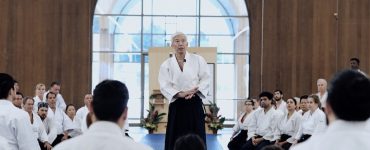
Let us consider portions of a long presentation that Doshu gave to the Japan Martial Arts Society (JMAS) in March of 1986. The newsletters of JMAS, of which I was one of ten founding members, are no longer in print, and I shall not reproduce the essay in full, copyright still being in effect. But I will quote some sections of this essay, because they are relevant to many discussions of these issues now active on Aikido Journal and Aikiweb.
1. “… when we speak of aikido, we must take into consideration founder Morihei’s previously mentioned spiritual interests. From these he wrought the new form of shugyo training found in aikido, … .taking the training methods inherent in the old budo and utilizing them, not as a means of seeking the defeat of an enemy, but as a process of self-advancement towards a higher human plane….”
Make any assertion you like, but this alone establishes that aikido is not Daito-ryu, anymore than Christianity is Judaism.
2. “After the beginning of the Showa period, …there were other religious influences on his art. For example, [Morihei] was involved with Kawatsura Bonji and his misogi purification practices which derive from Shinto, with the Mitake kyo, and this sect and that.”
A cursory reading of these two passages would suggest that Ueshiba’s change was one of ideology, NOT technique. However, if we read a little more carefully, we note that he developed a new form of training (shugyo) to accomplish his goals, using elements from other ascetic practices. Thus, , as he began to alter Daito-ryu technique, it is very likely that he also altered the core-training methods to enhance the innovations he was making.
3. “… we respond with an entering movement in irimi fashion, then make use of the circular and rotating actions of enten no ri to lead and throw. It is always a combination of these principles. This irimi-issoku idea … is an extension of jujutsu ideas concerning the degree of concentration and attention needed to respond instantly. In aikido, however, it is taken further and combined with rotating movements to form a type of spiritual training.”
Aikido starts as pure Daito-ryu (irimi-issoku), and then is rounded out, the opponent projected away rather than crushed or folded close in. In other words, you can’t do aikido unless you can do Daito-ryu. Kamata Hisao describes Ueshiba Morihei’s early aikido in Daito-ryu terms: “He always said, ‘You must enter the opponent; get inside him and then draw him into you!’” This, by the way, is true ukemi on Ueshiba’s part— fully congruent with the precepts of koryu, rather than the modern idea that ukemi is “taking falls.”
4. “It is clear that unless your center is firmly established, rooted to the earth, then it will be impossible to achieve aikido movements. The strict life-style that has historically been associated with budo is one of the ways of establishing this necessary firmness of center.”
Whole-body movement, ground-force, etc., was far more “embedded” within individuals when they lived a harsh, physical life, working with their bodies — what is sometimes referred to as “farmer’s strength.” Mike Sigman mentioned to me the idea that intrinsic body skills (ki/kokyu/aiki) probably developed as an extrapolation from the skills and efficiency that a person naturally develops to accomplish hard tasks of daily life, that understanding integrated, with increasing sophistication over the centuries, with the “unnatural” process of martial arts training and technique. Here are some examples of pure laborer’s strength, all but the first from the book The Super Athletes:
• Indigenous Amazonian hunters have been filmed shooting a dart into a monkey with a blowgun, then following the monkey for at least a mile as it flees through the trees. The hunters ran over the rough ground, twisting and turning through the brush, placing their bare feet perfectly, avoiding roots and rocks, writhing and dipping, stark naked, to slip unharmed past whipping branches. They were more graceful than the finest modern dancer. These men also kill tapir and boar, many hundreds of pounds, and carry that dead-weight home, walking miles on the same ground.
• In 1940, Irvin Bauman husked 46.58 bushels of corn in 1 hour, 20 minutes in Davenport, Iowa.
• In 1959, Lino Brenz-Verca, a 32 year old miner, transferred 2000 pounds of ore from the ground to a truck in 2 minutes, 2 seconds, with a 19 second penalty for tossing 95 pounds entirely over the truck.
• In 1961, William Hardy laid 5,469 bricks consecutively in an eight-hour working period (one brick every five seconds).
• A market “carrier” in Paris was required to be able to run 200 meters while carrying 440 pounds on his head.
Let us then consider several examples of naturally developed strength applied to combatives:
• Joe Stecher, one time heavyweight wrestling champion developed his legs by squeezing a sack of grain in a scissors hold, to the point that he could burst it
• Consider turn-of-the-century boxers. Ruby Bob Fitzsimmons weighed between 155 — 170 pounds, but was heavyweight champion. He was a terrifyingly powerful puncher, a former blacksmith. Photographs show a skinny man who appears to be made completely of connective tissue rather than muscle. Joe Choynski, a heavyweight contender who weighed a mere 162 pounds, perhaps the greatest “almost champion” in boxing history, attributed his great punching power to his previous trade as a candy puller (old-style candy-making is done with a spiraling twist). Stanley Ketchel, a great middleweight, said he got his power from a job that required him to toss bricks into an open freight car.
Returning then to Ueshiba Kisshomaru’s statement, an individual who has led a hard physical life, particularly one that requires awkward load-bearing, is going to be someone who can more easily learn the specialized methods of a martial practice in which power is exerted against someone exerting power against you. A perfect example of this would be Kimura Masuhiko, perhaps the greatest judoka in the history of Japan. He was, as a child, a lotus root farmer. All day, every day, he was immersed up to his hips as he pulled out tubers several feet long out of the muck. He augmented this natural strength with almost incessant physical training geared directly to his judo - thousands of push-ups every day as well as many thousands of repetitions pulling an inner-tube attached to the trunk of a tree. In this light, Sagawa Yukiyoshi’s several hours of daily shiko stomps make sense, not only as a training for the complementary distribution of forces within the body, but more basically as the “remedial” training required for any modern person if he wants to achieve the tenacious strength that any laborer (farmer, ditch-digger, porter, etc.) develops just through the actions of his daily life.
5. “To help us become able to “extend ki” or “build up ki in ourselves, we have in aikido the concept of “kokyu ryoku” (breath power), and a method so designed to enable us to learn how to send out this breath power….We use kokyu ryoku yosei ho (popularly called kokyu-ho) as the most basic exercise designed to develop this power and unification… We sit in formal Japanese style (seiza) and let our feelings sink firmly into our center of balance, the seika tanden located in the lower abdomen. Then from that point we let the totality of our bodily and spiritual powers flow out through our fingertips in an uninterrupted stream that extends to infinity…. This is the way of extending breath power that we must use. All of this is deeply tied in with the aikido concept of the Principle of Ki, of course.”
Ueshiba Kisshomaru does emphasize here some elements of the basics of proper physical organization and alignment, but if that was enough, why didn’t he - or any of the other top shihan for whom I took ukemi, both in kokyu ryoku yosei ho and in aikido techniques - manifest such power that we otherwise hear about? Perhaps because Ueshiba Morihei (and his compatriots in early Daito-ryu), as I have written over-and-over again, practiced basic breathing exercises, which one could also term kokyu-ho, which literally means “the method of breathing.” “Kokyu-ryoku yosei-ho” means “the cultivation of breath power.” This begs a question, because one can only further develop what one already has. Can we start with a two-person exercise that “refines” power, without developing such power first?
Ueshiba Kisshomaru had to have known this. He started every aikido class with a few moments of some of the Misogi-kai exercises, so this establishes that he did know what his father was doing. A few minutes at the start of aikido practice, however, was not how his father trained. Ueshiba Morihei awoke in the middle of the night and chanted prayers for hours, not only contacting divinity, but this also requiring him to engage in circular breathing using the abdomen, an unbroken, uninterrupted chant through inhale and exhale. One of my students is currently training in Shingon Buddhism, and his instructor has had him lie on his back with a large piece of pottery on his abdomen, requiring him to inhale, and exhale, chanting all the while without any movement of the pottery whatsoever. Although the prayers my student is chanting may be different, the internal mechanism — the pressurizing of the abdomen and lungs, and the controlled inhale and exhale while continuously chanting —is exactly the same as that of Ueshiba.
Furthermore, Ueshiba devoted hours of practice to solo exercises, both empty-handed and with weapons. This was too central an aspect of his father’s life for Doshu to have missed, and I’ve no doubt that his father taught him explicitly what he was doing.
It is obvious, therefore, that the only thing Ueshiba Kisshomaru lacked was the mileage, because unless one puts in the miles, one will not develop the body, and without the body, one will not be able to develop the skills. Yonekawa Shigemi illustrates this on even the “lower” level — explaining why the uchideshi were better than “outside” students. “[Ueshiba] didn’t teach people who came in from the outside differently. There was no distinction whatever made between the uchideshi and people who came from the outside. The content of the instruction was the same for everyone. However, as uchideshi, when we were taught we would practice the same things over and over again and take falls for O-Sensei.” It comes down to mileage and attention — both repetition with self-imposed mindfulness and a teacher who makes sure, one way or another, that you are doing it right.
Why didn’t Doshu put in the miles? Too late to ask, isn’t it? Maybe the work was too hard — too boring, too grueling, or too uninteresting. (My father tried to teach me electrical repair when I was a boy, but because I didn’t pay enough attention, he gradually stopped trying, and simply did the needed work in front of me, but with no further attempt at teaching.) Or perhaps he viewed his father the same way the Sufi viewed the magician who could walk on water — “You magicians spend ten years training to walk on water and for only a penny, you could have hired the boatman and gotten across the river ten years ago!” If aikido truly has an aim of embodying reconciliation of aggression among people, or even of misogi, is this purpose really served by a hermetic, obsessive practice that only a few might ever attempt, much less succeed, or is something accessible to nearly any person more likely to realize that lofty goal? In other words, should aikido be a hermit’s cave, an isolated monastery or a large church?
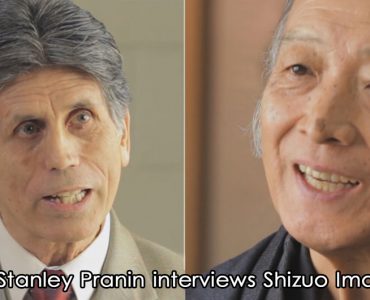
I concur with Stan Pranin that, for better and for worse, Doshu made aikido into something as different from the art of his father as Morihei’s martial art was from Daito-ryu. It became a worldwide movement. It has profoundly affecting thinking and action in fields as varied as psychology, negotiation and dance, areas that pre-war aikido would never have touched.
But, without barre work, no ballet; without scales, no virtuoso pianists; without juggling with the feet, no soccer; without prep work, no cordon-bleu. Without exhaustive solo training, no aikido? At least, no aikido of Ueshiba Morihei.
As I have previously written, I believe that the Ueshiba Morihei’s last EXPLICIT attempt to pass on his aikido - not the spiritual mission, but his final version of aikido as a martial art and complete psycho-physical training method - was the seminar in 1955, when he gathered together almost all of his top disciples, both pre-and-post war, to train for a solid week. Otherwise, why gather together on one mat all these men who studied at different times and derived different ideological messages and technical rationale? Given that some of the participants are still alive and some readers are surely their students, I still wonder if this week is of interest to anyone but me. Ki and kokyu training will still be accessible in a variety of disciplines as something to study and even master. But time is running out. Unless his training methods can be recovered and placed in their proper context, Ueshiba Morihei’s aikido will soon be gone.
Ellis Amdur — July 30th, 2007 (add comment)
Reader Comments
John Zenkewich writes:
Thank you for the essay.
When I was a young Aikidoist my Sensei who was an Uchideshi once commented to me that he needed to teach every day as he was a “professional” and I didn’t since I was a lawyer by profession.
I remember how this statement annoyed me as I was young enough to think I would be able to reach the abilities of the founder.
Ah, the arrogance of youth.
Brian Kagen writes:
More…
http://tinyurl.com/yqmue9
WAGNER JOSE BULL writes:
Up to my present knowledge Aikido training is a study of Nature powers, and it is a exercice to develop awareness and perception of the universal and individual Ki in order that man can reverberate with the Creative Energy . It can not be taught but grasped by intuition through continuous training and search cause it depends on each one´s perception. It is much more a matter of awareness then of methods of training.
DIferent persons will have always diferent Aikido cause they grasp different aspects and views in their trainings.
Aikido is what it is cause mainly 4 important men shared their perceptions of Nature powers with mankind and put then into practice: Sokaku Takeda, Onisaburu Deguchi, Morihei Ueshiba and Kishomaru Ueshiba.
Each one did his part very well.
Of course there are those that trains Aikido and develop higher levels of perceptions and other that simply don´t. It is the same as studying music. Some people will never be a “virtuoso” no matter how much they practice.
Perfect illumination and effective demonstration of real kokyu power, in the level of Takeda Sokaku, or Morihei Ueshiba like beeing a virtuoso, it is not for all consequentelly. It is not just a matter of method of training and milliage, but in my view, mainly due to DNA, or in other words, the individual gift granted by Nature to each person..
In Brazil millions have trained and practiced soccer, but only Pelé was able to do what he did. It is exactelly the same thing with Aikido. In spite the techniques of how to kick, touch the ball it is the same for all.
The good news is that Aikido training will benefit everybody, that it why it is so popular and is exactelly for this reason that we brazilians keep on practicing soccer no matter if we resamble Pele or not.
In my dojo I have great students, if they will keep on they will become fantastic aikidoists, and of course there are other that have very poor Aikido and are long time practicioners doing the same kind of training methods.But the important thing is that they train together with me and we have fun together and we develop each one of a us on a diferent rate according to our nature. We do not have to be Takeda, or Ueshiba, or Kishomaru…just beeing ouselves is sufficient, and AIkido training for sure will help us to fullfill this individual and vital goal.
It is not easy to touch the body of a good martial artist that attacks us with full power, and make him lift and fall down like a potatoes bunch as it seems Takeda Sokaku could do or we believe he could. This requires, “virtuosity”.
We must pay high respect to those that left Aikido to us as a tool of perfection, no matter the speed we can use it. If we want to improve there is only one way, train hard to develop more perception of KI works, but not fall into the trap that we have 100% chance to become like Ueshiba or Takeda or Kishomaru. Each one has a level to reach in this life, each one has one mission that the universe expects from . It is very important to understand that, then we will become much more tolerant and live better.
Wagner Bull
Ellis Amdur writes:
Mr. Bull - I am in almost absolute agreement (A.A.A.) with you! (And that statement may be remarkable to both of us!).
One point, however. Virtuosity must be cultivated, as well as merely inborn. One example that I’ve had a chance to witness a little is my wife’s ballet history. She was, in the 1980’s, one of the top ballet dancers in the world. She was, of course, enormously talented. But she also worked very hard (something she tells me that she never liked to do), particularly on basics. And when she moved from the Hamburg State Opera to the American Ballet Theater, she had to relearn a lot. She had a basis of Russian ballet technique, but Hamburg was mostly modern ballet. AT ABT, she had to learn the classic repertoire, and in addition to all the hours of study she had to do with her ballet coach, she took private classes with Maggie Black, a woman known only among the dancers, who is considered by many to be a master at teaching one how to move “naturally” - following the way the body is made to move, as opposed to forcing the body in an artificial aesthetic “vice.”
All this by way of saying, one may know that one is a genius from a young age, or one may find one’s genius emerging when planted in fertile ground. Therefore, although there is no guarantee of virtuosity, rigorous, correct, basic practice offers us a chance to arrive at the peak of what we could possibly achieve.
Best
Ellis Amdur