Aikido Journal Home » Aiki Blog Aiki News Japan

Thoughts on Putting Ki back in Aikido Practice

Although I have a career of interest and practice in Asian martial arts that goes back to the early 1960’s, I need to stress that my particular interest since about 1974 has been mostly about how to replicate and train a type of strength I felt in a visiting Aikido sandan at a party near Miami, Florida. Following that trail has led me through years of Aikido, of Taiji (Tai Chi), Xingyi, Bagua, and a lot of visiting and discussions with numerous stylists from many other arts (Japanese, Chinese, and Indonesian). My interest and focus in actual martial prowess waned after I encountered these skills because I see them as the heart of the real Aikido and the quintessence of what harmony with the universe really means.

One thing that became clear, gradually, was that everyone with knowledge of these skills is demonstrating and talking about the same core abilities, no matter where they’re from or what style they’re doing. The reason for the ubiquity of the Yin-Yang symbol and the common traditional beliefs throughout Asian martial arts (not to mention calligraphy, Asian dance, etc.) becomes clear after a while: these body skills are quite ancient and have had time to spread all over Asia and for widely disparate arts to contain many of the same codifications of knowledge that were developed centuries ago about “ki” (qi, prana,etc.) in the focused sense of the body usages called “ki”. It would be too much of a digression in this discussion to deal with the entire spectrum of what ki is and the attendant belief structures, so while acknowledging that there is a lot more to the topic, let’s keep the focus on some of the body skills.

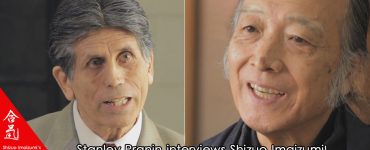
When I was doing Aikido, the old films of Ueshiba doing the occasional ki-demonstration were available, but the greater archives (thanks to people like Stanley Pranin and others) were not available. As these archives have gradually been exposed, interviews done, etc., one thing that begins to stand out is the size of the archival data which shows various Aikido experts doing ki demonstrations. In the earlier days of U.S. practice, a common problem was that there was not so much archival data to review; a second problem was that while the more obvious demonstrations (often called “ki tricks” in a mildly dismissive way) stood out, some of the actual applications involving the ki body-skills were not recognized as being related to the more showy “ki tricks”. They are the same thing. The combination of “ki tricks” and Aikido techniques using ki skills is rather overwhelming in retrospect… but many people still don’t spot the functional use of ki in Aikido because their minds seem to register only the physical technique and its associated subtleties or “blending”, and so on.

The current question being discussed by many, nowadays, is how to regain a stronger usage and training of the ki body skills within Aikido. Unfortunately, the topic of ki and how to train it is both simple and complex, so all this discussion can do is touch on a few basic ideas, while leaving many other things undiscussed.

Perhaps the most serious question of all boils down to how someone can continue to practice the Aikido they know (or think they know) while learning an Aikido with the ki skills. The second-most serious question might be thought of as “what do I need to do to supplement my Aikido?”.

The first question is the real hurdle. I was reading somewhere about how in Pilates some instructors make the students do a sit-up by focusing on pulling in the muscles in the pelvis and perineum areas in order to do the sit-up. It’s a totally different way of doing a sit-up in a world where there are already a number of “here’s my take on how to do a sit-up’s” out there. But imagine for a minute that this Pilates sit-up is the Real True Cross of sit-ups and you’ve been doing or teaching sit-ups for thirty years the wrong way. It looks like the same sit-up, but it’s done completely differently, isn’t it? Now then, let’s take some average-Joe’s version of Aikido and tell him that he has to similarly learn to walk, push, apply power, etc., completely differently than he’s been doing (a much more massive change). He says, “Fine”, he wants to learn this different way, but he wants to continue his Aikido workouts doing the old way and gradually changing over. That gives a vague idea of the problem, but the actual changeover is a lot more different than just clenching different muscles when you do a sit-up. So what to do?

Koichi Tohei proposed an approach which is a great first-attempt for us to study. In my opinion, Tohei’s general thesis of relaxation is very similar to Ueshiba Sensei’s approach, although perhaps it deviates by being slightly more “soft” than the practices Ueshiba used for himself. Now, I have to admit that I never fully appreciated Tohei’s attempted teaching method until I had acquired some skills and had attempted to acquire others; my views of his approach have matured over time. The only problem I have with Tohei’s approach is that he appears, in my opinion, to attempt to explain how to do something while at the same time trying not to give away too much. Plus he tries to focus on many aspects of ki using some of the ancient ki-beliefs and some modern self-help schools.

But Tohei sets up some beginning-training ideas of forming a strength around a core stability that is “immoveable”. Essentially Tohei uses the ancient ideas of sourcing forces upward and outward from the body so that their power comes from the ground; forces downward source their power from the body weight. Initiating forces come from either the strong lower body attached to the earth or the weight; the rest of the body has to be trained to not initiate any forces, but only to convey the primary forces. In ancient times, the primary forces were called “the Ki of Heaven and Earth”, or similar titles. Conveying but not initiating forces is the key to the word “relax”, as used in many Asian martial arts.

To cut to the chase, learning to move in this entirely new way (where the initiation of force sources is completely different from the shoulder, arm, and body forces of “normal” movement) is the major hurdle. It’s not a part-time movement that we would only adapt during Aikido and training; it’s a full-time, different way of moving entirely. Changing Aikido movements and techniques into this form of force-sourcing is difficult indeed and much harder than many people envision and probably it’s a hurdle that most people will not be able to overcome, for a variety of reasons.

The second big question has to do with what someone would need to change in order to bring the ki skills to their Aikido, but the common side-question often has to do with the efficacy and self-defense portions of Aikido. Gozo Shioda, in a book written by his students (not by Shioda, it needs to be emphasized), reportedly made much of the actual power that can be developed in Aikido. Morihei Ueshiba’s actual power is often mentioned in anecdotes by his followers. The important point is that the physically-evinced power in Aikido should be coexistent with Aikido techniques. Aikido techniques, no matter how subtly done, without the ki-power are not enough; ki-power without Aikido’s techniques and subtleties is not enough either, I might add.

The point is that the efficacy of Aikido is noticeably diminished without the ki power (often interchangeably described as kokyu-power because of the inherent vagueness and broadness of the terms). So the suggestion would be that before someone begins to look for ways to “supplement” Aikido, perhaps first they should gain the full powers of Aikido and then see what, if anything, is missing. To do incomplete Aikido and complain about its incompleteness is to do Aikido an injustice.

Within the Aikido syllabus are a number of exercises which are frankly simply misused and which have become, for the most part, ritual exercises that do little other than add to the window-dressing. Without belaboring the point, the “needed changes” and “supplements” to Aikido can be found in the various exercises, including suburi, that are already in Aikido but which are generally incorrectly done because they use the “normal” strength, not the ki strengths. In other words, the exercise tools are sitting right there already and all that’s missing is correct training in how to use those tools…. And the will to make the change.

The problem gets us back to the analogy using the “correct” Pilates sit-ups (not a very complete analogy, I’ll admit). If you’ve been doing sit-up wrong for thirty years and they make you somewhat strong and they look the same to the casual observer… why should you change? That’s a question that is very applicable to the hurdle of learning the ki-strength skills in Aikido. Perhaps we can try to imagine what Ueshiba’s reply would be if we asked him whether such skills were really necessary for Aikido.

The preceding blog entry was submitted by one of our readers. If you would like to submit your own entry, please click here. Be sure to read over the rules and guidelines before submission.

Mike Sigman — September 24th, 2007 (add comment)

Reader Comments

Steve Gegner writes:

Last summer I had the good fortune to visit the Maui Ki Aikido dojo and attend both a Ki-Meditation class and an Aikido Class. Christopher Curtis Sensei is the head instructor, and in my opinion is an excellent instructor of utilizing Ki and practicing Aikido. The dojo was founded in Maui, HI by Sinichi Suzuki Sensei in 1953 under the supervision of Koichi Tohei.

They have an interesting web site http://hawaiikiaikido.org/flash.html of which the right-hand scroll-down menu contains a number of “Transcripts” and “Articles” related to Ki Aikido.

As a 66 year old practitioner of a type of Tomiki Aikido, I find Ki Aikido (at the opposite end of the spectrum) very interesting and a good learning experience.

Stanley Pranin writes:

This is a wonderful article and should be required reading for all. The comments about “sourcing power upward and outward from the ground,” and “downward from the bodyweight” are very insightful ways of looking at the phenomenon of ki and incorporating this into one’s training. Thank you, Mike!

Mike Sigman writes:

My pleasure, Stan. The inherent problem with “sourcing the ground” (or the weight) is that it involves a mental trick to form these paths, not a physical way of initiating a movement. In other words, doing one of Tohei’s “Ki Tests” involves a mental shift of the source of power and “relaxing” so that the upper body only conveys the incoming/outgoing forces.

Tohei’s preferred visualization vaguely suggests the “One Point” as the source (rather than, say, the shoulder joint) and he has some limited (perhaps too limited, looking at the success ratio from that vague visualization)… but the point to note is that he is employing a mental “trick” which changes the source of the forces in order to do all of the so-called “ki tests”.

When the sourcing is arranged properly, the body will surprising conform to help convey the forces according to the new sources, but only up to the level to which the body is conditioned. In other words, a person can use kokyu power correctly only up to the level the body has conditioned to sustain the new arrangement of patterning; if too heavy a load is put on an unprepared body, the new patterning breaks down to some extent and the normal muscles (like shoulder, arm, etc.) kick in and the training becomes diluted. This is why working with weights is a no-no for someone trying to re-pattern their body to move “from the dantien”.

But again, Tohei’s approach of using the mind to set up and change (automatically, with practice) the force sourcing is an examply of how the mind arranges forces, rather than the body posture or “form” being needed to arrange the forces. Here’s a couple of ancient comments from a Chinese woman martial-artist (Yuh Niuy) about the importance of these skills in a “Tao” or “Way”…. and proper Aikido contains exactly these things:

“Weak and exposed in appearance;

But powerful when unleashed.

One’s reactions may start afterwards,

But the response arrives there first.”

Notice the same comment that is used in Aikido about the opponent’s motion starts first, but you arrive first. If your mental and physical control of these mind-directed forces is good, they will always “arrive” and be ready before an opponent’s physical technique can arrive. This is divine.

Another partial comment by Yuh Niuy in relation to the mind-directed forces (kokyu/ki) says this:

“The Way is so small and simple, but the meaning is timeless and profound.

The Way has an entrance; it also has a Yin and a Yang.

The entrance constantly opens and closes,

Yin and Yang weaken and flourish.

When the Way is battle, be full-spirited within,

But outwardly show calm and be relaxed;

Appear to be as gentle as a fair lady, but react like a vicious tiger.

Though hidden within, the spirit of the body moves;

Though obscured like a setting sun, the spirit moves like an unleashed rabbit,

Catching the body and outrunning shadow like a mirage.

Back and forth in one breath.

The spirit cannot be retained in form.

And, though ever moving, it cannot be heard.”

The last portion of the above, particularly, refers to the fact that the “spirit” or “will” (what O-Sensei referred to as the “Divine Will” in his douka) flits more swiftly than the body and is independent of any form or posture. My point being that this foothold topic of sourcing forces from the ground and the weight is a paramount entry-level to the understanding of what a true “Way” or “Do” really is.

Robert H Cowham writes:

Out of interest who was the Aikido sandan?!