The Kata of Play: Part 2
Last week a colleague said she planned to go to Shikoku over the year-end break and do part of the 88-temple circuit made famous by Kukai. To my reply that she would be doing some shugyou (ascetic training), she laughed. Far from it; she was going to get closer to nature and enjoy some peace and quiet. Like many ‘modern’ Japanese, my colleague was not really aware of the depth of the ancient tradition she was following and how it has shaped contemporary attitudes to play and relaxation. Shugyou became traditionally associated with Shugendou, and it is important for the kata of play to look at the early history of this movement.
As explained in the previous blog, shugyou was a way of training as a means to achieve ‘sokushin joubutsu’. The training consisted of meditation, fasting and other repetitive activities. Such activities took place in mountainous terrain and to enter this terrain and practise shugyou was to experience nature in all its diversity of temperament and, by establishing a lasting relationship with this ‘play’ of nature, ultimately to transform one’s own nature. This was a psychological or spiritual change, brought about as the result of the continual and repetitive practice of prescribed actions.
Historical Interlude
The general name for this ascetic training is shugyou and the practice underwent several developments. To begin with, shugyou was practiced by individual mountain hermits, called ‘yamabushi’, who regarded the mountains as kami. (“Yamabushi” is sometimes wrongly translated as ‘mountain warrior’ and occasionally they might have been such. However, “bushi” [= ‘fushi’: to bow down or prostrate oneself] is written differently from the compound “bu-shi” [= warrior]). With the transplantation of Buddhism in Japan, especially at the hands of Saicho and Kukai, the shuugyou exercises became more organized and prescribed, like endurance sitting or endurance walking, and tied to Buddhist methodology (the ‘shisu-zanmai’ of Tendai Buddhism). The shugyou training was done in a particularly intense and concentrated fashion by the Shugenja, the practitioners of Shugendou, such that the yamabushi came to be indentified with Shugendou, which became an organized religious movement in the late 12th century.
Thus, the yamabushi gradually emerged from the mountains and, as sorcerers, healers, exorcists, local priests in charge of fertility rites, doers of spectacular rituals, spread Mikkyou Buddhism at a local level. The focus of training for the yamabushi was the acquisition of ‘gen’ or ‘rei-gen’, the magical powers that enabled them to be effective shamans and to communicate with and draw on the power of kami and buddhas (though Mikkyou denotes Tendai and Shingon Buddhism, shugendou was eclectic and blended this with local kami cults, yin-yang fortune-telling and magic practices: it makes little sense to think of Shinto or Buddhism in ‘either-or’ terms here). The yamabushi wandered around the country displaying their rei-gen, seen through their mastery of fire, water and swords. The rituals of the yamabushi, with their mudras and ‘henbai’, were the roots in Japan of a tradition of ‘minzoku geinou’ (folk performing arts), the most ancient of which are the ritual dances known as kagura.
This was paralleled by another development involving the aristocracy. This second development was the broadening of shugyou training. In the 12th century the mountain paths of the shugendo practitioners between Yoshino in Nara and Kumano in the Kii peninsula became pilgrimage trails, popular among the aristocracy as an excursion away from court life in Kyoto. These pilgrimages also created a special relationship with nature, which allowed the participants to claim that they were doing shugyou. These pilgrims were not so disciplined as the yamabushi, but nevertheless the route, season and accessibility of nature were designed to appreciate the playful aspects of nature.
As one scholar has put it, “In this respect, kagura theatre and shugyou austerities are both ways of ‘playing’ which combine ascetic devotion and aesthetic pleasure. The magical rites of kagura have been transformed into mass entertainment and shugyou is difficult to distinguish from popular pilgrimage. Kagura and shugyou are part of a cultural history of play in Japan which remains to be written and which would require the description of activities as diverse as pilgrimage, gambling and the martial arts, tea ceremony and karaoke (sic).”
More to follow.
Peter Goldsbury — December 11th, 2004 (add comment)
Reader Comments
WAGNER JOSE BULL writes:
Aikido according to the Founder was a kind of “missogi shygyo” a austere training to purification of the spirit. In the shinto cerimonies we did in our dojo the priest asked us to in the middle of it, after the kami would be invocated, to do Aikido demonstration to “please ” him.
Aikido in its essence has a lot to do with this “magic” things of the yamabushi that were part of the japanese folklore as Peter has said and popular shinto, and omoto Kyo too. Here in Brazil we see it in the african religions like Umbanda and Candomble.
I have the strong belief that the Founder did that “jo no Missogui ” exercices in the beggining of his demonstrations and other breathing and “ki”exercices and as a kind of rite to invocated the presence of the “Aiki o Kami”, and that is why some say that his demostrations sometimes had somehting of supernatural, and he manisfested increadable powers. If this was just part of his imagination or not, the fact is that many said that the collor of hiw eyes changed, and when he was like that the techniques looked much more powefull. Many shihan that were his uchideshi mentioned that.
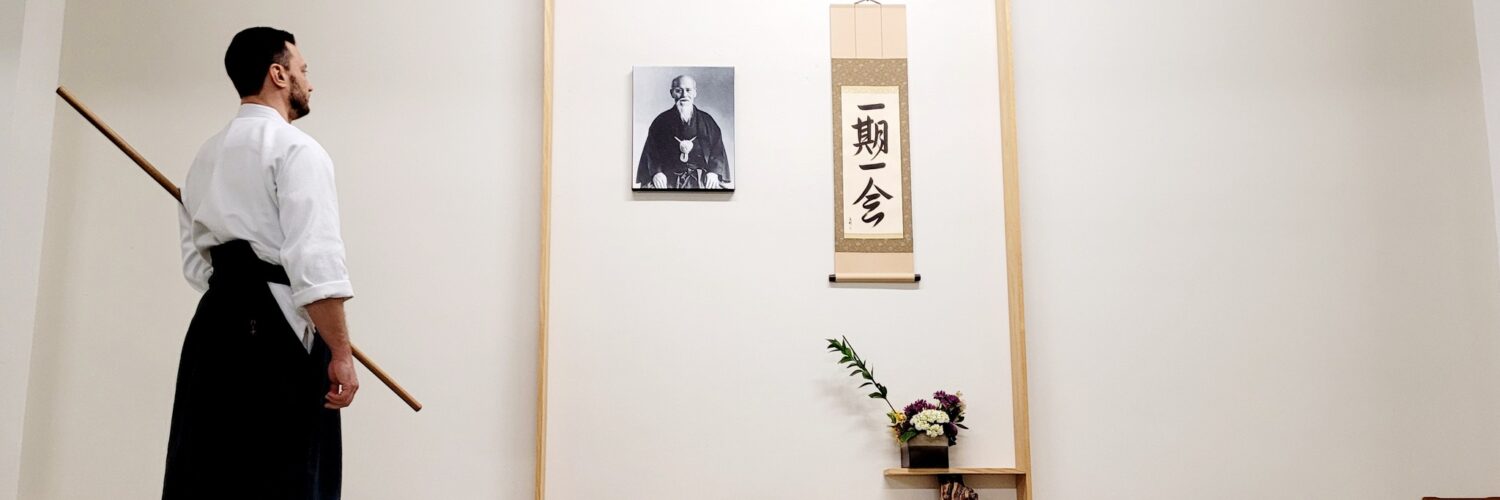
For the same reason that the girl Peter mentioned, did not knew that she was not going to do someting just to be more close to nature but something much more deep, presentelly many japanese start practicing Aikido as a kind of gimnastic, without having the slightesst notion of the deppness of this practice in spiritual terms. The same happens in many westerns dojos. It is a pity that this is happening and I am afraid for the future of Aikido if this fact do not comme to the conscience of many, specially in present Japan. That awe for the divine, for the unknown, for the mistic things are each day diminishing. Each time the “kamiza” is losing its importance reducing its significance as just the “picture” of the Founder.
Nice article Peter.
Wagner Bull
Brett Wilderman writes:
“presentelly many japanese start practicing Aikido as a kind of gimnastic, without having the slightesst notion of the deppness of this practice in spiritual terms. The same happens in many westerns dojos. It is a pity that this is happening and I am afraid for the future of Aikido if this fact do not comme to the conscience of many”
As anyone approaches Aikido in a light hearted casual maner, the depth of it remains available to be experienced at a rate that is appropriate for them. When a situation of apparently great depth is approached, people often hesitate. Pinching one’s nose and holding in a breath is no way to advance into an austere practice. Sharing Aikido without pretense or reserve will allow the spiritual depth to be discovered by those that will. I hope.
Tobin Threadgill writes:
Peter,
This essay of yours is quite timely.. I have been researching the Folk Shinto Takamura Yukiyoshi Sensei was devoted to. He frequently undertook pilgrimages of shugyo to Mount Kurama and notes indicate his interest in Yamabushi Tengu. One of our kai members is a Shingon Priest and in conversation with him I am more significantly appreciating the apparant synthesis of Folk Shinto beliefs and Buddhist influences in this spiritual mindset. Your excellent article is just another piece of the puzzle that is bringing into view a clearer picture of my enigmatic teachers beliefs and fundamental view of life.
In the future I plan to travel to Mt Kurama and the countryside near Lake Biwa to further trace the roots of the spiritual influences that influence our branch of Shindo Yoshin ryu.
The manner in which the broader definition of kata, play and spirituality all merge to create the unique experience accessable in classical Japanese learning should be of interest to all serious students of Nihon budo.