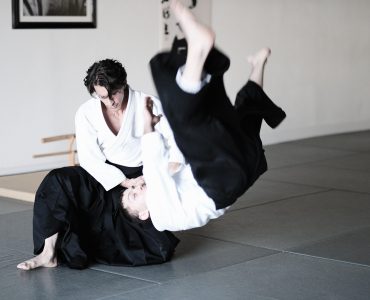
Systema: Tutorial on Rolling
[We have just received this excellent tutorial from Vladimir Vasiliev’s school in Toronto. Vladimir and his teacher General Mikhail Ryabko will be on hand for Aiki Expo 2005 in Los Angeles. Don’t miss them! -Ed.]
On behalf of Mikhail Ryabko, Vladimir Vasiliev and all of us here at Russian Martial Art, we’d like to wish you a very Merry Christmas and a Happy New Year!
We wish you a lot of success in your training, and everything else that you do. May God bless you and your families.
Here is a small Christmas gift to you, put together by one of our Senior Instructors — Kevin Secours, from Montreal Canada.
“TUTORIAL ON ROLLING”
Learning to roll can be intimidating. This tutorial is not intended primarily for experienced martial artists, it is intended for anybody who wants to improve his or her physical health and more closely align body to mind and soul. Rolling initially contains so many inherent fears that learning to master it truly frees the mind and body.
I have been a huge fan of the kinesthetic aspects of the Russian martial arts since the beginning and have been researching similar ideas, like the Feldenkrais and Somatic approaches to total body fitness (which also incorporate rolling). I first became aware of just how unsatisfactory my traditional training and teaching approaches were for conveying the importance of rolling when I was instructing a new student who had previously broken his hip by taking a nasty fall on the ice in a cold Montreal winter. I spent a lot of time trying to find better ways to teach this student rolling. He had so much stored fear and tension from his body’s intrinsic memory of that trauma, that he forced me to develop a very simple set of drills that have since allowed all of my students to pick up the practice more easily.
1. I begin by having a new student kneel with their palms on the floor about three feet apart, with their fingertips spread and facing outwards (their back is slanted at roughly a 45 degree angle).
2. From this position, I have them perform a few deep breaths or breath holds, to relax into the position.
3. Then, without moving their hands, I have them inhale from a stationary position, then exhale and lean to one side. The arm on the side to which they are leaning will bend to a 90 degree angle while the far arm will straighten. The goal is to exhale, while gently “kissing” the inside of the far, outstretched shoulder to the ground. Then they inhale gently back up to a center position and exhale to the opposite side.
4. This series is repeated at least 3 times per side, with the goal being to let the breathing inflate and deflate the body, bringing awareness to the lightness of the body, the elasticity of the joints, while giving them a gentle stretch.
5. The next phase is to continue the same side-to-side breath sway, now adding the simple additional move of looking underneath the bent arm. I often explain it by saying the arm that is bent to a 90 degree angle provides a window through which they can attempt to look back at the tail end of their body. This action of gently looking helps deepen the breathing and stretches more deeply into the spine.
6. The next phase is to continue the same action, now adding a rotation of the extended (straight) arm, rolling from the palm of the hand onto the back of the hand. This gently stretches the shoulder, deepens the understanding of the relationship between breathing and movement and prepares the student for the roll.
7. The next phase is to perform the same action, but now lifting the extended palm off the floor slight, performing the rotation in the air, and now instead of contacting the floor with the back of the hand, the emphasis is placed on trying to contact the floor first with the back of the extended shoulder and the tricep. Emphasis is placed on relaxing and massaging the meat of these areas, without impacting either the shoulder blade or the elbow. Emphasis s also placed on avoiding contact completely with the head. I often have students just roll slightly back and forth, very slowly in this position, to massage the shoulder open.
8. The next phase is to begin the roll. Emphasis here is always placed on avoiding contact with the head and any other bony aspect of the body. I stress the importance of greeting the ground with the near shoulder and then slowly transitioning to the opposite shoulder with breathing and relaxation. In the beginning, I always recommend that students allow themselves to fall through the motion. As they become more acclimatized and relaxed, they can slow the motion down through correct breathing and then work on coming back the way they came with a reverse roll.
Happy Rolling!
by Kevin Secours”
Stanley Pranin — December 19th, 2004 (add comment)
Reader Comments
Nicholas Busan writes:
Kevin,
Very nice . Lets a fresh “out of the box beginner” over come their deep grown “fear of falling”. I think we all have been told by our parents when we were just starting to walk “now don’t fall, you’ll hurt yourself”. That phrase is buried deep in our minds. Remembering how I learned to take “ukemi” the old fashioned Japanese way of “just do it” this is much better with less injuries. It took a long time for me to heal up from my first week of hard high breakfalls.
I do something similar with my beginning students. I start them on the ground on all fours, but then I have them extend their hand and arm under them to try and touch the opposite foot all the while exhaling and tucking in their heads. If they extend all the way back with their arms they eventually naturally roll over. Haven’t thought about the exhalation / inhalation that you do. Will have to try that on the next new student.
Good article, thanks.
Nicholas Busan
Jem Wilson writes:
Falling as a gentle stretch…nice. We also begin in a fetal position on our backs, roll up on to all fours - taking lots of time - and then, when we feel ready, roll back again. Keeping the spine curved with chin down and coccix forward seems to be a common challenge in this situation. Something deep seems to happen with the body-mind. Thank you