Aikido Journal Home » Aiki Blog Aiki News Japan

Integrating internal training into your aikido

Had a recent discussion with my friends at the Itten Dojo in Pennsylvania, who are trying to integrate internal training (solo exercises) into their aikido practice. A dilemma can occur when trying to “insert” the acquired power into aikido, particularly if you’ve learned it from outside, rather than from day one. The new insights and strength that one acquires can potentially bust aikido technique, or disturb practice. One can easily begin to question the aikido form/techniques, and be tempted to simply stick to the internal training without aikido at all. Of course, that is a viable option. But if you think you ought to, why continue to do your aikido at all?

Here is a quote from the excellent Di Guoyong on Xingyiquan, V. I.

“Strengthen your root internally, strengthen you body externally. The internal is the way to nourish health, the external is the way to move. If you have the internal but not the external, then you cannot succeed at martial arts. If you have the external but not the internal then you cannot succeed at deep trained skill” Xingyi Classics

Aikido provides you with a structure to contain internal training. Without it — or another martial system — you could conceivably get the “power” of a fat man or a weight lifter. Paul Anderson, the one-time world’s strongest man, (lift of 6000 pounds) decided to be a pro boxer. He was almost killed in his first bout with a journeyman boxer. Therefore, if you are not “respecting” the form, you can conceivably end up with less than you started, even though you can quite comfortably sustain a push to the chest or a punch to the belly.

So here are my suggestions for training.

1. When a senior trains with a junior, he or she should ONLY ONCE completely stop the technique in a round of practice of the technique. This is for “calibration,” to gauge their strength. Thereafter, unless it is a specialized practice, devoid of the requirements of martial virtue, you should be right at the limit of their skill. With your superior knowledge of structure, the form and internals, you template them to move at the limits of their ability. They’ve got to work hard to do it right, but not so hard that they must abandon the principles they are newly learning.

2. Any move or response that ignores basic combat criteria (for example, if I ground myself while leaving my eyes in easy reach of a thumb-gouge) is wasting time - if you care about the martial side of things. Make sure that your training with partners does not abandon martial integrity. This includes even trying to “ground” a wrist lock, for example. Make sure as you try to channel the twisting force through the body that you are not out of position vis-à-vis the partner’s possible atemi, etc.

3. NEVER stop the instructor’s technique in front of the students. I’m talking about when you are called up to demonstrate the technique to be practiced. Unless the instructor asks for just that. Instead, assist the instructor in making his or her point, and then when you break for practice, NOW engage in mutual testing. If you choose to practice in a dojo environment, then a dominance-hierarchy based authority is useful, maybe necessary to maintain the community. If you destroy that, and hold the teacher up to contempt, you may destroy the dojo. (See my forward to Old School for an example of how a man of integrity responded to such a challenge). I am NOT saying that you collude in making a weak instructor look good. Rather, when the teacher is instructing, give him or her the respect to present to the class the skill they are to practice. Then when you break out in practice, you and the instructor SHOULD test how to make things stronger - and if you can stop him or her then, all the better for both of you.

4. Don’t make the dojo a “Darwinian” venue, unless you are working out of a garage or barn that you own. If you break new members’ confidence, merely displaying that you are too strong for them to touch, and they too stupid and inept to do any better, they will discontinue.

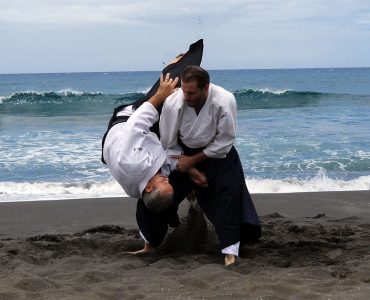
5. “Simply grounding out” in the middle of the technique, making it impossible for the junior to bring off any technique, is an “old school” aikido cliché, similar to demonstrators making it difficult for cops to carry them away from the gates of the Pentagon. Make it challenging, but not impossible to accomplish the technique. The challenge, to repeat, should be at the level that the person must “work” (properly) to maintain correct form. If their form/structure breaks, you’ve stopped doing ukemi (receiving body) and changed to mere dominance. (Grounding out was the typical way shihan at the Aikikai used to prove they were “better” when they did the rounds around the class. If you grounded them out in turn, they’d get offended . I remember once when one of the more infamous brute shihan did this to me while “making the rounds”, stopping my every move, but expecting me to tank when taking ukemi for him, and I, without thinking, slipped behind him, took him down and choked him. We were both equally surprised, and for a moment, things were rather - - - fraught - - - but it was an automatic response on my part to someone who, from any practical perspective was grounded like a sack of potatoes, unable to adapt or respond to his partner adapting to him. (This may seem contradictory to #3 above, but I will point out that he was making the rounds - I would never have done this when he was in front of class instructing… . .Besides - mumble, mumble, mumble - he deserved it).

6. Unless you are clearly and openly practicing a “principle,” in which you may start with expansive “over-movement,” don’t exaggerate movements in a way that violates basic principals. For example, another shihan I took ukemi for was always infamous for his wrist-breaking nikyo. But he would rise up high to slam down on the wrist with his entire body-weight. You literally had to stand there waiting for him to “arrive,” he with an opening big enough to drive a truck through. I knew how to take the fall so I wasn’t permanently injured, but frankly, it was as stupid as standing waiting for someone to wind up and punch you in the face, with your only response to try to minimize the damage by rolling with it.

In sum, the challenge is to work on multiple levels. Solo training to increase whole-body (internal) strength. Aikido practice to give a structure, a laboratory vessel, so to speak, within which you can challenge, test and develop your skills. Finally, aikido practice is used as a reminder that power without proper form, skill, and mindful awareness of potential danger is useless power indeed.

… oh, the book? What book? I know it put it down somewhere. Wherever I left those car keys. As a matter of fact, it’s hidden … Actually, it’s in peer review. When several last chapters are chewed over by my consulting expert, I will do some rewriting and restructuring. Hopefully by fall now. There’s just a lot to learn to get it right so I can lay it properly to rest.

www.ellisamdur.com

Ellis Amdur — May 30th, 2008 (add comment)

Reader Comments

Doug Walker writes:

Very nicely summarized. For myself, correct practice is something I find must be constantly worked on and requires ongoing communication and clarification with the teacher and the partner about what is currently being worked on, how we are training, how to interpret what just went wrong, how much can I take right now, etc, etc, etc. It makes me wonder how the “shut up and train” crowd does it.

You know you are killing us out here with the book delays, don’t you? No pressure though!

rabble rabble rabble ; )