Recommended reading: “Interview with Takako Kunigoshi” by Stanley Pranin
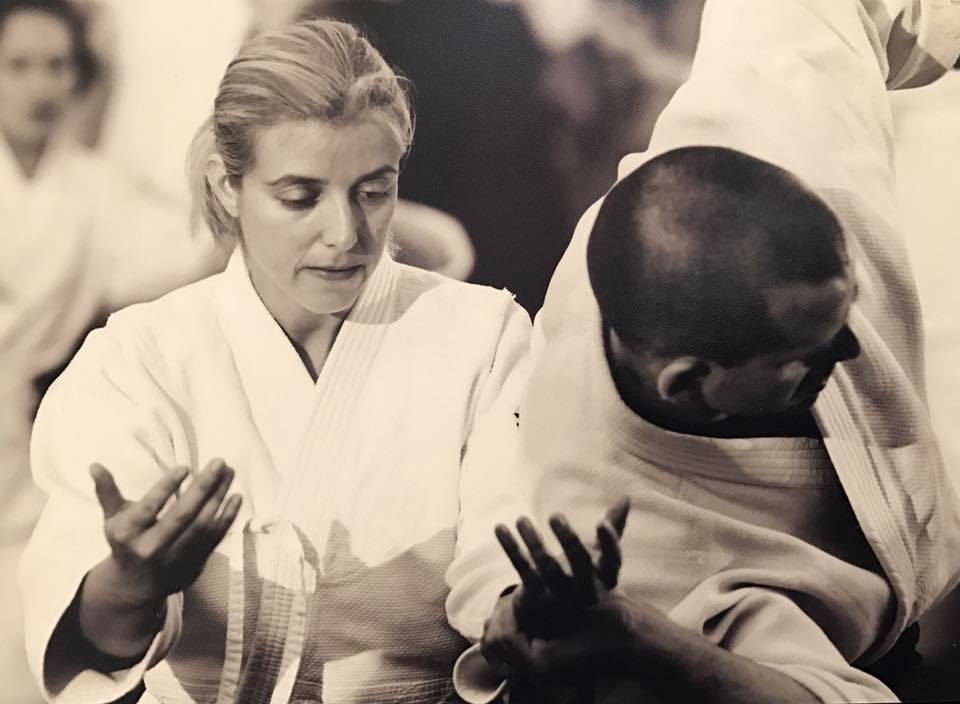
There were few women who practiced the Aiki Budo taught by Morihei Ueshiba in the prewar era. One of them, Takako Kunigoshi, occupies a special place in the early years of the art due to her dedication and artistic talents.
“I started in January of 1933, the year that I graduated from school. I was then able to continue up to a little before the air raids began over Tokyo. At one time I had been asked to teach self-defense to female employees of a company located next to the famous Kaminari Mon (Thunder Gate) of the Asakusa Temple in Tokyo’s old town district. I went there with the grand daughter of Yakumo Koizumi (the well known Meiji period author better known to foreign readers as Lafcadio Hearn), Ms. Kazuko Koizumi, and we would teach there together. She is dead now, however. Then the air raids started and there were always warnings and alarms and things were getting a little dangerous so we had to stop. We never got to train very much there.”
Click here to read entire article.
This article is available in complete form to subscribers to the Online Aikido Journal. If you would like to support this archival effort, you may take out a subscription here.
July 18th, 2005 (add comment)
Reader Comments
Ellis Amdur writes:
I’m sure it would have been difficult to ask Kunigoshi sensei (and the other pre-war deshi), but I wish that somehow the interviewer could have asked them, each and all, one more question. “Why did you stop training aikido?”
Stanley Pranin writes:
Kunigoshi Sensei and many other prewar students stopped training due to the war and its terrible aftermath. Only a few actually spanned both prewar and postwar eras.
Ellis Amdur writes:
Stanley - that’s where, in effect, my question lies. For some, mere survival could be answer enough. But here we have a martial art which offered, per the doctrine, so much - powerful waza, powerful spirit. One could imagine that in the aftermath of war, such an art would be a refuge, not something one no longer had time for. But what I do find remarkable is that so many of the prewar deshi, who were so committed, did one of two things - they stopped training - or they split, forming their own organization. Now as to the latter, it may simply be that hot-blooded men merely wanted to shine in their own light, and explore in directions different from that of the founder. But even so, that so many of the leading figures either found no place in aikido, or no place within Osensei’s post-war aikido - (“Osensei’s?” Is that the question they asked?) - is quite an interesting conundrum to me.
maciej jesmanowicz writes:
I do not feel that I am the only one looking for answers to so many questions which have risen during my aikido practice and because of it, I share my thoughts on this forum. I must admit that I really appreciate Editor giving us a wide perspective to aikido from the historical point of view, and the interview with Takako Kunigoshi is a good example of how his work builds a base for some answers.
I found two technical approaches in aikido, mentioned by Takako Kunigoshi, very interesting. The first one teaches the way how the Founder expected to be attacked. Her words: “We were also expected to be able to take the role of the attacker and wield the weapons. When you cut the weapon should make a high-pitched whistling sound… ” do not need any comments. Ironically, I am still looking for a clip of a master able to take that kind of attack. The second interesting fact considers the way how ukes had been thrown in the Founder’s dojo. Ms. Takako Kunigoshi remembers: “When you are practicing in the dojo and all you do is throw people then it’s really hard on the uchideshi, I thought, because they were taking break falls morning noon and night.” It seems that, these ‘rolling’ ukemi, we practice today, were not considered by a founder at all, and were ‘invented’ for aikido without his knowledge.
What does this mean, and why have I just pointed out these issues? For years, I wondered how to compare aikido, I practice, with the Founder’s idea about a new martial art, he had in mind, in the early XX century, when a practical use of budo was still doubted. The only reasonable answer, I could find, lies in an expression, that today, unfortunately I would call an empty slogan: “Aikido Is a Peaceful Martial Art.” Whatever I do in my dojo, whatever looks smooth and nice, however it can never be applied in a real conflict situation, simply because the consequences of our opponent’s lack of ukemi skill are easy to predict. So, questions were raised of how to perform an aikido technique ‘peacefully’ and what is a reason for doing it? Let me try to answer this question: Do not throw your opponent - let him fall down, and protect his fall in the way judokas practice. Do it fast and precise, so that you do not to let him know what had just happened. It is the only way to change his aggressive attitude against you which ultimately is your objective. I just pointed out a judokas’ way, because they practice their throws this way, using break falls. There is no shame in using a judo experience in aikido, because just like Kano implemented it from another school so did Ueshiba.
Geoffrey Yudien writes:
I was interested in Takako Kunigoshi’s comment that, “[w]hen I was training … there was nothing like dan grades.” Does anyone know how O Sensei’s approach to awarding rank changed over the years? Thanks!