
 Josh Gold
“Flinging yourself around in the fakest of ukemi in order to make an incompetent look good, deceives no one, but yourself.”
 Pseudo-aikido is identifiable by the ineptness of its practitioners, something which waving a camera around, hot music, drums and grass growing introductions cannot hide. It impresses no one but those who know better, and that negatively.
Sizzle does not win fights, nor enable survival against serious odds. Skill does.
Skill cannot be faked, and at best, any attempt to do so is worse than amateurish. It is suicidal.
Remember the good ol’ Chinese Fung-ku movies where someone would punch the air (out of the maai) and the other guy would rush in to “block” it? What on earth for? Why on earth block anything?
“Modern aikido” has become too self-excusing. Many schools do not even know what the basic techniques are or have a name for them. They “flow.” And well they may. Among each other. Because any real attacker would have other plans.
If you wake up, it will be in a hospital. But DO NOT BLAME AIKIDO. That’s not where the fault lies, but rather in the fact that you have been deceived and have allowed yourself to be deceived by the unscrupulous posing as proponents of Aikido. Or simply deceived yourself because you live in fear of death and lack the backbone to admit it.
If your attacks are weak you are practicing nothing more than dancing. Real attacks will not be weak. In any case, Aikido cannot function without strong ki to harmonise. Without strong ki, you will necessarily and obviously have to revert to initiating atemi waza.
If you are an “accomplished martial artist,” but only in the confines of your own dojo with people half your size and have no clue how you would fare in reality, well may you dream on, but the awakening, when it comes, will be a cruel one.
Ballet like attacks, aside from being funny to look at, are also stupid in the extreme.
Flinging yourself around in the fakest of ukemi in order to make an incompetent look good, deceives no one, but yourself. And sometimes the incompetent you are propping up.
If you don’t know what covering up means, or how to, what the **** are you doing playing at being a “martial artist?”
Standing waiting and posing for an attacker to reach you is another sign of ineptitude, dullness of mind and combative incompetence. You wait, you die.
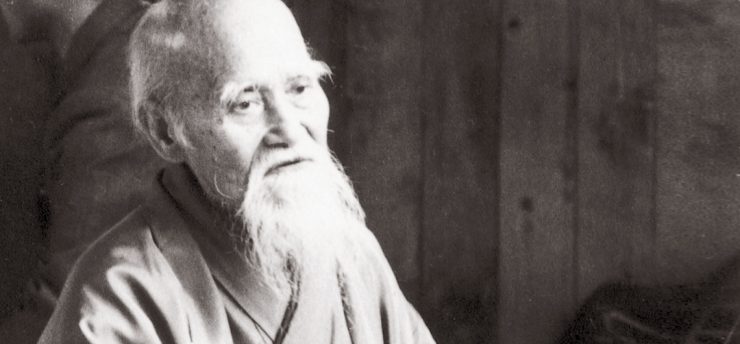
Does no one read O’Sensei’s exacting references to moving whole body, intercepting, irimi-tenkan, etc.? Do you watch the movies with him in them for mere entertainment?
And then there are the excuses. Holes in doughnut theories and fairy tales and “we train for spiritual reasons.” Meaning exactly what? If someone can DEFINE this bullshit and make sense of it, I’m willing to listen.
I will not dignify the politico players, as they are not worthy of anyone’s undersoles. They just want to collect money by dishonest means and have no moral worth.
So what are we doing people, when we mimic small cuttings from Shinto rituals we do not understand, when we poorly mimic Japanese language we don’t understand, and when we pose and carry on?
On the other hand, it IS POSSIBLE to actually learn AIKIDO. This is achieved by carefully studying and regularly practicing the basics with progressively increasing real intention.
It’s a question of backbone and integrity.
If a builder builds you a house, you expect it to stand and not collapse on you. His “spirituality” is not your concern.
His integrity and skill ARE.
You expect the car manufacturers to build you a machine which is reliable and safe. You expect the butcher, baker, grocery and fruit and vegetables to be clean, safe, nutritious and good for you and not toxic. And so on.
Budo is no different. Unless you have successfully served in an industry that SERVES society with skill to prevent and mitigate emergency; and in this case, particularly violence, and yet you presume such titles as “sensei,” “shihan,” “gohan” and other fancifully invented nonsense, YOU ARE IN FACT A FRAUD!
There is no field so full of fools and frauds, thugs and deceivers, incompetents and snake oil salesmen than that of so called “martial arts.”
This is because the average person fears what they do not understand, and are easily deceived by smoke and mirrors.
Certificates, coloured cloth and lineages mean nothing when you’ve never cut your teeth and proven your mettle in the litmus test. Live action.
So then you should call your pseudo-budo, ballet, dance, yoga, light cardio, sandplay… anything but “martial.”
There are more than too many liars and cheats in the world who prostitute the appearance of something and market bells, whistles and shadows for an illicit buck.
A gi, a hakama, accoutrements, do not make you a teacher. Their significance is wasted on pretenders.
Only skill gained in experience and the clear thinking it brings, and ongoing study of the subject you propose, serve as a qualification of merit.
And as a SERVANT of those you presume to teach, you ought to have something of value to impart. Not just rote you copied from someone without thinking, or got out of a book or something.
Budo is the stopping of aggression.
There is no more responsibility more sacred, more potent, more loaded with the immensity of sacred trust than the PROTECTION OF LIFE.
See to it then that you are in fact capable. Otherwise, leave for other pastures and other arts more fitting of your stature and measure of courage and integrity.
And leave the Budo to those who can.
Otherwise, keep training, but stop pretending to have all the answers. No Budo, Aikido included, is set in concrete but is a Path of Endless Discovery.
Every true teacher of stature, Morihei Ueshiba included, have made the request that those who follow in that Path, improve with authentic discovery, what they left behind.
“What I have done, you can do greater,” and, “Please take what I have left behind and continue this process of discovery,” etc.
Let us then continue to discover together with the humility that is due.
And when the call to arms comes and it is time to protect everything we all cherish, then we’ll see what you are really made of.
Even better, don’t wait. There are numerous, non-military as well as military career paths that require courage, backbone, integrity and applied Aikido attitudes and which will serve to uplift society and our world. Some pay well too. You will be earning it.
If your Budo is increasing your clarity and perspective, you will increase in harmony both inner and outer in all your relationships. If, on the other hand, it is adding to your delusions, this too will be noticeable; more so by the feedback than your own evaluations.
It is very hard to be objective about oneself. The fruit of your actions define you. The trail you leave and whether it is one of increased suffering or upliftment.
The litmus test is in the capability of serving for uplift in the face of adversity.
 Antonio Aloia



Nev is right, you cannot get lost in the mindset that what you do in the training hall makes you a fighter because every time you do that in real life … out comes the book of dirty tricks to thwart everything you have been training to overcome in your training hall.
Coming to grips with death, with your ego, with the fact that every time you are caught in violence you could lose …. are as much embracing the fear in your mind as it is overcoming all the emotions and thoughts that inhibit you from realizing why you have chosen to do Aikido as PART of your training regimen. JUST like nature, or even the car you drive, Aikido is a part of the whole that makes up what you need to be that person you are trying to be.
To be not afraid, to be a fighter, to be a winner, to be a someone who can go out in the world and have a better than a 50/50 chance of success. And yet … the true purpose of our existence is to discover and leave some of that discovery for others to expand upon generation after generation after generation.
What? YOU thought being alive was about you? Get a clue! For one minute in a 24 hour day it is about you, but the rest of the day …. NOT!
I am not so politically correct as Nev and maybe not as polite, but when you get older, maybe encountering a deteriorating disease as I have, seeing less time ahead than behind and death/fear as something that must be embraced mentally/ emotionally as the inevitable fear that everything you think you knew means nothing, maybe you too will write words that seem to mean nothing.
Until one day, down the road, you read the words again and realize …. DAMN … Nev Sagiba was right!
Thank you, i never realized how important aikibudo was to be until i became a full time care giver to my mother who had ovarian cancer for three years. She died nine months ago and i am broken hearted. i am also a published poet and unknown actor soon to have my first audition for a professional theater company, and i say art has saved my life, its important that art be real. in a world that understands only violence and the reward of serving one who is a hero. Practice both in mind body and spirit. i am a yellow belt and i don’t care how long it takes me to achieve whatever, i practice, just the fact that aikibudo or aikido has given me a lighter step, and a feeling of winning with humility, eh i don’t even know what i am trying to say,lol, peace i guess, yes, being a student of martial arts has brought be piece
Why I practice Kyokushin Karate as well. Easily the toughest most difficult toe-to-toe karate
“The heart of our karate is real fighting. There can be no proof without real fighting. Without proof there is no trust. Without trust there is no respect. This is a definition in the world of Martial Arts” Kancho Shokei Matsui – Kyuokushin Kai-Kan Karate
Great stuff. Many forget that Aikido is a martial art. There are spiritual and physical benefits for sure, but these should occur as a biproduct of martial study and application and not the primary emphasis.
In the past I also thought something similar to Sagiba Sensei, but with time and age, I changed my point of view.
Aikido in fact as O Sensei saw it, was a way to purify the 5 senses and the mind in order to grasp reality. Aikido goes beyond regular budo. Aikido is a spiritual budo in order to make people be able to understand the laws that governs the universe and in reverberating with living fully and happily. One can learn this is many ways.
There are people that can train strong, and in a figthting environment but there are those that can not. Modern Aikido is a attempt to make something that everybody can train and benefit from the ideas of purification and getting in tune with “kannagara”, (God, Big Nature, (Daishizen) proposed by O Sensei. We train the body, when we practice Aikido, but in fact we are training our spirit.
Maybe Sagiba Sensei, cannot train Aikido without under the possibility of a strong and real attack, but this does not mean that a 70 year old woman, that never practiced sports before cannot practice Aikido in a more “gentle” environment and learn the essence of the art in the same way. Presently I think she can and should. The same happens with younger people with different backgrounds. I have never met anyone or any teacher that really mastered Aikido 100%. Even O Sensei said that he had not year mastered Aikido, so , if we would demand perfection all teachers would be frauds, and of course it is not like that.
O Sensei said that if he had to compare himself to someone he would prefer to try to copy the gods, and that the water that would follow from the mountain would speak more truth than the one coming from the mouth of any man.
The difference between a good Aikido teacher and a bad Aikido teacher, is that the first really is doing his best to improve his students, and the bad ones are those that want just to explore people or to satisfy their egos or to get their money. In this way, I agree there is a big difference in dojos. But it has nothing to do with technical ability or knowledge. One can teach and learn in different stages, there are those that is better to start in the elementary school and some that they must go to the university otherwise they would learn nothing. Each one must look for his best place in the moment. To put a student of elementary school in the university is a mistake and vice versa.
A Sensei is a practitioner not a perfect master. The difference between him and his students is just that he has more time of practice, more experience, but sensei and students are in fact studying and learning together in a cooperative attitude. The sensei is more a leader then a master. He invites his students to follow a way that he is going through and that he believes with all sincerity. If he likes to use drums, tvs, music, meditations, clap hands, orientalism, etc., and there are people that like his choice, that is fine. IF this all helps and motivates then to go on, fine!!!
Everybody is free to follow and do what he feels what is good for him. How can I know what it is best to other people if sometimes, I cannot even chose what is better to myself?
Who knows Aikido? Who knows the truth?
We are all beginners…….what in fact we need is good luck to knock in the good door according to our present conditions… and that it will be opened to us!.
Of course honesty and integrity is a must in any dojo, but not methods of training as much different the best in order more people can chose what it is more fitting to then in a present moment.
Wagner Bull
Thank you… so much Mr. Wagner, I agree with your vision and your words. I’m getting tired of the idea that true budo only happens in the mat or within the confines of physical encounters.
Well, I can’t begin to tell you the serendipity of this post. In an essence, for me, the conundrum goes backwards. Perhaps, though, that is better.
Having tested my mettle through out my own life on several accounts: street fighting, illness fighting, protection of others, service of a higher/ life sacrificing order, and on.. I find it more and more difficult to communicate to my students that their opinions are not experience. That simply judging others will not protect themselves and that , all in all, if they don’t like heavy contact then they are lying to themselves. Lying because they have never had to confront truth .Lying to themselves that by holding experiences out they are winning over them…….So I offer strong aikido like I was given. Maybe even a more violent brand, if that confession has any nobility at all. I’ve thought about this for a long time.
In the dojo we train hard. I am a self-professed ‘hard-ass’ and I’ve had the great wonder of training without the opportunity for much self-deceit.
women must be harder and men must be more gentle, noting biological its perception, we all care too much about what people think, you think a security guard at a UFC match give a blitz, about martial arts, if there’ss a fight in the crowd, the sucker is going down, down town to chinatown. The way to being light, is humor, martial arts is taken way to serious by personal problems, i mix boxing muy thai and aikibudo, so then i can dance, even if it takes me ten years to get my black belt, its demographics, one group should watch another group a ymca group is not the same as a secret police group, some like dark chocolate some white chocolate
As I said above; opinions are not experience. Keep training. Good luck.
Wow!!
What a great dichotomy
Bruce writes “There are spiritual and physical benefits for sure, but these should occur as a biproduct of martial study and application and not the primary emphasis.”
And right after him Wagner goes for the spiritual pursuit of Aikido.
After World War 2 into the fifties, sixties what was O’Sensei’s purpose? Was it t to spread a kick ass martial art, a spiritual budo, or something else?
Clearly it was O’Sensei’s martial ability that gave him the platform and connections to speak and be heard. But to follow O’Sensei into the spiritual realm do you even need to know how to block a punch at all?
Thanks guys.
i think the weird thing of life, and you can correct me on this, is we dont respect other peoples REAL experience and always need to learn the hard way, imagination is powerful and how many of us will have a chance to test our art in war, aikido is a tested art form of the samurai, and was tested by our masters, we should listen more, and train more and realize the irony that sometimes we have to get our ass kicked to realize this art form is not an illusion, and feeling or blocking for me i am still learning so, i think its good because i just dont like blocking, still learning… and all n all i can say is getting out of the way and using the weight of the other person even if the technique is not a hundred percent, i get out of the way first, most young martial artist are self indulgent, and that is why we have dojo and partners and trust, to see that kote nage or nigi, are not the same , one degree to the extreme right on a wrist with correct foot work, and that person is no longer a weight problem,
Thanks all for the valuable feedback and great commentary.
It’s good to hear that at least some people feel strongly about honesty in training.
Whether you train hard or soft, the essential requirement is to train honestly.
And then take the benefits so distilled out of the dojo into life.
It’s about improving instead of merely setting out to prove ego.
As the old guy said, “These play things of the dojo (techniques) are steppingstones to something greater…”
When in the service of life, you’ve looked death in the face, perhaps then that word “spiritual” will have more meaning than a trendy fad blindly followed and reinforced by endorphins.
Clarity of mind enables life navigation.
Thanks for being engaged.
It is truly appreciated.
John,
If you imagine “spiritual” is some kind of effete vacation wallowing in a comfort zone, you are in error. The battles get greater and the rigors and responsibilities multiply exponentially. You will need to know much more than how to deal with a punch.
Dealing with punches is the kindergarten. But essential training.
Denial and avoiding facing up to facts is self-delusion and self-delusion is not spirituality.
That’s why its usually warriors and not monks who gain some measure of that much-maligned term “enlightenment.”
It’s about integrity, honesty and backbone, something not found in fancy robes and different ways of posing and pretending.
The nature of Budo is not merely a set of conceptual ideas about something, but rather, whole-person understanding based on experience gained in practice.
Aikido is Budo. Budo is the art of stopping conflict. Before you can develop such skill, you must necessarily come to terms with, and understand the reality and the nature of conflict. Attacks in training have to be as real as you can safely deliver them, otherwise you will learn nothing more than how to dance.
Keep well,
Nev
Hi Nev
glad to see we agree that blocking punches is the kindergarden of life.
“spiritual” a vacation in the comfort zone? Hardly
More an issue of integrity in every aspect of our lives.
Still frankly I would love to have gotten a chance to discuss with O’Sensei what he saw as the connection between his martial training & his “spiritual/religious” training in shingon & omoto.
Keep training & turning up the heat.
Hi John,
It’s interesting how much wavelength there is between Aikidoka who train but have never met.
I think O’Sensei left us the connection in the working tools of Aikido basics, the foundations, as passed on by good teachers and which he topped with, “Practicing the waza with integrity is sufficient if doing the other practices is not your thing,” and “Find out yourself. Practice!”
There’s numerous of his other quotations to be found in AJ archives and some other sources where he tries to define the connection.
Notwithstanding, I believe each Aikidoka can best discover through personal experience as a result of training.
Thanks again for your feedback and keep well.
Nev
Hi Nev
Excellent article, not the kind of stuff that most Aikidoka wish to read or hear, but clear and to the point. It is so rare to read an article where the author is prepared to be so direct.
I for one really did appreciate the positive content of your article.
In the 1950’s Kenshiro Abbe Sensei would often say
” No matter your pretence, you are what you are and nothing more ! ”
Henry Ellis
Nev,
Great Article!
I only wish there were more Aikido Students who train properly instead of the current alternative. It gets really old hearing excuses like, “you’re not harmonizing,” or “you’re not blending,” whenever a yudansha doesn’t have the quality of technique to get me to fall and too large an ego to listen to any feedback so he could throw me properly.
Again, great article, thanks!
Dear Nev,
I consider your article to be quite interesting and honest. And though I don’t really agree with everything you say in it, at least not 100%, I would like to ask you and other aikidoka a question that goes a bit beyond the idea.
It’s not something that requires a universal answer since things are just too individual in each particular case (the relativity law seems to pervade the universe :)), yet I will try to ask:
Do you allow a thought that certain individuals (!not me!) may have a NATURAL ability to be just FASTER and MORE ACCURATE than aikidoka who’ve spent years of honest training in a serious dojo? Aiki waza or no aiki waza.
Would that be a case of a bujutsuka versus a (gendai)budoka?
This is not an attempt to say that aikido is this or that, I really like it (just as I like Daito-ryu). It’s just something that MAY happen in real situations, right?
I’m sorry if my knowledge is not broad enough. Anyway I would be grateful to hear your point of view on this no matter how fantastically impossible my question sounds.
Thank you very much,
Taras
Aikido Yoshinkan background
Nev, thanks for expounding on your philosophy. I see many mentions of O’Sensei here as if Aikido begins and ends with the man himself. Ask yourself, did he invent Budo? Or is Aikido an expression of Budo? And what do we truly know of the man? Unlike most weekend samurai, Morihei Ueshiba devoted his life to both Budo and Spiritual practice simultaneously, and it took this dedication to obtain mastery in both. The Spiritual practice gave him a sense of faith and peace, both critical to courage, but let’s not be fooled into thinking that his practice of Budo was spiritual. It was not. It was first and foremost rigorous and true martial application.
My belief is that both spirituality and Budo are seperate paths that affect one another, and only come together when both courage and skill are required when facing uncertainty. The common link to both is in the promotion of Balance. Can a person fake balance? Maybe in the lame dojo’s where fools are deluded into thinking they are acquiring skill by the mimicked application of technique. Are they balanced? Have they taken the balance of the uke? I have news…the emperor has no clothes. Most of these fools are neither spiritual, nor are they capable of handling a genuine attack at full intensity and speed as administered by a less than cooperative uke outside the dojo. I have practiced with them for 2 years. All they offered me for my initial 2 years of practice were poor, impractical technique. It has taken another 3 years to unlearn this.
Today, myself and one of the posters on this blog are banned from most Aikido dancing schools because we expose their fraud. The look of disbelief when they can neither move us, take our balance or immobilize us is priceless.
Where I think I disagree with some of the comments here are in relation to the conspiracy theories. I truly believe that most so-called Aikidoka are more deluded than dishonest. I can’t blame the widespread skepticism of Aikido as a practical martial art. In my school, we have had mma, muiy thai, tae kwon do, karate practitioners come in, get their asses kicked and they never return. I myself left a mainstream Aikido school because I realized the practice was both impractical and false. Thankfully today, I am acquiring the skill to handle real attacks with and without weapons. As a consequence, I am acquiring greater balance, presence of mind and confidence.
Thanks to my teacher and the real masters who came before him.
I don’t have the answers folks. But I do like to prod people to question and offer feedback because unless one questions, the search for answers cannot begin.
I’m heartened by all the responses though. A good open discussion is a good thing. I’m learning from your feedback. As in training we can all gain from each other’s views. Thank you all.
Taras, The paradigm Ueshiba was trying to restore goes back to Origins. It’s not a question of this versus that, but of are you prepared to spend your life becoming the best that you can possibly be, develop immense levels of skill and then sacrifice your life to protect LIFE and all that is best in it? Or at least put yourself in a position of high risk to serve life? Or in a key position that will bring about much good despite the fact you risk being misunderstood?
What is today touted as “aikido” is usually just the entry level, the first door, warmups that may lead to the GREAT AIKIDO that protects the Universe and the Life that’s in it. Difficult to put in words but I hope you catch the gist.
Mo Khan, You said it. And what’s the next step? When nobody can beat you in reasonably predictable settings, what do you do then? Where do you go from there?
O’Sensei was one of many before him who arrived at the point where the big “so what?” then hit him.
The question is this: Where do we go from that point?
It’s not commonly known but Buddha was another invincible warrior before he went searching for more.
What is the next paradigm shift?
I have noticed that dojos which don’t teach Aiki-Ken or teach it poorly have weak Aikido. It’s almost as if the spirit of Aikido is captured right there in this training for me. Perhaps I ought to say Budo since I am referring to the martial way of Aikido. O’Sensei himself has said to train with the feeling of Ken in all your Aikido. I believe I have a small grasp on what he means here.
Aiki-Ken works on so many levels for me. It brings to the mats the vital energy that can be very unsettling in the beginning. Death is literally staring in your face if you treat the Ken as a live blade which you should at all times. From this many things spawn and one’s technique seems to be decisive, confident and centred.
Perhaps this is what separates the Aikido that appears “flowery,” light and low key from that which has a sense of urgency or decisiveness.
My 2 cents.
Jer, RIGHT ON!!!
That’s a long discussion, but even better essential training. Without weapons, particularly blades, Aikido dies and becomes dance. Despite any pundits who say otherwise, that’s how AIKI was born. And that’s how it is developed. That’s how it starts to make sense. And when it saves your life in a situation where the attacker is armed and you have to move to live, not mere sport, it seals the deal and proves the efficaciousness of Aikido-Aikijutsu above all other arts.
Mr Sagiba seems to have much to say about many things. Researching his website/s reveals no clearly stated biography with his teachers, years of training in Aikido and Japanese weapons arts etc (the areas in which he professes his expertise. People may be more considerate of his thoughts were they to see evidence of them in action in his video clip/s and to gain a sense from the biography of the training and experiences through which these skills and strong opinions were forged.
As for the content of this particular article, it appears to be rather single dimensional and takes no account of the continuum that is life. In an aggressively stated opinion, Mr Sagiba says “… Budo is the stopping of aggression.” Poignantly he then goes on to urge us to “… Otherwise keep training but stop pretending to have all the answers.”
Finally Mr Sagiba reminds us “…There is no field so full of fools and frauds, thugs and deceivers, incompetents and snake oil salesmen than that of so called “martial arts.”
Nev, as to your question of what comes next, I personally believe that the Japanese paradigm of Shu Ha Ri affords the answer. I am sure you are familiar with this, but it’s bears mentioning to answer your question in a qualified manner.
In the first stage Shu, as students, we try our best to learn what is taught us and simply obey the instructions as given accepting the faults in execution because we are still as yet learning. It is here that learning from a true master is important.
Ha, is the stage where the techniques are executed more or less without conscious control and we start to do them in a more fluid manner, and our own unique way of doing them begins to manifest.
Ri, the third stage is where the paradigm question comes into play. At this stage, we have mastered the basics, can demonstrate them in a test or circumstantially. Our unconscious choice and variation of a technique, and hence self expression becomes manifest. The next paradigm in other words would be our own personal version of Aikido as a natural extension of ourselves. All great masters of the past had their own unique expression of Aikido: Tadashe Abe, Kenshiro Abe, Nakazano, Tohei, Noro etc. I submit therefore that there is no one Aikido, or Budo for that matter. Our transcendance and expression of Aikido is an ever evolving expression of ourselves as we change.
I meant, what comes after ri? Or what does ri lead to or support?
Exactly what you are doing Nev, teaching others to discern between truth and falsehood and raising awareness for those like us who are as yet still learning the basics. Thanks for sharing your valued perspective.
What about read what O Sensei said:
Book : “The secrets teachings of Aikido” page 48, Kodansha First edition:
“Aikido must function in harmony with the dictates of heaven. Physical Budo never leads to perfection, and brute strengh has limited aplicatons. True Budo is the clarification of all the dimensions of matter and spirit;It generates a robust, pure and indestructible energy; In Aikido , first we must know ourselves; next we must know that all elements of the universal are contained withing us; then we must discern the true nature of the cosmos. Do this, understand the laws of nature, and you will be radiant, able to execute marvelous techniques. Upon reflection , we can see that Aikido is the source of Japanese Budo, following and iluminating universal principles”
Wagner Bull
I liked your comments,
Others will defend to the death what they do, and sometimes will get very aggressive doing so. I am tired of watching Aiki-dance or flied techniques and the like, but you are trying to wake up people who have committed their lives to their interpretation, or their leaders, of what Aikido is. Your comments are bound to find stones thrown back at you, as no-one likes to think that they have been tricked or easily fooled. Why do people flock to some Aikido schools and teachers, even though what they teach may be so far removed from the essence of Aikido that even O-Sensei would not recognize it? Because people crave to be a part of a group, they crave acceptance, safety in numbers, like minded people so they do not think that they are strange or outsiders. Yet, in life, outsiders and people who think outside the box, are the ones who stand out and make a name for themselves. In Australian Aikido organizations they now have Shihans, and vast numbers of high ranked individuals, many of whom are incompetent and could not fight their way out of a wet paper bag. Yet they are promoted to levels of distinction by Hombu Japan. The only way to stem this flood of fools is to have Hombu play a major role in the awarding of such high ranks. Hombu should have these candidates travel to Japan and put on a demonstration of their idea of Aikido in front of Doshu and/or a committee of their peers. There should be a reasonable standard set, and if it is not satisfactory enough they should be refused promotion. I know what you are thinking, in my dreams. Hombu has never intervened or apparently tried to control or regulate Aikido outside of its walls. Not my problem is just not good enough. Hombu has never had a complaints department, and just like the way things are done in Japan, they never will. Have you not read the fable of the King with no clothes? In Aikido, and in life, so many people settle for far less than they are worth just to be part of something big. I prefer to walk to the beat of my own drum. I choose few students and work on quality. I choose to look on Aikido as a skill to be passed on, and not just a profit making machine. I try to follow the teachings of the founder, rather than the rantings of a fool. As in a spring, is not the purest cleanest water closest to the source? I have a guide and mentor who trained directly under O-Sensei and he gives me autonomy and the freedom to walk my path testing and trying out methods and techniques. I choose to utilize techniques that work well, rather than follow blindly learning incorrect techniques that are guaranteed to lead me to my ruin in real life. Ultimately, we all have a choice, so just smile and follow your path. Enjoy the journey.
Ten thousand aikidoka ten thousand Aikidos.
IMHO, only folks Nidan or higher should be allowed to discuss philosophy in aikido.. Up until this point (a) you don’t have enough experience to talk of the abstract side (b) your body is still pliable enough to focus on the physical part of practice whatever intensity you can muster (c) you don’t have enough time to distract from PRACTICE, so PRACTICE don’t talk..
I can’t believe that I didn’t get into this melee sooner. You tell ’em Nev! I recall Tom Everett, a sempai at old San Francisco related a story about someone complaining at length about how a Saito student grabbed them. To which, when it finally wound down to a last snivel, the Saito guy simply responded, “Grab my wrist”. Presumably keiko continued.
I don’t have a problem if people want to train aikido as dance. Dance is nice. Characterizing dance as a martial art is, however, false advertising. Nor, do I think it likely that without the reality of conflict, even if it is necessarily stylized and limited, there is much chance of getting anywhere close to the mindset of O Sensei. Ikebana might work better, or Cha no yu.
Much of Aikido here in the US and in Japan has lost it’s martial “edge”…it has been degraded to a “work-out” or a non-martial martial art with cosmic overtones…excellent article Nev.
The tail wags the dog. Thus lots of Aikido has evolved to meet the needs of what attracts most people to aikido. Most respondents and Nev aren’t ‘most people’ , be that a good or bad thing for the art.
Organisations will always become cumbersome self defeating juggernauts because they are strictured by the limited opinions of some poor fool on a pedestal besotted with the fantasy of his own self importance. Even though so may have some modicum of limited skill, unless they have actively served as protectors in high risk, life threatening situations, it is still only an act.
REALITY IS THIS. The universe is your home and field of exploration. Limitless and vast as it is it makes our education never ending. When someone tries to kill you, no organisation or guru figure will place themselves at risk, fly in with their cape and underpants on the outside of their tights to save the world. They just like to imagine they can. The excuses will then abound. When the poo hits the fan it is you ALONE, and if you LET it, ALL OF THE UNIVERSE.
Only one Aikido will save your life. The one that is authentic! Opinions push up poppies.
Rank means nothing unless you gained IN THE FIELD and returned alive. If you can not teach people to survive effectively you are a fraud.
Budo is protection of life. Aikido is and can be the pinnacle, but it won’t happen in a glass bubble.
Whilst practice at manageable levels is and can be for everyone, few will take up the challenge and actually apply it to serve and to save under high risk. These qualify to impart with greater measure of authenticity.
Hard asses are the nicest people in real life. Authentic. And those who deceive themselves in the dojo, I have noticed, tend to have no moral qualms about deceiving others in real life.
For those who like to imagine “the spiritual realm” is some sort of cosy vacation, multiply mundane life and death situations by ten thousand. There is nothing spiritual about feel-good daydreams or substance induced hallucinations. Rather, standing up to watch your buddy’s back, under fire instead of running, or placing yourself between someone who cannot defend themselves, when you know all the wowsers, weaklings and cowards will judge you harshly because they do not see clearly enough to understand moral principle in its highest essence.
In the end all a person can do is their best to be true to the best they know. Even then we all make mistakes under severe testing. But that’s where we learn out greatest lessons.
Buki waza are everything to Aikido, because the ultimate weapon is mind. Deployed as Katsujinken, it opens up a whole new chapter.
To Carlo A:
you can learn from the greenest apprentice.
Amen…the newest folks walking thru the door can be the true teachers.
Perhaps you could provide Youtube links of examples of fake vs real Aikido.
Two more things come to mind … One is the Sack of Potatoes … and what the hell are your blocks supposed to be doing, what pressure points are you supposed to be attacking instead of blocking?
Aikido is a moving breathing art that is not attacking a sack of potatoes or a heavy bag, there are techniques of judo and jujutsu that can accomplish the movement necessary to cross back over into the realm of aikido. Aikido needs movement … LIFE… or Ki as many people seem to refer to.
In the end the study of Aikido’s shorthand is a well of notes into the realm of pressure point exposure and you must EXPAND your studies to find the answers that will give the answers your teachers cannot and, more often, will not give you . Mostly it is for your own safety and your own good, just like any weapon in the hands of the inexperienced … you become a danger to yourself and others, but just like those who are practiced and skillful … you must seek the knowledge and practice with a skilled teacher also.
At some point … one MUST talk, and one must STUDY outside the practices of Aikido to find the answers, and I tell you .. the answers are all around you if you want to find them. In some ways the balance of what makes this network of electronic communication we are sending out writing out onto is the balance of many things in harmony to accomplish this goal of words on a screen and so to are the techniques we study called martial arts not only the physical aspect but the mental and electrical aspect energy being exchanged or put into conflict also. Our techniques are the well tuned orchestra of many instruments that sound out of tune by themselves but create the harmony of the concert when they play together.
So… I tell you … practice Aikido, but do your homework and studies because Aikido is not all of martial arts but ONE of the very important practices that will help you in any other martial art you might study.
Yes, this goes against the cult thinking .. a teacher who says you must practice constantly, attend class constantly, ignore the studies of other martial arts … but the best aikido practitioners are those who COME from the study of other types of martial arts. AND … many of them continue their studies when they are not on the mat practicing!
Realize … .ALL STYLES OF MARTIAL ARTS ARE MADE UP! Truly … in the final analysis a teacher learned and taught a number of techniques and then the practice of those techniques became labeled as a particular style of martial arts, do not be hypnotized into a cult mind, yet be respectful or those who dedicated their time and effort to maintain and teach each style of martial arts you encounter. ONLY with experience will you come to see how the variation of techniques are dependent upon the weaknesses of the human body/ mind/ spirit. for all practices of martial arts and you will see the similarities to the root techniques from which all variations come from. THAT is when you are truly a student of martial arts. It will also be the awakening when you can more easily spot the pretenders also …
But, in REAL LIFE … without the pretenders … how could we not learn the lessons to find the real masters who continue to give us the lessons we need to teach a valid form of self-defense that is not just physical, but extends into the mind and spirit of society and civilization itself? AND THAT is the point for your studies in the first place … it was NEVER all about you .. but it was about what you leave behind and others learn and teach, learn and teach, learn and teach to leave a better society and civilization.
I wonder some days if some teachers “get it”? Ya have to make enough money to make a living … but it’s never about the money, the fame …. it’s about what you leave behind … it’s not about you.
And … if we could live beyond our days and look ahead into the future … would we see what our students and their students turn the practice into 50 or 100 years down the road? What are they going to do? There is the important lesson… how much did O’Sensei leave behind to guide us into the future as he passed on the lessons of his teachers, and their teachers, and their teachers?
It seems Mr. Sagiba has some very specific people and/or schools in mind for his criticism. He seems to suggest they are frauds, deceivers, incompetents, dull minded, liars and cheats. Will he show some courage, backbone and integrity and name them so they can have the option to debate him in public? Could it be that these people and/or schools who are beneath anyone’s under soles are only straw men living within Mr. Sagiba’s consciousness?
Aikido can be extremely effective when taught w/the understanding that it is a razor sharp sword …when used mindfully and w/its intensity dictated by the situation…having taught Aiki-based DT to police cadets for quite a long period of time (10 years) in a state where horses are still rustled and the borders are wide open and with almost no police patrols.The results of the effectiveness of these techniques has been validated by numerous police/highway patrol and SWAT arrest reports…the power of knowing you have an effective tool available to you in a tight spot helps to keep mental chaos to a minimum and allows for clear thinking as well as good judgement in a stressful situation…thus the arresting officer can meet the level of conflict with true professionalism.
Aikido when taught as a “New Age” martial not only loses its effectiveness, it also cheats the student…being strong does not mean being a bully …Strong is the true measure of one’s maturity and wisdom used properly as a result of good teaching and hard keiko.
Ultimately there is no “martial art.” In real survival there is what works and what fails. What works will save you, what fails will make the earth more fertile. As is the nature of the planet’s ecology.
Now, if you have a concept or an idea of what might work, you simply do not know. Training helps develop the clarity of knowingness. Practice attunes the body-mind connection to understanding the actual as opposed to the illusory array the mind’s offshoots may throw up.
What works does not come from ideas but from deep within. That “deep within” is the result of many things among which includes the accumulated evolutionary experience of the planet and survival from the very first amoeba’s predispositions and even before that, the forces of fire, water, air and carbon solids as they interact and still do in our bodies. And the clarity behind our lower mind. More so the last few million years of our simian evolution’s accumulated experience as instinct.
Also however, the inner tuition or intuition of mind and refined mind some call “spiritual.”
Instincts are the wealth of the past. Intuition that of the future. They both impinge ands blend in the present instant.
They can do this harmoniously or chaotically depending on whether our lives are disciplined or mindless.
That immaculate channeling of potential in the present instant, akin to a magnificently sophisticated radio receiver and transmitter, the Hito Junja, can bring in the whole of the Universe with its infinite potentials.
The refinement (misogi) of training (shugyo) keeps tweaking and fine tuning these receptors and transmitters of the “ki of the universe.”
What works then is the concert, juxtaposition, symphony of immaculate potential which will become dormant of not exercised under duress and challenge, the life giving principle of nature and the universe.
Too much challenge and we break. Insufficiency and we decay. A balanced and modulated regular, manageable dosage as made possible by dojo life, augments this fine tuning.
Most people never tap their amazing potentials, choosing rather to pamper themselves while the other nine tenths of the world live in extremes of duress, attrition and squalor. This is why humanity stands now at the crossroads of a lose/ lose proposition, with the choice to enact a balanced win/ win possibility where the planet and all life on it will thrive instead of struggling in futility as even the wealthy so called economies do, that reflect the sick man of the world.
Aikido is the essence of thriving, in that it is, as Morihei said, “A creative budo..”
Self deception is the greatest disease of mankind, whatever the field of endeavour be use it is based on unsound and superstitious thinking which will invariably learn the hard way when things built on a lie, collapse, as inevitably they must.
Morihei also cited, “Truth is victorious..” In other words scientific exactitude in all things, that which comes from conscious clarity that a properly challenged Aikido training evokes naturally thereby healing the soul.
Aikido is a means to convert discord into harmony and you cannot train honestly unless you are willing to provide an authentic, albeit modulated measure of discord to harmonise.
Then you aiki skill will grow and progress in a meaningful manner which can be deployed constructively and beneficially into the world without fighting or contending, but rather standing firm, holding the line of moral integrity in a way that adds to harmony and truth rather than discord and deceit.
Then, having attuned to the innate principle of harmony back of it all, with harmony you can just wing it and restore creativity in the face of adversity, big or small.
Or something like that. Work it out for yourself!
and in the end….it’s not the arrows…..it’s the Indians.
Nev,
I can see that you feel strongly about not only this topic, but also Aikido. You also seem to have a passion for seeing true Budo well practiced. I’m very grateful for the insights you give throughout your posts.
Unfortunately, it is becoming more and more difficult for me to read your articles in a way that helps me grow in my awareness and understanding of Aikido. The conversational style you employ seems to devolve more often into ranting attacks on “the wrong ways” than shoring up “the right ways” with reason and supporting anecdotes.
Your experience is a treasure trove of knowledge to people who want to learn the ways of Aikido (and Budo in general). I would love to continue hear more of your positive insights, the experiences you have had that lead to those insights, and suggestions for mindsets and techniques I should keep in mind while I pursue Aikido.
ps. As an aside – and just to see what would come up – I put together all of the words that you yelled in your article and found..
DO NOT BLAME AIKIDO
DEFINE
IS POSSIBLE AIKIDO
ARE
SERVES YOU ARE IN FACT A FRAUD!
SERVANT
PROTECTION OF LIFE
Great article I totally agree with your thoughts. For those who study ask the question, is it the Illusion of truth or the Reality of truth you are studying. I know of too many who studied the illusion and woke up bloody in the street..
Alex R.
Aikido arts institute
Until aikido introduces free sparring into all its schools, it will generally remain ineffective as a combat art. Ex-judoka Tomiki understood this. You cannot, should not, expect the rehearsal of pre-arranged techniques, with a compliant uke, to produce combat skills.
Take judo for example: The novice is taught a technique or two to practice as uchi-komi (repetitions). What happens when they step onto the mat for their first randori (sparring)? Nothing works! Why? Because the novice has to learn those things which only develop from free sparring: Distancing, setting up a technique, executing a throw/lock/hold down *against resistance* etc etc.
Without sparring, aikido can be nothing but a hollow dojo dance…
Sounds like you may need to shop around for a different Aikido dojo than the ones you’ve seen so far.. A good Sensei will quickly gauge the skill level of whoever walks in the door and build them toward whatever ideal of Aikido the Sensei has in their mind. Being able to put Aikido into practice in real situations was always one of the goals in the dojo I attended.
David,
A Yoshinkan dojo was more realistic than most: Full speed, determined attacks, with uke resisting unless the defense technique was properly executed. But still no free sparring: That essential experience of distancing, set ups etc against unrehearsed attacks was still missing. Let’s take a for instance:
At one of my free trial lessons (Aiki-kai), an orange belt aikidoka looked at my old judogi and invited an attack. I approached cautiously, took a jacket hold with *relaxed* arms, feinted a front leg throw (Sasae-tsurikomi-ashi), dropped him with a rear leg throw (Osoto-gari) and pinned him with a basic hold-down (Kesa-gatame).
The orange belt had no idea what to do. All his training had been against stiff-armed opponents using brute force. In addition, once on the mat, since aikido has no groundwork (newaza), he was clueless. When I leaned back and crushed the air out of his chest, he tapped out.
Note that I’m a judo novice. I was graded 6th kyu (white belt) about 40 years ago and have not been in a judo dojo since. Now, if I can figure out an effective anti-aikido tactic during the trial lesson, what could a dan-graded judoka/jujutsuka do with your average aikidoka?
Regards,
Budoman
I’m not familiar with the orange belt, but it sounds like it might be akin to the Brown belt that we used in our dojo, we called them Sempai (https://aikidojournal.com/encyclopedia?entryID=587) and they were almost always a few kyu removed from Dan.
In my experience, the skill level of the Sempai’s varied quite a bit. Everyone who had reached a Dan level, however very clearly knew what they were doing in any of the situations I saw them in. Even when I didn’t react in an expected way to a technique they very quickly and effectively changed their technique.
I’m curious about the circumstances of the situation you described concerning your first trial lesson. Your description suggested to me that you were approaching it as a sparring match; was the orange belt you were working with see it that way while he was inviting the attack?
In our dojo the Nage and Uke are in a partnership to improve their techniques and remove vulnerabilities while learning to subdue the attacker more effectively. More of a partnership than a sparring match. You might find an art like Hapkido a little more to your liking if you want an opponent to win or lose against and you want to try something other than Judo. Aikido seems to be more about controlling the attack and quickly getting beyond the confrontation than winning the confrontation itself.
Just my 2 cents. In the interests of full disclosure, I am a decidedly below average aikidoka. But I know good teaching when I see it!
David,
That dojo used judo rankings: Orange belt = 4th kyu (he’d been training about 2 years).
I approached the encounter as a friendly judo vs aikido randori. I suspect the orange belt expected a slam-dunk. A 60+ old fart in a worn judo suit: how hard could it be? After all, aikido legend has its stories of judoka being soundly defeated by aikidoka. Well, not on this occasion.
The episode doesn’t really prove much. Except perhaps, ‘never underestimate your opponent’ [grin]. To spell it out, in my opinion, aikido in general has some deficiencies:
~ No free sparring (Tomiki style excepted)
~ Too much emphasis on cooperative uke (Yoshinkan excepted)
~ No groundwork/grappling
~ Handling of more subtle, non-telegraphed attacks
I also think in general, aikido is oversold e.g.
YouTube has a clip of Tohei Shihan sparring with a ‘grappler’. However, on closer inspection it turns out that Tohei’s opponent was an untrained journalist. Tohei handles it well, defeating the journalist. Now in the comments it is hailed as a triumph for aikido. But is it? Any good judoka or wrestler could do the same…
P.S. Have chosen Tai Chi as my martial discipline for old age.
Regards,
Budoman